Geopolitics and Expertise (eBook)
John Wiley & Sons (Verlag)
978-1-118-29174-0 (ISBN)
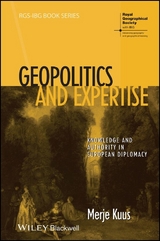
Geopolitics and Expertise is an in-depth exploration of how expert knowledge is created and exercised in the external relations machinery of the European Union.
- Provides a rare, full-length work on transnational diplomatic practice
- Based on a rigorous and empirical study, involving over 100 interviews with policy professionals over seven years
- Focuses on the qualitative and contextual, rather than the quantitative and uniform
- Moves beyond traditional political science to blend human geography, international relations, anthropology, and sociology
Merje Kuus is Associate Professor of Geography at the University of British Columbia, Canada. Her research focuses on political geography and transnational policy processes. She is the author of Geopolitics Reframed: Security and Identity in Europe’s Eastern Enlargement (2007) and co-editor of the Ashgate Research Companion to Critical Geopolitics (2013). She has also written on security narratives, intellectuals of statecraft, the idea of Europe, and transnational diplomatic practice.
Merje Kuus is Associate Professor of Geography at the University of British Columbia, Canada. Her research focuses on political geography and transnational policy processes. She is the author of Geopolitics Reframed: Security and Identity in Europe's Eastern Enlargement (2007) and co-editor of the Ashgate Research Companion to Critical Geopolitics (2013). She has also written on security narratives, intellectuals of statecraft, the idea of Europe, and transnational diplomatic practice.
Series Editors' Preface vii
Acknowledgements viii
Introduction: The Crown Jewel 1
1 The Dead Relative: Bounding Europe in Europe 12
Geopolitics by Nobody; Carving Places out of Space; Embodied
Europes
2 Knowledge and Policy in Transnational Fields 32
Placing Diplomatic Knowledge; Policy Fields; "The work of
reciprocal elucidation"
3 Brussels and Theatre: Bureaucracy and Place 61
Planet Brussels; Those Who Hold the Pen: EU Professionals; The
Political and the Technical - and the Social
4 Transnational Diplomats: Representing Europe in EU 27
86
European External Action Service; Curved Mirrors: Negotiating the
National; The Group for Which There is no Term: The New Member
States
5 Powers of Conceptualization and Contextualization
112
A New Object of Knowledge; Fields of Expertise in the European
Quarter; "Most people just want to do what they are told"
6 Feel for the Game: Symbolic Capital in the European Quarter
133
Symbolic Capital; "We are dealing with elites"; "In the third
degree of depth"; "An urbane, subtle approach"; Shifts and
Spirals
7 Political Geographies of Expertise 171
Knowledge From and On the East; Finding a Market; "Things are
evolving"; Managing Difference
Conclusion: Circles of Knowledge 195
References 209
Index 225
'This book transcends the now problematic divide between
representational and practical approaches to understanding
geopolitical relations. More specifically, much research on the EU
tends to focus more on the formal workings of the institutions and
rarely penetrates the corridors of power to consider what actually
happens within the bureaucracy itself. The book is to be welcomed
as a contribution to theoretical debate in human geography and as a
significant contribution to EU Studies.'
--John Agnew, UCLA
'In contrast to the oceans of generalization about the
European Union, here is a high-resolution study of the balance of
interests and power based on years of face-to-face interactions
with diplomats and Eurocrats who inhabit Brussels' European
Quarter.'
--James D Sidaway, National University of Singapore
Chapter One
The Dead Relative: Bounding Europe in Europe
Geopolitics by Nobody
When investigating the use of geographical and geopolitical claims in the European Quarter, I often hear that such claims do not matter. For many of my interviewees – multilingual cosmopolitan foreign affairs professionals – ‘geography’ connotes the given, the immutable, and the limiting. Geography associates vaguely with things like regional planning – useful but unexciting – and geopolitics alludes to some of the more troubled facets of Europe’s history. Some of my interlocutors appear intrigued by the concept of geopolitics, but others find it distasteful although they are too polite to say so. Even asking questions about a geographical concept, Europe in this case, is deemed an odd activity: out-of-date and slightly suspicious, like enquiring about a dead relative who passed away in unclear circumstances.
The narrative that pervades the European Quarter suggests that European integration is an anti-geopolitical project. Integration has enabled Europe’s nation-states to mend their historical antagonisms and overcome the violence inherent in territorial power politics. As an idea and a political project, Europe transcends rigid borders internally and externally. Internally, inter-state tensions have been transferred from the realm of high politics into administration as the member states have pooled their sovereignty in one regulatory space in many spheres of societal life. Externally, the union is a new kind of global power that influences world affairs through norms and standards rather than zero-sum territorial politics. Integration is never one-way or complete, but it nonetheless gradually smoothes Europe’s internal divisions and creates a harmonized space on a continental scale. The nation-state is not undone but national interests and knowledge claims are integrated into European networks and partnerships. As a political subject, Europe has prevailed over geopolitical power games among states and their alliances.
At the same time, Europe as an idea, an identity, and a set of values is invoked frequently as a fundamental principle of EU policy-making. The union’s civil servants identify strongly with ‘the European process’ and ‘Europe’ in contrast to a various ‘others’ ‘outside’ of Europe (Wodak 2009, 58). For many of them, the idea of Europe is central to their careers and their personal histories, and they see their work partly in terms of advancing a distinctly European societal model. A commission official explains: “We are defending a cultural model, neither the Japanese model nor the American model, but the social market economy, the Rhine model. And that idea is shared from the south of Spain to the north of Sweden” (quoted in Hooghe 2001, 81). When accepting the Nobel Peace Prize in 2012, Herman Van Rompuy explicitly refers to the idea of Europe as a guiding principle of EU actions: European integration, he says, is propelled not only by the sheer necessity of cooperation but also by “a sense of togetherness, and in a way speaking to us from the centuries, the idea of Europa itself” (Van Rompuy and Barroso 2012). Timothy Garton Ash (1999, 316), a prominent historian, captures the elusive presence of Europe in European political life when he remarks:
There is Europe and there is ‘Europe’. There is the place, the continent, the political and economic reality, and there is Europe as an idea and an ideal, as a dream, a project, process, progress towards some visionary goal. No other continent is so obsessed with its own meaning and direction. These idealistic and teleological visions of Europe at once inform and legitimate, and are themselves informed and legitimated by, the political development of something now called the European Union. The very name ‘European Union’ is itself a product of this approach. For a union is what it’s meant to be, not what it is.
For my interviewees, Europe works in such an absent-yet-present form. It is a category of everyday speech and practice but not a category of analysis. They use the concept of Europe, but they are sceptical of my effort to take the category apart to see how it is put together. Many EU professionals view the union as a sui generis object: a one of a kind geopolitical entity inexplicable by existing terminology (Shore 2006). The idea of Europe is central to this mystique. An official of the European Commission explains: “That’s how you can get everybody in favour of Europe and disagreeing at the same time, because each individual is in favour of his preferred version of Europe” (quoted in Benson-Rea and Shore 2012, 12).
The political ambiguity of the European Union relies in part on the geographical ambiguity of Europe. It is based on the bundling up of seemingly clear-cut geographical claims with aspirations and visions about politics and culture. Garton Ash (2001) pinpointed this over a decade ago:
‘Will Europe never be Europe because it is becoming Europe?’ To most speakers of the English language, the sentence must look like nonsense. But in Brussels, the capital of Europe and the inner temple of the European debate, it is perfectly comprehensible and indeed vitally important. One just needs to insert the different meanings of the word ‘Europe’. The sentence then reads: ‘Will the current European Union of fifteen states – that is, Europe in sense 1 – never attain the long dreamed-of political unity – that is Europe in sense 2 – because it is now committed to including most other states on the geographical continent of Europe – that is, Europe in sense 3?’
Much has changed since 2001, but that amorphous bundling up of political ideas and geographical definition still underpins European politics. There is still a kind of banal mysticism to the concept Europe: it is simultaneously in constant view and indescribable, concretely territorial and abstractly philosophical. Evoking Europe has political effects but appears to be an apolitical exercise. Like Michael Billig’s (1995) banal nationalism, Europe and geography function as ideological habits that enable to get things done while remaining analytically invisible. And just as national sentiments are maintained by being flagged daily, so is Europe maintained by being flagged in EU policy-making. We need to understand how this happens. We must consider geographical knowledge – that dead relative in the title of the chapter – to elucidate the geopolitical undercurrents inside seemingly a-geographical claims.
A central problem with the commonsense narrative of Europe is that it seems to have no agents: its bounding appears to happen on its own, mostly in national power centres, without the active participation of the professionals who work in its name. Europe as a geographical concept seems to lack agents and happen in no place in particular. Roland Barthes’ (1980, 151) point about political myths captures the dynamics well. Like a myth, the geographical concept of Europe is:
a kind of ideal servant: it prepares all things, brings them, lays them out, the master arrives, it silently disappears: all that is left for one to do is to enjoy this beautiful object without wondering where it comes from. … Nothing is produced, nothing is chosen: all one has to do is to possess these new objects from which all soiling trace of origin or choice has been removed.
The meanings of Europe have been debated since the inception of the idea in the 18th century.1 Most writings focus empirically on the statements of Europe’s political and intellectual elites. When it comes to Brussels, the best we have are general statements by high-level commission officials (Hooghe 2001; Ross 2011). Such accounts are helpful but too general for a detailed understanding of EU policy processes. A closer account requires that we analyze the evocations of Europe in more specific terms to tease out where these evocations come from, for what audiences they are tailored, how they demarcate Europe, and how they are combined and sometimes welded together in Brussels. The question is about the ways in which geographical arguments are continuously made and re-made by political agents in specific social contexts. With respect to Europe, the question is not where Europe’s borders are or should be, or where commission officials think these borders ought to be, but how EU officials use the concept of Europe in their daily work. The answer to this open-ended question can illuminate the intellectual frames of EU policy-making. The point is not that we must consider geographical categories alongside political and technical claims, but that political and technical claims rely on unspoken geographical assumptions.
Europe is a political metaphor across Europe and a specific local idiom in the European Quarter in Brussels (Shore 2000, 2). The phrases and imaginaries used by top EU officials are not written by these officials; these formulations are developed by career policy professionals in the union’s capital city. When asked about the formulation of EU policy, a commission official remarks with a slight smile: “Well, in the commission, as in any large institution, it depends on who is holding the pen.” The uses of Europe in the European Union cannot be read off political statements on Europe in general. These practices...
| Erscheint lt. Verlag | 24.12.2013 |
|---|---|
| Reihe/Serie | RGS-IBG Book Series | RGS-IBG Book Series |
| Sprache | englisch |
| Themenwelt | Naturwissenschaften ► Geowissenschaften ► Geografie / Kartografie |
| Sozialwissenschaften ► Politik / Verwaltung ► Europäische / Internationale Politik | |
| Schlagworte | Diplomacy • diplomatic service • diplomats • EU Foreign Policy • European External Action Service • European politics • European Quarter • European Union • Foreign policy analysis • Geographie • Geography • Geopolitics • Human geography • International Relations • Political Anthropology • Political Geography • Political Science • Politik / Europa • Politikwissenschaft • Politische Geographie • Rigorous • Social & Cultural Geography • Sozio- u. Kulturgeographie • transnational diplomacy • transnational policy processes • transnational regulatory institutions |
| ISBN-10 | 1-118-29174-3 / 1118291743 |
| ISBN-13 | 978-1-118-29174-0 / 9781118291740 |
| Informationen gemäß Produktsicherheitsverordnung (GPSR) | |
| Haben Sie eine Frage zum Produkt? |
 EPUB (Adobe DRM)
Größe: 343 KB
Kopierschutz: Adobe-DRM
Adobe-DRM ist ein Kopierschutz, der das eBook vor Mißbrauch schützen soll. Dabei wird das eBook bereits beim Download auf Ihre persönliche Adobe-ID autorisiert. Lesen können Sie das eBook dann nur auf den Geräten, welche ebenfalls auf Ihre Adobe-ID registriert sind.
Details zum Adobe-DRM
Dateiformat: EPUB (Electronic Publication)
EPUB ist ein offener Standard für eBooks und eignet sich besonders zur Darstellung von Belletristik und Sachbüchern. Der Fließtext wird dynamisch an die Display- und Schriftgröße angepasst. Auch für mobile Lesegeräte ist EPUB daher gut geeignet.
Systemvoraussetzungen:
PC/Mac: Mit einem PC oder Mac können Sie dieses eBook lesen. Sie benötigen eine
eReader: Dieses eBook kann mit (fast) allen eBook-Readern gelesen werden. Mit dem amazon-Kindle ist es aber nicht kompatibel.
Smartphone/Tablet: Egal ob Apple oder Android, dieses eBook können Sie lesen. Sie benötigen eine
Geräteliste und zusätzliche Hinweise
Zusätzliches Feature: Online Lesen
Dieses eBook können Sie zusätzlich zum Download auch online im Webbrowser lesen.
Buying eBooks from abroad
For tax law reasons we can sell eBooks just within Germany and Switzerland. Regrettably we cannot fulfill eBook-orders from other countries.
 PDF (Adobe DRM)
Kopierschutz: Adobe-DRM
Adobe-DRM ist ein Kopierschutz, der das eBook vor Mißbrauch schützen soll. Dabei wird das eBook bereits beim Download auf Ihre persönliche Adobe-ID autorisiert. Lesen können Sie das eBook dann nur auf den Geräten, welche ebenfalls auf Ihre Adobe-ID registriert sind.
Details zum Adobe-DRM
Dateiformat: PDF (Portable Document Format)
Mit einem festen Seitenlayout eignet sich die PDF besonders für Fachbücher mit Spalten, Tabellen und Abbildungen. Eine PDF kann auf fast allen Geräten angezeigt werden, ist aber für kleine Displays (Smartphone, eReader) nur eingeschränkt geeignet.
Systemvoraussetzungen:
PC/Mac: Mit einem PC oder Mac können Sie dieses eBook lesen. Sie benötigen eine
eReader: Dieses eBook kann mit (fast) allen eBook-Readern gelesen werden. Mit dem amazon-Kindle ist es aber nicht kompatibel.
Smartphone/Tablet: Egal ob Apple oder Android, dieses eBook können Sie lesen. Sie benötigen eine
Geräteliste und zusätzliche Hinweise
Buying eBooks from abroad
For tax law reasons we can sell eBooks just within Germany and Switzerland. Regrettably we cannot fulfill eBook-orders from other countries.
aus dem Bereich