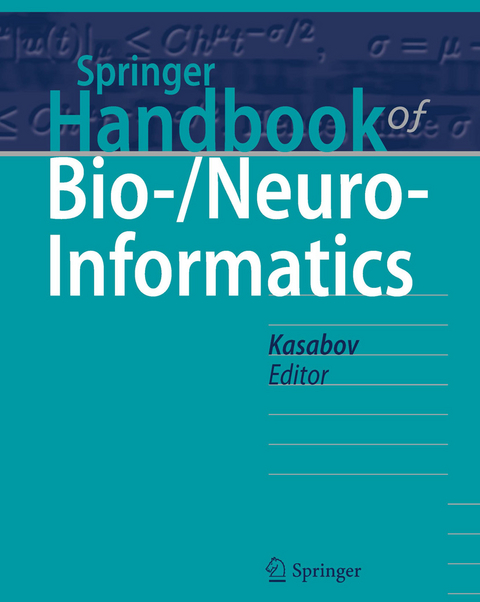
Springer Handbook of Bio-/Neuro-Informatics (eBook)
LVII, 1229 Seiten
Springer Berlin (Verlag)
978-3-642-30574-0 (ISBN)
The Springer Handbook of Bio-/Neuro-Informatics is the first published book in one volume that explains together the basics and the state-of-the-art of two major science disciplines in their interaction and mutual relationship, namely: information sciences, bioinformatics and neuroinformatics. Bioinformatics is the area of science which is concerned with the information processes in biology and the development and applications of methods, tools and systems for storing and processing of biological information thus facilitating new knowledge discovery. Neuroinformatics is the area of science which is concerned with the information processes in biology and the development and applications of methods, tools and systems for storing and processing of biological information thus facilitating new knowledge discovery.
The text contains 62 chapters organized in 12 parts, 6 of them covering topics from information science and bioinformatics, and 6 cover topics from information science and neuroinformatics. Each chapter consists of three main sections: introduction to the subject area, presentation of methods and advanced and future developments. The Springer Handbook of Bio-/Neuroinformatics can be used as both a textbook and as a reference for postgraduate study and advanced research in these areas. The target audience includes students, scientists, and practitioners from the areas of information, biological and neurosciences.
With Forewords by Shun-ichi Amari of the Brain Science Institute, RIKEN, Saitama and Karlheinz Meier of the University of Heidelberg, Kirchhoff-Institute of Physics and Co-Director of the Human Brain Project.
Nikola K Kasabov is currently the Director of the Knowledge Engineering & Discovery Research Institute and Personal Chair of Knowledge Engineering in the School of Information Technology, Auckland University of Technology, New Zealand.
He has published over 350 works, among them journal papers, textbooks, edited research books and monographs, conference papers, book chapters, edited conference proceedings, patents and authorship certificates in the area of intelligent systems, connectionist and hybrid connectionist systems, fuzzy systems, expert systems, speech recognition, bioinformatics, neurocomputing and neural networks.
Prof. Kasabov is a Fellow of IEEE, Fellow of the Royal Society of New Zealand and the New Zealand Computer Society, President of the International Neural Network Society (INNS), Past President of the Asia Pacific Neural Network Assembly (APNNA) and also a member of INNS, ENNS, and the IEEE Computer Society. Recently Prof. Kasabov was endowed the title of 'Guest Professor' at Shanghai Jiao Tong University, China.
Prof. Kasabov is the General Chairman of a series of biannual international conferences on Neurocomputing in New Zealand. In 2007 Prof. Kasabov was awarded The Bayer Science Innovator Award. He received The Royal Society of New Zealand Silver Medal for contribution to Science and Technology in 2001. He is an Associate Editor of numerous international journals and a leader of a National Research Programme funded by the Foundation for Research, Science and Technology (FRST)
Nikola K Kasabov is currently the Director of the Knowledge Engineering & Discovery Research Institute and Personal Chair of Knowledge Engineering in the School of Information Technology, Auckland University of Technology, New Zealand.He has published over 350 works, among them journal papers, textbooks, edited research books and monographs, conference papers, book chapters, edited conference proceedings, patents and authorship certificates in the area of intelligent systems, connectionist and hybrid connectionist systems, fuzzy systems, expert systems, speech recognition, bioinformatics, neurocomputing and neural networks.Prof. Kasabov is a Fellow of IEEE, Fellow of the Royal Society of New Zealand and the New Zealand Computer Society, President of the International Neural Network Society (INNS), Past President of the Asia Pacific Neural Network Assembly (APNNA) and also a member of INNS, ENNS, and the IEEE Computer Society. Recently Prof. Kasabov was endowed the title of ‘Guest Professor’ at Shanghai Jiao Tong University, China.Prof. Kasabov is the General Chairman of a series of biannual international conferences on Neurocomputing in New Zealand. In 2007 Prof. Kasabov was awarded The Bayer Science Innovator Award. He received The Royal Society of New Zealand Silver Medal for contribution to Science and Technology in 2001. He is an Associate Editor of numerous international journals and a leader of a National Research Programme funded by the Foundation for Research, Science and Technology (FRST)
Chap. 1 Understanding Nature - Symbiosis of Information Science, Bioinformatics and NeuroinformaticsPart A Understanding Information Processes in Biological Systems (Ed. Heike Sichtig)Chap. 2 Information Processing at the Cellular Level.- Chap. 3 Integrated Approaches for Understadning the Cell.- Chap. 4 Information Processing at the Genomics Level.- Chap. 5 Understanding Information Processes at the Proteomics Level.- Chap. 6 Pattern Formation and Animal Morphogenesis.- Chap. 7 Understanding Evolving Bacteria ColoniesPart B Molecular Biology, Genome and Proteome Informatics (Ed.: Chris Brown)Chap. 8 Exploring Interactions and Structural Organization of Genomes.- Chap. 9 Detecting microRNA Signatures Using Gene Expression Analysis.- Chap. 10 Bioinformatics Methods to Discover Cis-Regulatory Elements.- Chap. 11 Protein Modeling and Structural PredictionPart C Machine-Learning Methods (Eds: Irwin King, Kaizhu Huang, Heike Sichtig)Chap. 12 Machine Learning Methodology in Bioinformatics.- Chap. 13 Case-Based Reasoning for Biomedical Informatics and Medicine.- Chap. 14 Analysis of Multiple DNA Microarray Datasets.- Chap. 15 Fuzzy Logic and Rule-Based Methods in Bioinformatics.- Chap. 16 Phylogenetic Cladograms: Understanding and Learning from Biomedical Data.- Chap. 17 Understanding Protein Folding Modeling.- Chap. 18 Kernel Methods and Applications in BioinformaticsPart D Modeling Regulatory Networks: The Systems Biology Approach (Eds: Chris Brown, Heike Sichtig, Irwin King, Kaizhu Huang, Francesco Masulli)Chap. 19 Path Finding in Biological Networks.- Chap. 20 Inferring Transcription Networks from Data.- Chap. 21 Analysis of Transcriptional Regulation.- Chap. 22 Inferring Genetic Networks.- Chap. 23 Structural Pattern Discovery.- Chap. 24 Molecular Networks - Representation and Analysis.- Chap. 25 Whole-Exome Sequencing DataPart E Bioinformatics Databases and Ontologies (Ed.: Francesco Masulli)Chap. 26 Bioinformatics Databases.- Chap. 27 Ontologies for BioinformaticsPart F Bioinformatics in Medicine, Health and Ecology (Eds: Francesco Masulli, Danilo Mandic)Chap. 28 Statistical Signal Processing Models And Methods.- Chap. 29 Epigenetics.- Chap. 30 Control of Autoimmune Diseases.- Chap. 311 Nutrigenomics.- Chap. 32 Bioinformatics and Nanotechnologies: Nanomedicine.- Chap. 33 Information Modeling Technologies for Personalized Medicine.- Chap. 34 Health Informatics.- Chap. 35 Ecological Informatics Part G Understanding Information Processes in the Brain and the Nervous System (Ed.: Heike Sichtig)Chap. 36 Information Processing in Synapses.- Chap. 37 Spiking Neural Networks.- Chap. 38 Statistical Methods for fMRI Activation Detection.- Chap. 39 Neural Circuit Models and Neuropathological Oscillations.- Chap. 40 Understanding the Brain via fMRI ClassificationPart H Advanced Signal-Processing Methods for Brain Signal Analysis and Modeling (Ed.: Danilo Mandic)Chap. 41 Nonlinear Adaptive Filtering in Kernel Spaces.- Chap. 42 Analysis of Multiple Spike Trains.- Chap. 43 Adaptive Multiscale Time-Frequency AnalysisPart I Information Modeling of Perception, Sensation and Cognition (Eds: Lubica Benuskova, Heike Sichtig)Chap. 44 Modeling Vision with the Neocognitron.- Chap. 45 Information Processing in the Gustatory System.- Chap. 46 EEG Signal Processing for Brain Computer Interfaces.- Chap. 47 Spiking Neural Networks.- Chap. 48 Neurocomputational Models of Natural LanguagePart J Neuroinformatics Databases and Ontologies (Eds: Shiro Usui, Raphael Ritz)Chap. 49 Ontologies and Machine Learning Systems .- Chap. 50 Integration of Large-Scale NeuroinformaticsPart K Information Modeling for Brain Diseases (Eds: Lubica Benuskova, Francesco Masulli)Chap. 51 Alzheimer’s Disease.- Chap. 52 Integrating Data for Modeling Biological Complexity.- Chap. 53 A Machine Learning Pipeline .- Chap. 54 Modeling Gene-Dependent Dynamics of Cortex and Epilepsy.- Chap. 55 Information Methods for Predicting Stroke.- Chap. 56 Recognition of Rehabilitation ActionsPart L Nature Inspired Integrated Information Technologies(Eds: Lubica Benuskova, Danilo Mandic)Chap. 57 Brain-Like Robotics.- Chap. 58 Developmental Learning for User Activities.- Chap. 59 Quantum and Biocomputing - Common Notions and Targets.- Chap. 60 Brain-, Gene-, and Quantum-Inspired Computational Intelligence.- Chap. 61 The Brain and Creativity.- Chap. 62 The Allen Brain AtlasAcknowledgements.- About the Authors.- Subject Index
| Erscheint lt. Verlag | 30.11.2013 |
|---|---|
| Reihe/Serie | Springer Handbooks | Springer Handbooks |
| Zusatzinfo | LVII, 1229 p. 490 illus., 200 illus. in color. |
| Verlagsort | Berlin |
| Sprache | englisch |
| Themenwelt | Informatik ► Theorie / Studium ► Künstliche Intelligenz / Robotik |
| Medizin / Pharmazie | |
| Naturwissenschaften ► Biologie | |
| Technik ► Bauwesen | |
| Schlagworte | Bioinformatics • Neuroinformatics |
| ISBN-10 | 3-642-30574-1 / 3642305741 |
| ISBN-13 | 978-3-642-30574-0 / 9783642305740 |
| Informationen gemäß Produktsicherheitsverordnung (GPSR) | |
| Haben Sie eine Frage zum Produkt? |
 PDF (Wasserzeichen)
DRM: Digitales Wasserzeichen
Dieses eBook enthält ein digitales Wasserzeichen und ist damit für Sie personalisiert. Bei einer missbräuchlichen Weitergabe des eBooks an Dritte ist eine Rückverfolgung an die Quelle möglich.
Dateiformat: PDF (Portable Document Format)
Mit einem festen Seitenlayout eignet sich die PDF besonders für Fachbücher mit Spalten, Tabellen und Abbildungen. Eine PDF kann auf fast allen Geräten angezeigt werden, ist aber für kleine Displays (Smartphone, eReader) nur eingeschränkt geeignet.
Systemvoraussetzungen:
PC/Mac: Mit einem PC oder Mac können Sie dieses eBook lesen. Sie benötigen dafür einen PDF-Viewer - z.B. den Adobe Reader oder Adobe Digital Editions.
eReader: Dieses eBook kann mit (fast) allen eBook-Readern gelesen werden. Mit dem amazon-Kindle ist es aber nicht kompatibel.
Smartphone/Tablet: Egal ob Apple oder Android, dieses eBook können Sie lesen. Sie benötigen dafür einen PDF-Viewer - z.B. die kostenlose Adobe Digital Editions-App.
Buying eBooks from abroad
For tax law reasons we can sell eBooks just within Germany and Switzerland. Regrettably we cannot fulfill eBook-orders from other countries.
aus dem Bereich