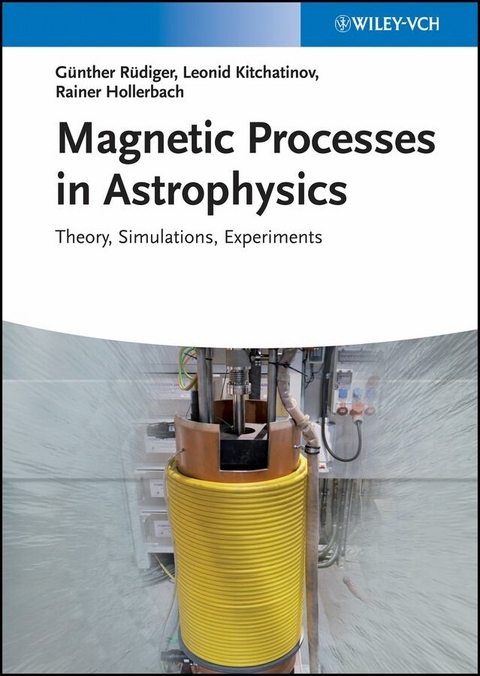

This second edition covers such additional topics as small-scale dynamos, while also presenting the latest results and experiments.
Gunther Rudiger is Professor at the Leibniz Institute for Astrophysics Potsdam, and lectured at the University of Potsdam. He has also worked at the University of Gottingen and is a former Visiting Professor at the University of Newcastle upon Tyne. For the successful
collaboration with the Helmholtz-Center Dresden-Rossendorf regarding the magnetorotational instability experiment PROMISE he was awarded the 2008 Science Prize of the Donor Federation of German Science.
Rainer Hollerbach received his Ph.D. from the University of California, San Diego. He is currently Visiting Professor in the Institute of Geophysics at ETH
Zurich, as part of the European Research Council project ?Magnetostrophic Flow in Experiments and the Core of the
Earth?. He is permanently based in the Department of Applied Mathematics at the University of Leeds, England. He is a Fellow of the American Geophysical Union and the UK Institute of Physics.
Leonid L. Kitchatinov received his Ph.D. from the Ioffe Physical Technical Institute, St Petersburg. He is permanently affiliated to the Institute of Solar-Terrestrial Physics, Irkutsk, and to the Pulkovo
Observatory, St Petersburg. He has repeatedly worked at the Leibniz Institute for Astrophysics Potsdam, supported by both the Deutsche Forschungsgemeinschaft
and by the Alexander von Humboldt Foundation as a Research Fellow for a year. He has also worked at the
University of St Andrews, UK.
Günther Rüdiger is Professor at the Leibniz Institute for Astrophysics Potsdam, and lectured at the University of Potsdam. He has also worked at the University of Göttingen and is a former Visiting Professor at the University of Newcastle upon Tyne. For the successful collaboration with the Helmholtz-Center Dresden-Rossendorf regarding the magnetorotational instability experiment PROMISE he was awarded the 2008 Science Prize of the Donor Federation of German Science. Rainer Hollerbach received his Ph.D. from the University of California, San Diego. He is currently Visiting Professor in the Institute of Geophysics at ETH Zürich, as part of the European Research Council project ?Magnetostrophic Flow in Experiments and the Core of the Earth?. He is permanently based in the Department of Applied Mathematics at the University of Leeds, England. He is a Fellow of the American Geophysical Union and the UK Institute of Physics. Leonid L. Kitchatinov received his Ph.D. from the Ioffe Physical Technical Institute, St Petersburg. He is permanently affiliated to the Institute of Solar-Terrestrial Physics, Irkutsk, and to the Pulkovo Observatory, St Petersburg. He has repeatedly worked at the Leibniz Institute for Astrophysics Potsdam, supported by both the Deutsche Forschungsgemeinschaft and by the Alexander von Humboldt Foundation as a Research Fellow for a year. He has also worked at the University of St Andrews, UK.
1. Differential Rotation of Stars
2. Radiation Zones: Magnetic Stability and Rotation
3. Quasilinear Theory of Driven Turbulence
4. The Galactic Dynamo
5. The Magneto-Rotational Instability (MRI)
6. The Tayler Instability (TI)
7. Magnetic Spherical Couette Flow
About the first book of the author on this topic:
"Researchers and advanced students will greatly profit from this book."
Rainer Beck, Max-Planck-Institut für Radioastronomie, Bonn
"The authors do a good job of conveying the excitement of the subject and of bringing together much of the research of important topics, a welcome addition to the bookshelves."
The Observatory
"Ruediger and Hollerbach have brought together the significant research on this topic ... will be of interest to both the geophysicist and the astro-physicist, and perhaps the physicist or engineer ..."
E-STREAMS
"... does contain many deep insights and there is valuable material...that is not easily accessible elsewhere.."
Geophysical and Astrophysical Fluid Dynamics
"...a valuable book to have and study...an encyclopedic guide to some of the most interesting problems in astrophysics...should be savored over many sittings."
Physics Today
Über das erste Buch des Autors zu diesem Thema "Magnetic Universe":
"...kann ich das Werk allen astrophysikalisch oder geophysikalisch interessierten Physikern empfehlen."
Physik Journal
1
Differential Rotation of Stars
Magnetic activity of solar-type stars is closely related to stellar rotation. The differential rotation participates in stellar dynamos by producing toroidal magnetic fields by rotational shear. Differential rotation and meridional flow can be understood in the context of mean-field hydrodynamics in stellar convection zones. Stratification in convection zones is so strong that the Schwarzschild criterion (dS/dr < 0, where S is the specific entropy) is fulfilled and the entire zone becomes turbulent. Due to the radial stratification the turbulence fields are themselves stratified with the radial preferred direction. Interaction of such a turbulence with an overall rotation leads to the formation of large-scale structure. Lebedinskii (1941), Wasiutynski (1946), Biermann (1951) and Kippenhahn (1963) were the first to find that differential rotation and meridional flow might be direct consequences of the rotating anisotropic turbulence. Details of the long history of this concept were presented by Rüdiger (1989, Chapter 2).
Whether a star is of solar-type is controlled by its structure. Stars of this type possess external (turbulent) convection zones. The solar convection zone only includes < 2% of the total mass but it extends about 30% in radius. The outer convection zones in cooler stars become deeper as stellar mass decreases until for M stars the convection zone reaches down to the center. On the other hand, for A stars the outer convection zone becomes very thin, but an inner zone becomes convectively unstable. For B stars this inner convection zone reaches considerable dimensions.
The level of stellar activity depends strongly on spectral type. There is, however, the striking fact that the linear depth of the outer convection zone, at 200 000 km, does not vary too much among the solar-type stars. We shall see later how important the total thickness of a convection zone is for the formation of differential surface rotation.
It is certainly unrealistic to expect a solution of the complicated problem of stellar dynamos if the internal stellar rotation laws cannot be predicted or observed (by asteroseismology). Differential rotation is explained here as turbulence-induced with only a small magnetic contribution. Mean-field hydrodynamics provides a theoretical basis for differential rotation modeling, so that the models can be constructed with very little arbitrariness. Nevertheless, differential rotation of the Sun can be reproduced by computations very closely and the dependence of differential rotation on stellar parameters can be predicted.
1.1 Solar Observations
1.1.1 The Rotation Law
The rotation of the solar photosphere was measured using the Doppler shifts of photospheric spectral lines or tracking rotation of sunspots and various other tracers. Doppler measurements of Howard et al. (1983) and the classical work of Newton and Nunn (1951) on sunspot rotation are the well-known examples. Within a small percentage, all measurements yield similar results. Obtained by tracing bright coronal structures in SOHO images Wöhl et al. (2010) give
(1.1)
for the sidereal rotation rate, with b = 90° – θ as the heliographic latitude. The angular velocity of 0.25 rad/day leads to a frequency of 462 nHz at the equator. The observed equator–pole difference of the angular velocity, δΩ, from (1.1) is 0.057 rad/day. We shall characterize the existence of differential rotation by the quantity δΩ = Ωeq – Ωpole rather than by the ratio
(1.2)
(here ≈ 0.23) because only ∇Ω is relevant for the inducting action of differential rotation but not its normalized value k. With (1.2) we follow the notation of the seminal paper by Hall (1991) who derived from photometric stellar observations a relation k ∝ Ω–0.85 (corresponding to the very flat relation δΩ ∝ Ω0.15 for rotating stars, see also Barnes et al. (2005)) which is rather close to the essentials presented in the theoretical part of this chapter.
Brown (1985) made the first attempt to infer how the latitudinal differential rotation varies with depth from rotational splitting of frequencies of global acoustic oscillations. Today the helioseismological inversions provide a detailed portrait of the internal solar rotation (Wilson, Burtonclay, and Li, 1997; Schou et al., 1998). Figure 1.1 shows the distribution of rotation rate inside the Sun. Latitudinal differential rotation seen on the solar photosphere survives throughout the convection zone up to its base. Helioseismology detects the location of the inner boundary of the convection zone at rin = 0.713 (Christensen-Dalsgaard, Gough, and Thompson, 1991; Basu and Antia, 1997). Latitudinal differential rotation at the inner boundary is reduced about twice compared with the surface (Charbonneau et al., 1999). A remarkable feature of Figure 1.1 is the sharp transition from differential to rigid rotation in a thin layer near the base of the convection zone. This layer, called after Spiegel and Zahn (1992) the solar “tachocline,” extends not more than 4% in radius (Kosovichev, 1996; Antia, Basu, and Chitre, 1998). Its midpoint is at (0.692 ± 0.005) , and it is slightly prolate in shape (Charbonneau et al., 1999). The tachocline is, therefore, located mainly if not totally beneath the base of the convection zone, in the uppermost radiative zone. Rotation beneath the tachocline is almost rigid at least down to 0.2 (Couvidat et al., 2003; Korzennik and Eff-Darwich, 2011).
Figure 1.1 Isolines of the angular velocity of the Sun after Korzennik and Eff-Darwich (2011). The rotation of the polar and the near-center regions is difficult to measure. With permission of the authors.
The main empirical features of the solar differential rotation can be summarized as follows (see Figure 1.1):
- an equatorial acceleration of about 23% at the surface,
- a near-surface shear layer with negative Ω-gradient in radius1),
- a sharp transition to rigid rotation in a thin tachocline,
- a rigid rotation of the deeper radiative core.
The ‘observed’ phenomenon of the sharp transition layer between the outer domain of differential rotation and the inner domain of rigid-body rotation is hard to understand without the assumption of internal empirically unknown magnetic fields. We shall show in Section 2.2 that indeed fossil fields with amplitudes of only 1 mG are enough to explain not only the existence of the tachocline but also its small radial extension.
The present state of differential rotation may, however, differ from other epochs when magnetic activity of the Sun was different. Ribes and Nesme-Ribes (1993) used statistics of sunspot observations over the Maunder minimum at the Observatoire de Paris to find a rotation rate slower by about 2% at the equator and by about 6% at midlatitudes than at the present time. The differential rotation was thus stronger than today. The more magnetic the Sun, the faster and more rigidly its surface rotates. Balthasar, Vázquez, and Wöhl (1986), however, could not find similar results for a regular minimum. Also Arlt and Fröhlich (2012), who worked with data obtained from the drawings of Staudacher from the period from 1749 till 1799 did not find a significant difference to the present-day value of δΩ 0.050 rad/day derived by Balthasar, Vázquez, and Wöhl (1986) from sunspot rotation. The reported average value of 0.048 indicates a slightly smaller value but this difference is not yet significant.
Figure 1.2 The butterfly diagram shortly after the Maunder minimum, as derived from the drawings of Staudacher between 1749 and 1799. Courtesy of R. Arlt.
The results are nevertheless highly interesting as they demonstrate the reliability of the data which also led to the construction of a butterfly diagram for the four cycles covered by the observations. The main question here is whether the dipolar parity which now dominates the solar activity already existed shortly after the Maunder minimum. This is certainly the case for the last two cycles shown in Figure 1.2 but it seems to be questionable for the older two cycles. For these cycles, which are closer to the Maunder minimum at least an overpopulation of near-equator sunspots is indicated by the data (Arlt, 2009).
1.1.2 Torsional Oscillations
As magnetic activity of the Sun varies with time, differential rotation may also be expected to be time-dependent. Variations of solar rotation law are indeed observed. Schrijver and Zwaan (2000), Stix (2002) and Thompson et al. (2003) presented detailed historical and data-based overviews of all phenomena concerning the temporal variations of the solar rotation law. As the magnetic force is quadratic in the magnetic field, the resulting flow is expected to vary with twice the frequency of the 22-year magnetic cycle. The 11-year torsional oscillations were first observed by Howard and LaBonte (1980).
Figure 1.3 shows the oscillation pattern. At a fixed latitude there is an oscillation of fast and slow rotation with an 11-year period. The whole pattern migrates at about 2 m/s toward the equator. The migration follows the equatorial drift of magnetic activity. Latitudinal shear of differential rotation is increased in the activity belt with faster than average rotation on the...
| Erscheint lt. Verlag | 2.12.2013 |
|---|---|
| Sprache | englisch |
| Themenwelt | Naturwissenschaften ► Physik / Astronomie ► Astronomie / Astrophysik |
| Technik | |
| Schlagworte | Astronomie • Astronomie u. Astrophysik • Astronomy & Astrophysics • astrophysics • Classical & Fluid Mechanics • Complex • Developing • Differential Rotation • earth sciences • Field • Fields • Galactic • Geophysics • Geophysik • Geowissenschaften • growing • importance • instability • Klassische u. Strömungsmechanik • Klassische u. Strömungsmechanik • Magnetic • Magnetohydrodynamik • Models • MRI • musthave • Phenomena • Physics • Physik • Quasilinear • rapidly • Sequel • Simulation • spherical • Stars • theory • Turbulence • zones |
| ISBN-10 | 3-527-64894-1 / 3527648941 |
| ISBN-13 | 978-3-527-64894-8 / 9783527648948 |
| Informationen gemäß Produktsicherheitsverordnung (GPSR) | |
| Haben Sie eine Frage zum Produkt? |
 EPUB (Adobe DRM)
Kopierschutz: Adobe-DRM
Adobe-DRM ist ein Kopierschutz, der das eBook vor Mißbrauch schützen soll. Dabei wird das eBook bereits beim Download auf Ihre persönliche Adobe-ID autorisiert. Lesen können Sie das eBook dann nur auf den Geräten, welche ebenfalls auf Ihre Adobe-ID registriert sind.
Details zum Adobe-DRM
Dateiformat: EPUB (Electronic Publication)
EPUB ist ein offener Standard für eBooks und eignet sich besonders zur Darstellung von Belletristik und Sachbüchern. Der Fließtext wird dynamisch an die Display- und Schriftgröße angepasst. Auch für mobile Lesegeräte ist EPUB daher gut geeignet.
Systemvoraussetzungen:
PC/Mac: Mit einem PC oder Mac können Sie dieses eBook lesen. Sie benötigen eine
eReader: Dieses eBook kann mit (fast) allen eBook-Readern gelesen werden. Mit dem amazon-Kindle ist es aber nicht kompatibel.
Smartphone/Tablet: Egal ob Apple oder Android, dieses eBook können Sie lesen. Sie benötigen eine
Geräteliste und zusätzliche Hinweise
Buying eBooks from abroad
For tax law reasons we can sell eBooks just within Germany and Switzerland. Regrettably we cannot fulfill eBook-orders from other countries.
aus dem Bereich