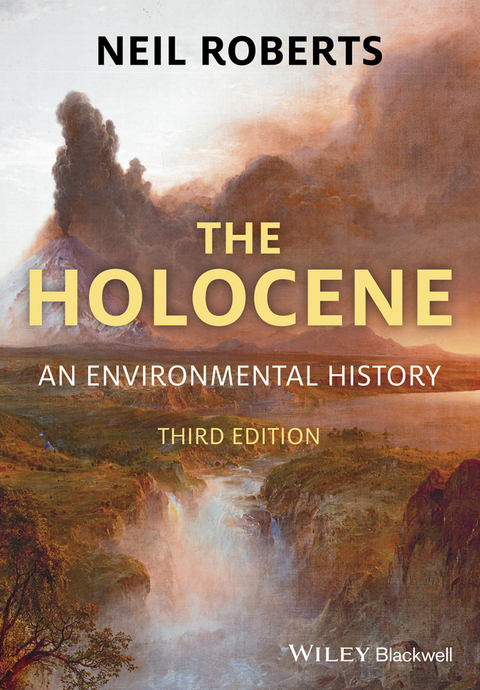
The Holocene (eBook)
John Wiley & Sons (Verlag)
978-1-118-71255-9 (ISBN)
The Holocene provides students, researchers and lay-readers with the remarkable story of how the natural world has been transformed since the end of the last Ice Age around 15,000 years ago. This period has witnessed a shift from environmental changes determined by natural forces to those dominated by human actions, including those of climate and greenhouse gases. Understanding the environmental changes - both natural and anthropogenic - that have occurred during the Holocene is of crucial importance if we are to achieve a sustainable environmental future.
Revised and updated to take full account of the most recent advances, the third edition of this classic text includes substantial material on the scientific methods that are used to reconstruct and date past environments, as well as new concepts such as the Anthropocene. The book is fully-illustrated, global in coverage, and contains case studies, a glossary and more than 500 new references.
Additional resources for this book can be found at: www.wiley.comgoRobertsHolocene.
Neil Roberts is Professor of Geography at Plymouth University in the UK and has been Visiting Senior Researcher at Stanford University, CA. His main research interests are in Holocene environmental change, especially lake sediment records of climate and human impact in Mediterranean regions. He is a fellow of the Royal Geographical Society, and served on the US National Academies Committee on climate changes of the last 2,000 Years.
The Holocene provides students, researchers and lay-readers with the remarkable story of how the natural world has been transformed since the end of the last Ice Age around 15,000 years ago. This period has witnessed a shift from environmental changes determined by natural forces to those dominated by human actions, including those of climate and greenhouse gases. Understanding the environmental changes - both natural and anthropogenic - that have occurred during the Holocene is of crucial importance if we are to achieve a sustainable environmental future. Revised and updated to take full account of the most recent advances, the third edition of this classic text includes substantial material on the scientific methods that are used to reconstruct and date past environments, as well as new concepts such as the Anthropocene. The book is fully-illustrated, global in coverage, and contains case studies, a glossary and more than 500 new references.
Neil Roberts is Professor of Geography at Plymouth University in the UK and has been Visiting Senior Researcher at Stanford University, CA. His main research interests are in Holocene environmental change, especially lake sediment records of climate and human impact in Mediterranean regions. He is a fellow of the Royal Geographical Society, and served on the US National Academies Committee on climate changes of the last 2,000 Years.
"In conclusion, we find the new edition highly recommendable to students and researchers but to those who are interested in how our modern envi-ronment came about and how human kind interacts with nature." (Geologos Journal, 1 August 2015)
"All the sections are very well referenced, making this a good book for serious research or to dip into a particular area of interest to the reader. For a reference work it is surprisingly easy to just sit and read, which I did, and found it interesting through to the last page. I particularly liked the way a wide range of ideas and disciplines were brought together to form a coherent thread throughout the book." (Proceedings of the Open University Geological Society, 1 April 2015)
"The text makes enjoyable reading, and although the author introduces many technical terms, they are all covered in a glossary at the end and included in the index. Summing Up: Highly recommended. Lower-division undergraduates and above; general readers." (Choice, 1 October 2014)
"This excellent book should be mandatory reading for any student taking a palaeobased environmental change module, and academics will also very much enjoy reading Neil Roberts' fine prose." (The Holocene, 1 October 2014)
1
Introduction
Are the moors and downs of the British Isles natural landscapes or were they created by human agency? To what extent has soil loss through erosion increased on cultivated land compared with areas of natural woodland? And is the recorded rise in global temperatures since 1980 a result of the current increase in greenhouse gases in the atmosphere, or is it just part of climate’s natural tendency to vary through time? Answers to problems such as these are often sought by monitoring contemporary environmental processes. For example, Gordon Wolman (1967) measured sediment yields from forested and cultivated land in the eastern United States and found that erosion was up to eight times higher for the latter. Alternatively, data from gauged field stations may be used, although the short time period of observation often proves to be a handicap. Most meteorological stations, for example, only have records going back to the first half of the twentieth century (Jones et al., 1999), and this makes it hard to identify any long-term trends of warming or cooling.
In fact, neither monitoring nor gauged records are likely on their own to provide complete solutions to the problems posed. This is because a longer-term view is required. An average human lifespan is so much shorter than the millennia of natural history that we tend to be aware only of short-term variations in the environment – the wet summer, the late spring, the ‘record’ flood. What we are much less aware of are slower, subtler changes such as alterations in the floristic composition of woodland, the silting up of estuaries and the advance and retreat of glaciers. Yet only a long-term perspective could tell us that Britain’s downs and moors were transformed from their original woodland before written history even began (Simmons, 2003).
Sources of information on past environments
For historic times, documentary sources can sometimes provide reliable observations on the former state of the natural environment. Tax records have been used to indicate late seventeenth- and early eighteenth-century climatic deterioration in southern Norway (Grove, 2004), while maps and legal documents show the changing position of Spurn Point spit on the east coast of England during the last 300 years (De Boer, 1964). Among the best historical sources are the early United States federal land surveys which mapped the pre-existing forest and grassland vegetation, and even recorded their species composition, before laying out land boundaries. Documentary data of this sort form an important part of historical ecology which applied to past flora and fauna (Sheail, 1980), historical geology when related to changes in the physical landscape such as rivers (Hooke and Kain, 1982) and historical climatology when linked to former climates (Bradley and Jones, 1992; Brázdil et al., 2005). In practice, the distinction between these sub-disciplines is often an arbitrary one.
Written records are, however, restricted to literate cultures, and as late as AD 1500, they existed only in Europe, Asia and North Africa. There are consequently long periods of human history for which recorded observations are absent, termed prehistory by archaeologists. Moreover, written history covers very different time spans in different parts of the world. Whereas written history began around 5000 years ago in Mesopotamia with the Sumerians, and 2000 years ago in Britain with Julius Caesar, it only started in the 1930s in the highlands of Papua New Guinea when aircraft brought the first European contact. Prehistory has come to be associated in Western thought with all that is remote, both in time and in cultural affinity, to twenty-first-century life. On the other hand, to a New Guinea highlander (or a Maori or black Zimbabwean), prehistory represents a direct cultural heritage which ended only a few generations ago. All of this means that the attitudes towards the natural world of many past societies have either gone unrecorded, or have appeared in written form only through the eyes of others. Ethnobotanical and other studies, however, have revealed a remarkable indigenous knowledge of the natural environment and its uses by modern non-literate hunter-gatherers, peasant farmers and nomads (Cunningham, 2001).
It is not only from ancient times and distant places that historical data on the natural environment prove to be deficient. Old men may recall how, when in their youth, fine catches of salmon were taken from Scandinavian rivers now devoid of fish, but because no one recorded the pH of the water until acid rain became a problem during the 1970s, it is difficult to know whether the salmon were eliminated by acidification or simply overfished. Availability of documentary sources therefore tends to inhibit consideration of non-literate regions such as Papua New Guinea and problems such as acidification, which do not appear in historical accounts. The example of megafaunal extinctions (see Chapter 3) serves to illustrate the point. When told that much African wildlife is threatened by extinction, our reaction is one of horror. Yet extinctions of even greater magnitude have occurred within the time span of human history considered in this book, notably in the Americas and Australia where up to 90% of all large mammals were lost. However, this ecological crisis remains known only to a narrow audience of specialists because no contemporary written accounts of it were handed down to posterity.
This book aims to recount and try to explain changes in the natural world through time, including those in human–environment relations. If a truly cross-cultural perspective is to be taken on this, then we need to escape from the restrictions imposed by information derived solely from contemporary or documented historical sources. This is not to deny the critical importance of such sources, but while they have been employed extensively in studies of environmental relations (e.g. Glacken, 1967; Worster, 1993; McNeill, 2000), other sources have not. Without a time machine in which to return to the past, we have instead to rely on proxy evidence, including that from palaeo-science, which provides environmental histories, and archaeology, which provides human histories. These two sources sometimes come together as environmental archaeology, in which plant remains, animal bones and sediments from archaeological sites are studied to reconstruct their past economy and environment (Branch et al., 2005). These subjects share in common many techniques such as radiocarbon dating and pollen analysis, and they are often investigated together to form interdisciplinary research projects.
For the moment, it is sufficient to note some of the strengths and weaknesses of the palaeoenvironmental approach (Rymer, 1980; Oldfield, 2005). One of its weaknesses is that it cannot reconstruct attitudes to the natural world by former human societies in the way that historical sources can. Medieval cosmologies which placed ‘man’ in a holistic relationship with the natural world, for example, would be scarcely comprehensible without texts to explain them (Cosgrove, 2008). Environmental archaeology, with its concern for site economies and food remains, inclines the investigator towards an economic view of past human life (e.g. Higgs, 1972). This bias towards economic and away from social and cultural explanations is most easily countered where the archaeological past meets the anthropological present, for instance, with the Hopi Indians of the American southwest (Butzer, 1982). In the case of prehistoric Europe, it is not so easy. Even so, we occasionally get glimpses of past symbolic and ritual activities linked to the natural world; for example, pollen of meadowsweet (Filipendula ulmaria) from Bronze Age burials in Scotland demonstrates how floral tributes were placed next to their dead (Tipping, 1994; Clarke, 1999).
Figure 1.1 Mechanisms and modes of studying environmental change over different timescales (modified from Oldfield, 1983). Reproduced with permission of the Geographical Association.
On the other hand, one of the great advantages of archaeology and palaeo-science is their ability to identify long-term patterns of cultural or environmental development (Caseldine and Turney, 2010; Caseldine, 2012). This is especially important because the timescales of adjustment in many environmental systems span centuries or millennia rather than individual years, via processes such as soil maturation and ecological succession (see Figure 1.1). In the case of palaeo-science, environmental reconstruction can be applied to more recent as well as to long-term changes. Most lake sediments, for instance, have continued to accumulate up to the present day, and they can therefore be used to give a historical dimension to such contemporary environmental problems as pollution of freshwaters. The continuous nature of most palaeoecological records provides what Frank Oldfield (1977) aptly described as ‘a true continuum of insight’. This enables us to establish whether environmental changes have been episodic or gradual and to identify baseline conditions if they existed. These techniques, unlike written records, have the further advantage of being as applicable in New Guinea as they are in New England.
Nature and society
All of the world’s landscapes and ecosystems are products of the natural and cultural processes that have shaped them over time to bring them to their present state. But what are those processes? Over the last one million years, a major factor has been climatic change, with the climate oscillating...
| Erscheint lt. Verlag | 26.11.2013 |
|---|---|
| Sprache | englisch |
| Themenwelt | Naturwissenschaften ► Geowissenschaften ► Geologie |
| Naturwissenschaften ► Geowissenschaften ► Meteorologie / Klimatologie | |
| Naturwissenschaften ► Geowissenschaften ► Mineralogie / Paläontologie | |
| Technik ► Umwelttechnik / Biotechnologie | |
| Schlagworte | Climatic Changes • climatology • Climatology & Palaeoclimatology • decadal variability • earth science • earth sciences • environmental changes • Geomorphologie • Geowissenschaften • Holozän • Holozän • Klimatologie u. Paläoklimatologie • Klimatologie u. Paläoklimatologie • Neil Roberts • Quartärforschung, Glaziologie • Quartärforschung, Glaziologie • Quaternary Science & Glaciology • The Holocene: An Environmental History • Umweltwissenschaften |
| ISBN-10 | 1-118-71255-2 / 1118712552 |
| ISBN-13 | 978-1-118-71255-9 / 9781118712559 |
| Informationen gemäß Produktsicherheitsverordnung (GPSR) | |
| Haben Sie eine Frage zum Produkt? |
 EPUB (Adobe DRM)
Kopierschutz: Adobe-DRM
Adobe-DRM ist ein Kopierschutz, der das eBook vor Mißbrauch schützen soll. Dabei wird das eBook bereits beim Download auf Ihre persönliche Adobe-ID autorisiert. Lesen können Sie das eBook dann nur auf den Geräten, welche ebenfalls auf Ihre Adobe-ID registriert sind.
Details zum Adobe-DRM
Dateiformat: EPUB (Electronic Publication)
EPUB ist ein offener Standard für eBooks und eignet sich besonders zur Darstellung von Belletristik und Sachbüchern. Der Fließtext wird dynamisch an die Display- und Schriftgröße angepasst. Auch für mobile Lesegeräte ist EPUB daher gut geeignet.
Systemvoraussetzungen:
PC/Mac: Mit einem PC oder Mac können Sie dieses eBook lesen. Sie benötigen eine
eReader: Dieses eBook kann mit (fast) allen eBook-Readern gelesen werden. Mit dem amazon-Kindle ist es aber nicht kompatibel.
Smartphone/Tablet: Egal ob Apple oder Android, dieses eBook können Sie lesen. Sie benötigen eine
Geräteliste und zusätzliche Hinweise
Buying eBooks from abroad
For tax law reasons we can sell eBooks just within Germany and Switzerland. Regrettably we cannot fulfill eBook-orders from other countries.
aus dem Bereich