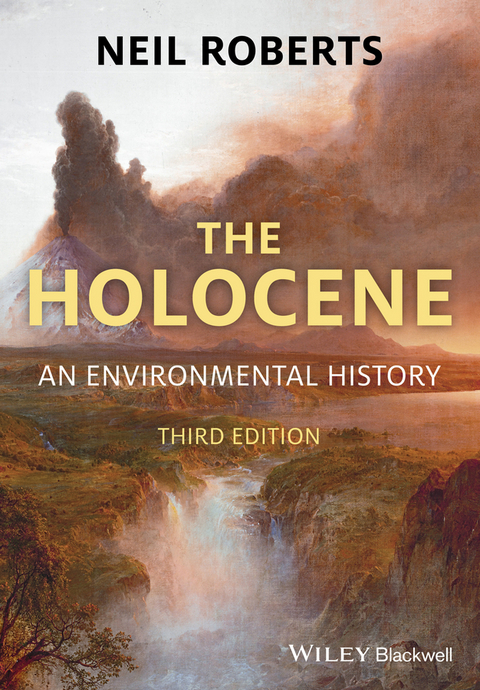
The Holocene (eBook)
John Wiley & Sons (Verlag)
978-1-118-71256-6 (ISBN)
The Holocene provides students, researchers and lay-readers with the remarkable story of how the natural world has been transformed since the end of the last Ice Age around 15,000 years ago. This period has witnessed a shift from environmental changes determined by natural forces to those dominated by human actions, including those of climate and greenhouse gases. Understanding the environmental changes - both natural and anthropogenic - that have occurred during the Holocene is of crucial importance if we are to achieve a sustainable environmental future.
Revised and updated to take full account of the most recent advances, the third edition of this classic text includes substantial material on the scientific methods that are used to reconstruct and date past environments, as well as new concepts such as the Anthropocene. The book is fully-illustrated, global in coverage, and contains case studies, a glossary and more than 500 new references.
Neil Roberts is Professor of Geography at Plymouth University in the UK and has been Visiting Senior Researcher at Stanford University, CA. His main research interests are in Holocene environmental change, especially lake sediment records of climate and human impact in Mediterranean regions. He is a fellow of the Royal Geographical Society, and served on the US National Academies Committee on climate changes of the last 2,000 Years.
The Holocene provides students, researchers and lay-readers with the remarkable story of how the natural world has been transformed since the end of the last Ice Age around 15,000 years ago. This period has witnessed a shift from environmental changes determined by natural forces to those dominated by human actions, including those of climate and greenhouse gases. Understanding the environmental changes - both natural and anthropogenic - that have occurred during the Holocene is of crucial importance if we are to achieve a sustainable environmental future. Revised and updated to take full account of the most recent advances, the third edition of this classic text includes substantial material on the scientific methods that are used to reconstruct and date past environments, as well as new concepts such as the Anthropocene. The book is fully-illustrated, global in coverage, and contains case studies, a glossary and more than 500 new references.
Neil Roberts is Professor of Geography at Plymouth University in the UK and has been Visiting Senior Researcher at Stanford University, CA. His main research interests are in Holocene environmental change, especially lake sediment records of climate and human impact in Mediterranean regions. He is a fellow of the Royal Geographical Society, and served on the US National Academies Committee on climate changes of the last 2,000 Years.
THE HOLOCENE AN ENVIRONMENTAL HISTORY 5
Copyright 6
Contents 7
Technical boxes 10
Preface to the third edition 11
Acknowledgements 13
About the companion website 14
1 Introduction 15
Sources of information on past environments 16
Nature and society 19
The significance of the Holocene 20
References 21
2 Reconstructing Holocene environments 24
Dating the past 24
Historical and archaeological dating 25
Radiometric dating methods 27
Dendrochronology and radiocarbon calibration 33
Other dating methods 39
Conclusion 42
Palaeoecological techniques 46
Pollen analysis 47
Plant remains 54
Creatures great and small 58
Freshwater and marine organisms 60
Geological techniques 61
Ice and ocean 65
Stable isotope analysis 67
Geomorphology and climate 69
Geo-archaeology 73
Modelling the past 75
Models of environmental reconstruction 75
Computer model simulations 78
Conclusion 80
References 80
3 The Pleistocene prelude (> 11 700 Cal. yr bp)
Ice Age environments 97
The glacial–interglacial cycle 97
Understanding the causes of long-term climatic change 102
The Last Glacial Maximum and after 106
The terminal Pleistocene (15 000–11 700 Cal. yr bp) 110
The Late Glacial in the North Atlantic region 110
Terminal Pleistocene climatic oscillation: A globally synchronous event? 116
Adjustment of geomorphic systems 119
Human ecology at the end of the Pleistocene 121
Megafaunal extinctions 124
References 129
4 Early Holocene adaptations (11 700–6000 Cal. yr bp) 142
Changes in the physical environment 142
Ice sheets and sea levels 142
Human adaptations to coastal environments 145
Lake ontogeny and soil development 149
The return of the forests 154
Europe 154
Eastern North America 156
Dry Mediterranean woodland 158
Tropical forests 159
Factors affecting forest re-advance 160
The ecology of Mesolithic Europe 165
The early Holocene in the tropics 168
Saharan palaeoecology 169
Early Holocene climates: Pattern and process 172
Conclusion 179
References 181
5 The first farmers 192
Agricultural origins 192
Southwest Asia 193
China and South Asia 198
Mesoamerica 200
Tropical domesticates 204
Independent innovation or diffusion? 207
The role of environmental change in early agriculture 208
Early agricultural impacts 213
European agricultural dispersals 215
Ecological consequences of early European agriculture 218
Conclusion 221
References 222
6 The taming of nature (6000–1000 Cal. yr bp) 231
Introduction 231
Changes in the natural environment 233
Climate and vegetation 233
The origin and development of blanket mires 242
Coasts and rivers 246
Cultural evolution 249
Hydraulic civilisation in Mesopotamia 250
Environmental impact in pre-Hispanic Mesoamerica 253
Pastoral nomadism 255
Mediterranean ecosystems 256
The making of the landscape: The british isles 263
The primaeval forest 264
Shaugh Moor: A Bronze Age landscape 268
The environmental impact of permanent agricultural clearance 270
Conclusion 275
References 276
7 The impact of modern times (1000–0 Cal. yr bp) 291
Introduction 291
Climatic changes in historical times 294
Climate history and global warming 296
Consequences of Medieval and Little Ice Age climate change 302
Expansion at the periphery 305
Conquest of the Northlands 305
The Pacific 309
Ecological imperialism 314
Land-use history and soil erosion 317
Pollution histories 326
Eutrophication: natural or cultural? 326
Acidification and atmospheric pollution 332
References 337
8 The environmental future: A Holocene perspective
350
Holocene environmental crises 354
Environmental conservation and Holocene environmental history 357
References 361
Appendix: Calibration table for radiocarbon ages 366
Glossary 367
Index 372
"In conclusion, we find the new edition highly recommendable to students and researchers but to those who are interested in how our modern envi-ronment came about and how human kind interacts with nature." (Geologos Journal, 1 August 2015)
"All the sections are very well referenced, making this a good book for serious research or to dip into a particular area of interest to the reader. For a reference work it is surprisingly easy to just sit and read, which I did, and found it interesting through to the last page. I particularly liked the way a wide range of ideas and disciplines were brought together to form a coherent thread throughout the book." (Proceedings of the Open University Geological Society, 1 April 2015)
"The text makes enjoyable reading, and although the author introduces many technical terms, they are all covered in a glossary at the end and included in the index. Summing Up: Highly recommended. Lower-division undergraduates and above; general readers." (Choice, 1 October 2014)
"This excellent book should be mandatory reading for any student taking a palaeobased environmental change module, and academics will also very much enjoy reading Neil Roberts' fine prose." (The Holocene, 1 October 2014)
| Erscheint lt. Verlag | 21.11.2013 |
|---|---|
| Sprache | englisch |
| Themenwelt | Naturwissenschaften ► Geowissenschaften ► Geologie |
| Naturwissenschaften ► Geowissenschaften ► Meteorologie / Klimatologie | |
| Naturwissenschaften ► Geowissenschaften ► Mineralogie / Paläontologie | |
| Technik ► Umwelttechnik / Biotechnologie | |
| Schlagworte | Climatic Changes • climatology • Climatology & Palaeoclimatology • decadal variability • earth science • earth sciences • environmental changes • Geomorphologie • Geowissenschaften • Holozän • Holozän • Klimatologie u. Paläoklimatologie • Klimatologie u. Paläoklimatologie • Neil Roberts • Quartärforschung, Glaziologie • Quartärforschung, Glaziologie • Quaternary Science & Glaciology • The Holocene: An Environmental History • Umweltwissenschaften |
| ISBN-10 | 1-118-71256-0 / 1118712560 |
| ISBN-13 | 978-1-118-71256-6 / 9781118712566 |
| Informationen gemäß Produktsicherheitsverordnung (GPSR) | |
| Haben Sie eine Frage zum Produkt? |
 PDF (Adobe DRM)
Kopierschutz: Adobe-DRM
Adobe-DRM ist ein Kopierschutz, der das eBook vor Mißbrauch schützen soll. Dabei wird das eBook bereits beim Download auf Ihre persönliche Adobe-ID autorisiert. Lesen können Sie das eBook dann nur auf den Geräten, welche ebenfalls auf Ihre Adobe-ID registriert sind.
Details zum Adobe-DRM
Dateiformat: PDF (Portable Document Format)
Mit einem festen Seitenlayout eignet sich die PDF besonders für Fachbücher mit Spalten, Tabellen und Abbildungen. Eine PDF kann auf fast allen Geräten angezeigt werden, ist aber für kleine Displays (Smartphone, eReader) nur eingeschränkt geeignet.
Systemvoraussetzungen:
PC/Mac: Mit einem PC oder Mac können Sie dieses eBook lesen. Sie benötigen eine
eReader: Dieses eBook kann mit (fast) allen eBook-Readern gelesen werden. Mit dem amazon-Kindle ist es aber nicht kompatibel.
Smartphone/Tablet: Egal ob Apple oder Android, dieses eBook können Sie lesen. Sie benötigen eine
Geräteliste und zusätzliche Hinweise
Buying eBooks from abroad
For tax law reasons we can sell eBooks just within Germany and Switzerland. Regrettably we cannot fulfill eBook-orders from other countries.
aus dem Bereich