Great Himalaya Trail (eBook)
Vertebrate Publishing (Verlag)
978-1-898573-90-6 (ISBN)
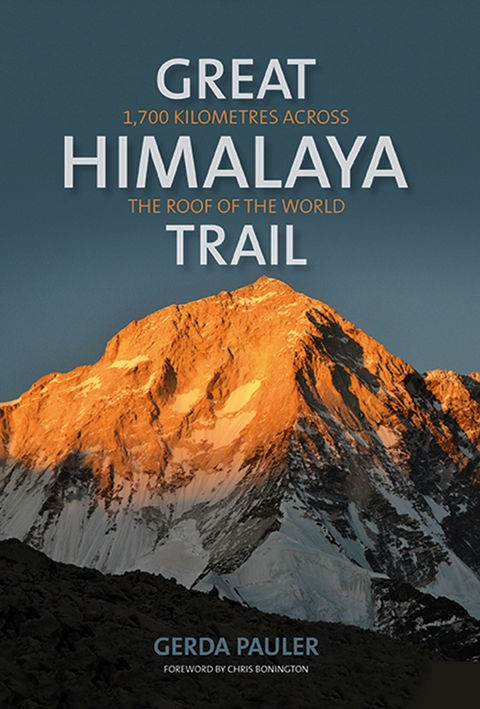
The Great Himalaya Trail is one of the longest and highest trails in the world. It is a trail that winds for 1,700 kilometres through Nepal - across the 'roof of the world', over ice-covered passes, crossing high-mountain deserts and through some of the most remote areas on earth. This path is perhaps the ultimate walk. In 2012, Himalaya veteran Gerda Pauler set out to walk the length of the trail to raise awareness of autism in Nepal. Travelling across the country with open eyes and ears, ascending high passes, visiting isolated villages and drinking tea with the locals allowed her to see and hear things many of us might never hear, never experience - and never know. Beautifully written like many great travel books and with a foreword by Sir Chris Bonington, this is so much more than a travel diary - it is a collection of stories from the very heart of Nepal and its people. From Tibetan tea and local beer to corrupt politicians and child marriage; cold nights and monsoon rain to incredible views and searing heat; and from angry yaks and giant spiders to Mr Bean and Jack Nicholson... 'Her book is not about her, but about this trip, across the roof of the world, done both for her own pleasure and for those who suffer from autism.' Sir Chris Bonington
— Chapter One —
Kangchenjunga
Day 1
Taplejung – Mitlung
Mind games
After an excruciating two-day journey from Kathmandu by bus and jeep, my guide Temba and I arrived in Taplejung late last night. This morning, when he knocks relentlessly at the door of my room at seven o’clock, I need almost fifteen minutes to sort out my thoughts. All of a sudden, I remember the radio interview I am invited to give. My journey across Nepal is not a just personal adventure, but first of all a charity walk for the Nepalese organization Autism Care Nepal, working with autistic children. I jump out of bed, pack my belongings in a hurry and dash downstairs for breakfast. Two journalists from the local radio station turn up before I finish the last pancake and, still munching, I answer the first questions. They want to support my project, which includes building knowledge and awareness about autism, by broadcasting general background information about this disorder. I deem this a good start to my long journey across Nepal.
After the interview, Temba and I stroll through the busy centre of Taplejung. The streets are crowded with a colourful, ethnic mixture of people who are here to do their shopping: food, furniture, electronics, or photovoltaic panels (solar cells), cooking pots, computers, fashion articles and traditional clothing. Shops and stalls offer virtually every-thing people need in life, and this makes the town a perfect place for my personal last minute shopping: plastic sandals, a spare torch and a nail file. The next town where I will (probably) have an opportunity to purchase items like these is Namche Bazaar; a forty-day walk from here.
‘Taplejung’ takes its name from the words Taple and Jung. Taple was a medieval king of the Limbu people (who originally lived in the vicinity of Lhasa, Tibet, and in the Chinese district Yunan), and Jung means ‘fortress’ in Limbu language. Thus, Taplejung can be translated as ‘King Taple’s Fortress’. Nowadays, there is no fortress left, but Taplejung’s role as a trading and administration centre has remained.
Leaving the last houses of Taplejung behind us, I can hardly believe my fantastic adventure has started. The last ten weeks have been filled with logistics, finding equipment sponsors, donors for Autism Care Nepal and contacting associations connected with autism. There had been no time left to mentally prepare for a four-month journey and, as a result, my thoughts are everywhere but here, in Nepal, today. Additionally, all sorts of worries begin to trouble me; many of which are totally irrelevant at this particular moment:
What if I sprain my ankle?
What if I break my leg?
What if one of my porters gets seriously sick?
What if I have to give up?
What if…
What if…
Thoughts about my parents, friends and my former job come and go, and I forget to take in and enjoy the beauty of the hilly landscape, the exotic smells and the friendliness of the people I meet on my way to Mitlung. It feels as if I am sitting in a huge glass ball, cut off from reality, a soap bubble floating through the air.
Day 2
Mitlung – Tapletok
Puja
The trail runs gently uphill through a sub-tropical landscape with banana trees and bamboo plants. Despite it only being March, the warmth of the sun conveys the feeling of being on a summer holiday. My attention wanders from the world of thoughts to the colourful flowers, blooming rhododendron trees and bougainvillea bushes that smell somewhat like honeysuckle. Slowly, I ‘arrive’.
Not far away from Mitlung, relatives of a deceased man have performed a three-day long Hindu puja beside the trail. They had erected several makeshift bamboo huts and built an altar in the biggest one to present their offerings to the deities. The people are dressed in their best clothes and there is still a solemn and sacred atmosphere around the place. Since the puja is over, the family has time to invite us for a cup of tea; together, we sit down for a while.
Puja is a Sanskrit word meaning ‘to worship’, ‘adore’ or ‘pay tribute to the divine’. It is a religious procedure performed, even if the form differs slightly, by Buddhists and Hindus alike. It is underpinned by strict rules and any traditional Hindu puja has certain components that never change: the singing of devotional hymns before the ritual starts and the seemingly endless repetition of certain mantras (holy words or short prayers) during the ceremony to awaken and appease the deities. The length and the arrangements, however, can vary depending on tradition and occasion.
Offerings like flowers, rice, milk and consecrated meals are made as signs of gratitude and deference. To prepare and open up for the presence and power of the deity or the guru, the chakra (‘life’ or ‘energy’) point of the people involved in the ceremony is marked with sandalwood colours. Normally, the puja ends with a prayer, and the worshipers bow or prostrate themselves to offer homage, but sometimes there is an additional light ceremony where oil lamps, incense or small pools of camphor oil are lit on stone slabs. The food offerings, which are filled with the deity’s cosmic energy at the end of a puja, are distributed amongst the guests.
Hindus perform pujas for various reasons, ranging from Puja festivals like Saraswati Puja, Kali Puja, Durga Puja, and Ganesh Chaturthi to the cleansing of private and public rooms or houses. Pujas are also performed for healing, to bless babies or newly-married couples, or at funerals.
We continue along the river Tawa and reach our planned destination for the day – the settlement of Chiruwa, at lunchtime. A kind peasant family prepares food for us and sells us cold chang (local beer, usually made of rice). It is a boon to sit down and relax for a while in the shadow of an enormous banana tree beside the house. Only ten days ago, I was among the snow-clad hills and frozen waterfalls of a Norwegian winter paradise. Here, the temperatures reach about twenty five degrees, and I feel the abrupt climate change affecting me, sapping my energy.
Since the day is still young, we decide to stroll on to Tapletok where we move into the only hotel there. Well, Temba moves into one of the hotel rooms – I choose the balcony because it is too hot inside.
Day 3
Tapletok – Sukathum
Children as porters
With an average monthly income of 20 Euros, Nepal remains one of the poorest countries in the world. In the Kangchenjunga Conservation Area (KCA), approximately 60% of the inhabitants live below the poverty line. Many of these people are farmers, families who cannot afford to send their sons and daughters to school for more than a few years, if at all. The children have to contribute to the financial standing of the family and either work on the farm or find employment somewhere else.
We meet two brothers, Lakpa and Nabin Sherpa, on the way to Lelep. I’m curious to learn more about these two children who, apparently, walk alone, and ask Temba to translate my questions. In the beginning, both brothers are shy, and it takes time before they reply.
Temba and I learn that the family owns a small farm near Taplejung and, though the fields yield enough food, the farm work provides no cash income. Lakpa is thirteen years old and has laboured as a porter since the age of ten; it was his father’s decision. His brother, Nabin, was forced to leave school after grade four. Now, at the age of eleven, he transports thirty-kilogram bags filled with rice, flour or noodles up and down the hills. When they talk about their two younger brothers who still attend school, I detect a blend of envy and sadness in their expressions, envy, because the two younger brothers can still escape from the toil at home, sadness, because they will, in all probability, have to share Lakpa’s and Nabin’s fate when they reach their tenth birthdays.
It may sound absurd, but Lakpa and Nabin are ‘lucky’. They work for the hotel at Lelep regularly and earn about 1,750 Rupees (23 USD) for the three-day trip as porters – a not only desirable, but vital source of income for the poor family.
In Lelep, where the boys deliver their loads, we meet them again. Lelep lies at the top of a steep rise overlooking the lower valley, and from it one trail runs along the Yangma Khola to the trading town of Olang-chun Gola while another passes Ghunsa and continues to Kangchenjunga Base Camp. Entering the village, I walk straight into the paved courtyard of the hotel and the adjoining shop (a well thought-out monopoly). Local children from well-off families are playing Caramboard, and there is a lot of laughter and much joking outside the hotel.
Lakpa and Nabin watch the scene from the distance. I neither see a smile nor do I hear laughter; all I recognize in their faces is sadness and resignation. They are aware of the fact that life circumstances deprived them of a carefree childhood and of even the tiniest chance of escaping lifelong hardships.
Nepal has a law that protects children, or so it says. It is illegal to assign work to anybody younger than fifteen years old. Who enforces this law, I wonder?
Day 4
Sukathum – Amjilosa
Voulez-vous coucher avec moi… ce soir?
If I had been asked whether I wanted to share my bed, my answer would have been a plainspoken ‘NO’, but no one had asked me. Nevertheless, an uninvited guest decided to stay over and was to make me think of him frequently over the next couple of days. I do not talk...
| Erscheint lt. Verlag | 7.11.2013 |
|---|---|
| Verlagsort | London |
| Sprache | englisch |
| Themenwelt | Sachbuch/Ratgeber ► Sport |
| Reisen ► Reiseberichte | |
| Reisen ► Reiseführer | |
| Naturwissenschaften ► Geowissenschaften ► Geografie / Kartografie | |
| ISBN-10 | 1-898573-90-5 / 1898573905 |
| ISBN-13 | 978-1-898573-90-6 / 9781898573906 |
| Informationen gemäß Produktsicherheitsverordnung (GPSR) | |
| Haben Sie eine Frage zum Produkt? |
 EPUB (Adobe DRM)
Kopierschutz: Adobe-DRM
Adobe-DRM ist ein Kopierschutz, der das eBook vor Mißbrauch schützen soll. Dabei wird das eBook bereits beim Download auf Ihre persönliche Adobe-ID autorisiert. Lesen können Sie das eBook dann nur auf den Geräten, welche ebenfalls auf Ihre Adobe-ID registriert sind.
Details zum Adobe-DRM
Dateiformat: EPUB (Electronic Publication)
EPUB ist ein offener Standard für eBooks und eignet sich besonders zur Darstellung von Belletristik und Sachbüchern. Der Fließtext wird dynamisch an die Display- und Schriftgröße angepasst. Auch für mobile Lesegeräte ist EPUB daher gut geeignet.
Systemvoraussetzungen:
PC/Mac: Mit einem PC oder Mac können Sie dieses eBook lesen. Sie benötigen eine
eReader: Dieses eBook kann mit (fast) allen eBook-Readern gelesen werden. Mit dem amazon-Kindle ist es aber nicht kompatibel.
Smartphone/Tablet: Egal ob Apple oder Android, dieses eBook können Sie lesen. Sie benötigen eine
Geräteliste und zusätzliche Hinweise
Buying eBooks from abroad
For tax law reasons we can sell eBooks just within Germany and Switzerland. Regrettably we cannot fulfill eBook-orders from other countries.
aus dem Bereich