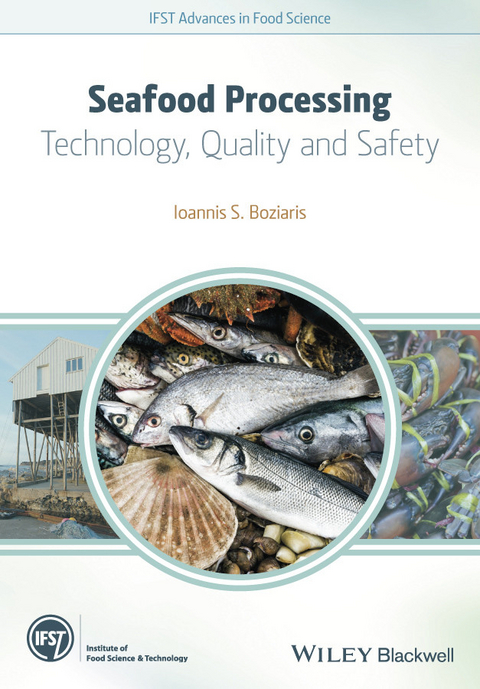
Seafood Processing (eBook)
John Wiley & Sons (Verlag)
978-1-118-34619-8 (ISBN)
Ioannis S. Boziaris (MSc, PhD) is Assistant Professor in Seafood Hygiene and Preservation since 2006 in
the Department of Ichthyology and Aquatic Environment, School of Agricultural Sciences, University of
Thessaly, Volos, Greece.
Part of the new IFST Advances in Food Science Series, Seafood Processing: Technology, Quality and Safety covers the whole range of current processes which are applied to seafood, as well as quality and safety aspects. The first part of the book ( Processing Technologies ) covers primary processing, heating, chilling, freezing, irradiation, traditional preservation methods (salting, drying, smoking, fermentation, etc), frozen surimi and packaging. The subjects of waste management and sustainability issues of fish processing are also covered. In the second part ( Quality and Safety Issues ), quality and safety analysis, fish and seafood authenticity and risk assessment are included.
Ioannis S. Boziaris (MSc, PhD) is Assistant Professor in Seafood Hygiene and Preservation since 2006 in the Department of Ichthyology and Aquatic Environment, School of Agricultural Sciences, University of Thessaly, Volos, Greece.
Chapter 1
Introduction to Seafood Processing—Assuring Quality and Safety of Seafood
Ioannis S. Boziaris
Department of Ichthyology and Aquatic Environment, School of Agricultural Sciences, University of Thessaly, Volos, Greece
1.1 Introduction
Demand for seafood has consistently increased during recent years with fish protein being the major animal protein consumed in many parts of the world. According to the Food and Agriculture Organization (FAO, 2012), fresh seafood represents 40.5% of the world's seafood production, while processed products (frozen, cured, canned, etc.) represent 45.9%. To assure the quality of raw material used for processing, fish has to be treated carefully before and after harvest. Often fish and shellfish undergo some type of handling or primary processing (washing, gutting, filleting, shucking, etc.), before the main processing occurs, to assure their quality and safety, as well as to produce new, convenient and added-value products (e.g. packed fish fillets instead of unpacked, whole ungutted fish).
Processing of seafood mainly inhibits and/or inactivates bacteria and enzymes which results in shelf-life extension and also assures food safety. While the main role of processing is preservation, processing not only extends shelf life but also creates a new range of products.
Seafood processing uses almost all the processing methods available to the food industry. The most widely used methods to preserve fish involve the application of low temperatures (chilling, super-chilling, freezing). Improvements in packaging technology (modified atmosphere packaging, MAP) and the application of chilling maximise quality retention as well as extending shelf life. Heating inactivates bacterial pathogens and spoilage microorganisms, which contributes to the stability and safety of the products. Irradiation is a well-established, non-thermal method, while high-pressure processing of seafood is being continuously increased. Traditional methods of preservation (curing, fermentation, etc.) are also used in the production of a variety of products.
1.2 Seafood spoilage
Seafood deteriorates very quickly due to various spoilage mechanisms. Spoilage can be caused by the metabolic activity of microorganisms, endogenous enzymatic activity (such as autolysis and the enzymatic browning of crustaceans shells) and by the chemical oxidation of lipids (Ashie et al., 1996; Gram and Huss, 1996; Huis in't Veld, 1996).
Seafood flesh has a high amount of non-protein nitrogenous (NPN) compounds and a low acidity (pH > 6), which support the fast growth of microorganisms that are the main cause of spoilage. The growth and metabolic activity of the spoilage microorganisms, especially specific spoilage organisms (SSOs), result in the production of metabolites that affect the organoleptic properties of the product (Ashie et al., 1996; Gram and Huss, 1996). Briefly, SSOs may initially represent only a small proportion of the microbiota (indigenous and exogenous); however, they subsequently proliferate to become the part of the dominant microbiota that has spoilage potential (the qualitative ability to produce off-odours) and spoilage activity (the quantitative ability to produce metabolites) (Gram and Dalgaard, 2002). Inhibiting the growth of SSOs increases the shelf life of seafood. Pseudomonas and Shewanella species spoil marine fish and crustaceans stored aerobically at low temperatures, while Photobacterium phosphoreum, various lactic acid bacteria and Brochothrix thermosphacta usually predominate in spoilage associated with MAP (Gram and Huss, 1996; Dalgaard, 2000).
Immediately following death, autolysis resulting from the action of endogenous enzymes, initially causes loss of the characteristic fresh odour and taste of fish and then softens the flesh (Huss, 1995; Ashie et al., 1996). The main changes that take place are initially the enzymatic degradation of adenosine triphosphate (ATP) and related products and subsequently the action of proteolytic enzymes. Enzymes are also responsible for colour changes. After microbial growth, enzymatic browning is the most important spoilage mechanism of crustaceans (Ashie et al., 1996; Boziaris et al., 2011). Browning of the crustacean shell is the result of the action of polyphenol oxidase on tyrosine and its derivatives such as tyramine (Martinez-Alvarez et al., 2007). Inhibition or inactivation of polyphenol oxidase by various means (heating, additives, etc.) as well as oxygen reduction or exclusion can prevent the loss of the original colour of the crustacean shell.
Chemical oxidation of lipids (oxidative rancidity) is one of the most important spoilage mechanisms, especially in fatty fish. Oxygen is necessary for the development of oxidative rancidity; hence, oxygen reduction or exclusion limits the oxidation reaction (Ashie et al., 1996).
All these mechanisms advance almost simultaneously contributing to the spoilage; however, fresh and lightly preserved seafood spoils mainly due to the action of microorganisms. For products in which microbial growth is retarded or inhibited, non-microbial mechanisms play a more determinative role.
1.3 Seafood hazards
Contamination of seafood by chemicals, marine toxins and microbiological hazards can be high. Various bacterial pathogens present in aquatic environments—either naturally (pathogenic Vibrio, Clostridium botulinum, Aeromonas hydrophilla), or as contaminants (Salmonella spp., pathogenic Escherichia coli)—can contaminate seafood, while contamination with other bacteria such as Listeria monocytogenes, Staphylococcus aureus, etc., can occur during processing (Feldhusen, 2000; Huss et al., 2000). Seafood can also be contaminated by viruses (such as hepatitis A virus, Norwalk-like viruses, Astrovirus, etc.), marine biotoxins (which cause several diseases such as diarrhoeic shellfish poisoning (DSP), paralytic shellfish poisoning (PSP), neurotoxic shellfish poisoning (NSP), amnesic shellfish poisoning (ASP) and fish ciguatera poisoning) and chemical contaminants (such as heavy metals) (Huss, 1994). Generally, processing mainly controls microbiological hazards but leaves chemical hazards or biotoxins virtually unaffected. Effective control of chemical hazards and biotoxins has to be applied mostly during primary production and the pre-harvest stages.
From a safety point of view, seafood can be classified in to seven groups according to the risk of microbial contamination and the processing method (Huss et al., 2000). Molluscs, especially those that are to be eaten without cooking, belong to the group with the highest risk. The second group contains the fish and crustaceans that will be consumed after cooking. The third and fourth groups contain lightly preserved (NaCl < 6% w/v in aqueous phase, pH > 5) and semi-preserved (NaCl > 6% w/v in aqueous phase, pH < 5) products, respectively. The fifth group contains the mild-heated products, such as pasteurized and hot-smoked seafood, while the sixth contains the heat processed products. Finally dried, dry-salted and smoke-dried seafood products have the lowest risk.
1.4 Getting the optimum quality of the raw material
Pre-harvest and post-harvest handling of fish affects its quality. A number of biochemical changes start immediately following the death of the fish. The most important change is the onset of rigor mortis, during which the initially relaxed and elastic muscles become hard and stiff. At the end of rigor mortis the muscles relax again but are no longer elastic. The mechanism of rigor mortis is described in Chapter 3. The significance of rigor mortis is important in post-mortem processing. Filleting fish in rigor may produce fillets with gaping and give lower yields, while whole fish and fillets frozen before the onset of rigor can give better products (Huss, 1995). The onset of rigor mortis and its duration depend on various factors such as the size of the fish, the temperature and the physical condition of the fish, including stress (Huss, 1995). For instance, in either starved or stressed fish the glycogen reserves are depleted and rigor mortis starts immediately. Rapid chilling of fish is important not only to inhibit bacterial growth but also for managing the onset and duration of rigor. Abe and Okuma (1991) suggested that the onset of rigor mortis depends on the difference between the sea temperature and the storage temperature. When this difference is high, the onset of rigor is fast and vice versa.
1.4.1 Pre-mortem handling
Handling of fish before death affects rigor mortis. It is important in wild fish to use methods of capture that do not stress and exhaust fish, while in farmed fish, pre-harvest starvation, harvesting and slaughtering practices that do not stress fish are essential to maximise seafood quality and shelf life (Bagni et al., 2007; Borderias and Sanchez-Alonso, 2011). The digestive tract contains a high bacterial population that produces digestive enzymes that result in intense post-mortem autolysis giving strong off-odours in the abdominal area (Huss, 1995). Starvation reduces the amount of faeces in the intestines and delays spoilage. In general, the starvation period is 1–3 days. Harvesting, stunning and killing methods greatly affect post-mortem changes and subsequent fish quality. When fish are rapidly killed, stress can be reduced, improving quality (Ottera et al., 2001; Bagni et al., 2007). Many methods can be used for stunning and killing fish, such as asphyxiation, live chilling in ice slurry, electrical stunning and electrocution, carbon dioxide...
| Erscheint lt. Verlag | 13.11.2013 |
|---|---|
| Reihe/Serie | IFST Advances in Food Science | IFST Advances in Food Science |
| Sprache | englisch |
| Themenwelt | Naturwissenschaften ► Biologie |
| Technik ► Lebensmitteltechnologie | |
| Weitere Fachgebiete ► Land- / Forstwirtschaft / Fischerei | |
| Schlagworte | Chemical • consistently • Contamination • Every Day • Fischverarbeitung • fish • fish products • Fleisch, Fisch, Geflügel • Fleisch, Fisch, Geflügel • Food Processing, Production & Manufacture • Food Quality Assurance • Food Science & Technology • Herstellung u. Verarbeitung von Lebensmitteln • High • Industry • Lebensmittelforschung u. -technologie • Lebensmittel / Qualitätskontrolle • Lebensmittel / Qualitätskontrolle • Lebensmitteltechnik • Life • major animal • many • Meat, Fish & Poultry • Meeresfrüchte • Meeresfrüchte • Necessary • new challenges • perishable • Processing • Product • Production • prolonged • recent years • Risk • Safety • Seafood • shelf • World |
| ISBN-10 | 1-118-34619-X / 111834619X |
| ISBN-13 | 978-1-118-34619-8 / 9781118346198 |
| Informationen gemäß Produktsicherheitsverordnung (GPSR) | |
| Haben Sie eine Frage zum Produkt? |
 EPUB (Adobe DRM)
Größe: 17,3 MB
Kopierschutz: Adobe-DRM
Adobe-DRM ist ein Kopierschutz, der das eBook vor Mißbrauch schützen soll. Dabei wird das eBook bereits beim Download auf Ihre persönliche Adobe-ID autorisiert. Lesen können Sie das eBook dann nur auf den Geräten, welche ebenfalls auf Ihre Adobe-ID registriert sind.
Details zum Adobe-DRM
Dateiformat: EPUB (Electronic Publication)
EPUB ist ein offener Standard für eBooks und eignet sich besonders zur Darstellung von Belletristik und Sachbüchern. Der Fließtext wird dynamisch an die Display- und Schriftgröße angepasst. Auch für mobile Lesegeräte ist EPUB daher gut geeignet.
Systemvoraussetzungen:
PC/Mac: Mit einem PC oder Mac können Sie dieses eBook lesen. Sie benötigen eine
eReader: Dieses eBook kann mit (fast) allen eBook-Readern gelesen werden. Mit dem amazon-Kindle ist es aber nicht kompatibel.
Smartphone/Tablet: Egal ob Apple oder Android, dieses eBook können Sie lesen. Sie benötigen eine
Geräteliste und zusätzliche Hinweise
Buying eBooks from abroad
For tax law reasons we can sell eBooks just within Germany and Switzerland. Regrettably we cannot fulfill eBook-orders from other countries.
 PDF (Adobe DRM)
Kopierschutz: Adobe-DRM
Adobe-DRM ist ein Kopierschutz, der das eBook vor Mißbrauch schützen soll. Dabei wird das eBook bereits beim Download auf Ihre persönliche Adobe-ID autorisiert. Lesen können Sie das eBook dann nur auf den Geräten, welche ebenfalls auf Ihre Adobe-ID registriert sind.
Details zum Adobe-DRM
Dateiformat: PDF (Portable Document Format)
Mit einem festen Seitenlayout eignet sich die PDF besonders für Fachbücher mit Spalten, Tabellen und Abbildungen. Eine PDF kann auf fast allen Geräten angezeigt werden, ist aber für kleine Displays (Smartphone, eReader) nur eingeschränkt geeignet.
Systemvoraussetzungen:
PC/Mac: Mit einem PC oder Mac können Sie dieses eBook lesen. Sie benötigen eine
eReader: Dieses eBook kann mit (fast) allen eBook-Readern gelesen werden. Mit dem amazon-Kindle ist es aber nicht kompatibel.
Smartphone/Tablet: Egal ob Apple oder Android, dieses eBook können Sie lesen. Sie benötigen eine
Geräteliste und zusätzliche Hinweise
Buying eBooks from abroad
For tax law reasons we can sell eBooks just within Germany and Switzerland. Regrettably we cannot fulfill eBook-orders from other countries.
aus dem Bereich