


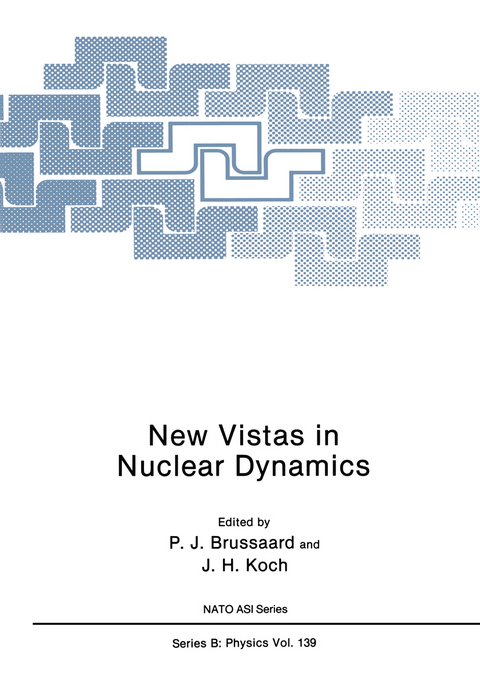
New Vistas in Nuclear Dynamics
Seiten
2012
|
Softcover reprint of the original 1st ed. 1986
Springer-Verlag New York Inc.
978-1-4684-5181-8 (ISBN)
Springer-Verlag New York Inc.
978-1-4684-5181-8 (ISBN)
The 1985 Summer School on Nuclear Dynamics, organized by the Nuclear Physics Division of the Netherlands' Physical Society, was the sixth in a series that started in 1963. This change reflects a shift in focus to nuclear processes at higher energy, or, more generally, to nuclear processes under less traditional circumstances.
The 1985 Summer School on Nuclear Dynamics, organized by the Nuclear Physics Division of the Netherlands' Physical Society, was the sixth in a series that started in 1963. This year's topic has been nuclear dynamics rather than nuclear structure as in the foregoing years. This change reflects a shift in focus to nuclear processes at higher energy, or, more generally, to nuclear processes under less traditional circumstances. For many years nuclear physics has been restricted to the domain of the ground state and excited states of low energy. The boundaries between nuclear physics and high-energy physics are rapidly disappearing, however, and the future will presumably show that the two fields of research will contribute to one another. With the advent of a new generation of heavy-ion and electron accelerators research activities on various new aspects of nuclear dynamics over a wide range of energies have become possible. This research focuses in particular on nonnucleonic degrees of freedom and on nuclear matter under extreme conditions, which require the explicit introduction of quarks into the description of nuclear reactions. Mean-field formulations are no longer adequate for the description of nucleus nucleus collisions at high nucleon energies as the nucleon-nucleon collisions begin to dominate. Novel dynamical theories are being developed, such as those based upon the Boltzmann equation or hadrodynamic models. The vitality of nuclear physics was clearly demonstrated by the enthusiastic lecturers at this summer school. They presented a series of clear and thorough courses on the subjects above.
The 1985 Summer School on Nuclear Dynamics, organized by the Nuclear Physics Division of the Netherlands' Physical Society, was the sixth in a series that started in 1963. This year's topic has been nuclear dynamics rather than nuclear structure as in the foregoing years. This change reflects a shift in focus to nuclear processes at higher energy, or, more generally, to nuclear processes under less traditional circumstances. For many years nuclear physics has been restricted to the domain of the ground state and excited states of low energy. The boundaries between nuclear physics and high-energy physics are rapidly disappearing, however, and the future will presumably show that the two fields of research will contribute to one another. With the advent of a new generation of heavy-ion and electron accelerators research activities on various new aspects of nuclear dynamics over a wide range of energies have become possible. This research focuses in particular on nonnucleonic degrees of freedom and on nuclear matter under extreme conditions, which require the explicit introduction of quarks into the description of nuclear reactions. Mean-field formulations are no longer adequate for the description of nucleus nucleus collisions at high nucleon energies as the nucleon-nucleon collisions begin to dominate. Novel dynamical theories are being developed, such as those based upon the Boltzmann equation or hadrodynamic models. The vitality of nuclear physics was clearly demonstrated by the enthusiastic lecturers at this summer school. They presented a series of clear and thorough courses on the subjects above.
Spectroscopy of Rapidly-Rotating Nuclei.- Nuclei at High Angular Velocities.- On Collective Dynamics in Low-Energy Nucleus-Nucleus Collisions: Nuclear Elastoplasticity.- The Boltzmann Equation and Nucleus-Nucleus Collisions.- Electromagnetic Interactions in Nuclei, Pion Number and the EMC effect.- Photonuclear Reactions at Intermediate Energies.- Hypernuclear Experiments, Low-Energy Antiproton Physics and Quark Structure of Nuclei.- The Relativistic Nuclear Many-Body Problem.- Quarks in Nucleons and Nuclei.- Models for the Structure of Hadrons: Bags, Solitons.- Forbidden and Rare Decays of Muons, Kaons and Pions.- Neutron Stars in Binary Systems.- Participants.
| Reihe/Serie | NATO Science Series: B ; 139 |
|---|---|
| Zusatzinfo | 147 Illustrations, black and white; 428 p. 147 illus. |
| Verlagsort | New York, NY |
| Sprache | englisch |
| Maße | 178 x 254 mm |
| Themenwelt | Naturwissenschaften ► Physik / Astronomie ► Atom- / Kern- / Molekularphysik |
| ISBN-10 | 1-4684-5181-2 / 1468451812 |
| ISBN-13 | 978-1-4684-5181-8 / 9781468451818 |
| Zustand | Neuware |
| Informationen gemäß Produktsicherheitsverordnung (GPSR) | |
| Haben Sie eine Frage zum Produkt? |
Mehr entdecken
aus dem Bereich
aus dem Bereich
Buch | Softcover (2024)
Wiley-VCH (Verlag)
CHF 83,85
Introduction to Quantum Electrodynamics
Buch | Softcover (2024)
Wiley-VCH GmbH (Verlag)
CHF 156,75


