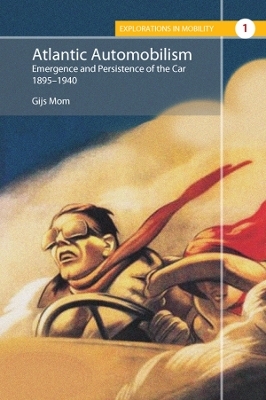
Atlantic Automobilism
Berghahn Books (Verlag)
978-1-78238-377-2 (ISBN)
Delves into the motives behind early car users
Explores the psychological and social reasoning behind our attachment to the vehicle, utilising material such as poems, popular music and films
Our continued use of the combustion engine car in the 21st century, despite many rational arguments against it, makes it more and more difficult to imagine that transport has a sustainable future. Offering a sweeping transatlantic perspective, this book explains the current obsession with automobiles by delving deep into the motives of early car users. It provides a synthesis of our knowledge about the emergence and persistence of the car, using a broad range of material including novels, poems, films, and songs to unearth the desires that shaped our present “car society.” Combining social, psychological, and structural explanations, the author concludes that the ability of cars to convey transcendental experience, especially for men, explains our attachment to the vehicle.
Gijs Mom is an historian of technology and teaches at Eindhoven University of Technology. A literary historian turned automotive engineer, Mom is author of The Electric Vehicle: Technology and Expectations in the Automobile Age (Johns Hopkins 2004); founder of the International Association for the History of Transport, Traffic and Mobility (T2M); and editor of Transfers: Interdisciplinary Journal of Mobility Studies (Berghahn Books).
List of Figures
Preface
Introduction
Explaining the car: Prolegomena for a history of North-Atlantic automobilism
Introduction: writing a synthesis
Do narratives explain?
Constructing a master narrative
Developing an explanatory toolbox
Conclusions
PART I: EMERGENCE (1895 - 1918)
Chapter 1. Racing, touring, tinkering: constructing the adventure machine (1895 – 1914/1917)
Introduction
First phase: emergence and roots of the petrol car (until 1902)
Second phase: resistance against elite touring in heavy family cars (1902 – 1908)
A first analysis of automotive adventure: the masculine ‘conquest of nature’
Third phase: the “small capitalist” and the “average man” (1908 until the war)
Conclusions
Chapter 2. How it feels to be run over: the grammar of early automobile adventure
Introduction
Driving and writing: Analyzing ‘affinities’ of touristic and artistic experiences
‘Auto-poetics’: mainstream authors
Literary resistance against the car: Critical voices from the UK
Colonialism by car: Gendered travel writing
Male violence and aggression: A French-Belgian group of writer-motorists
Sub-literary novels: the Williamsons and youth novels
Flight Forward: The avant-garde, silent movies, and the celebration of automotive violence
Tarkington, Cather and Dreiser: auto-poetics before America’s entry into the war
Enhanced Adventures: Analysis and conclusions
Chapter 3. Driving on aggression: The First World War and the systems approach to the car
Introduction
Preparing for war (1): clubs, the military, and aggression
Preparing for war (2): organizing mobility
Mobilization, immobility, remobilization: aggression, violence and atrocities
War trophies 1 to 3: the truck, logistics and maintenance
War trophy 4: thanatourism and other adventures
Ending the war, ending the chapter: conclusions
PART II: PERSISTENCE (1918 - 1940)
Chapter 4. “Why apologize for pleasure?” Consuming the Car in Boom and Bust
Introduction
The car as commodity; its spread among the Atlantic middle class
European car consumption and ‘Americanization’: eagerness compared
The car as ‘necessity’: A profile of car use in the Interbellum
Migration, mass tourism and the family car
Conclusions
Chapter 5. Translation and Transition: Re-adjusting the Technology and Culture of Middle Class Family Adventures
Introduction
Orchestrating Car Technology: Constructing the Closed Automobile
The process of Prosthetization: Mutually Adjusting Skills and Technology
Multiple Adventures: Thrills, Skills, and Risks
Conclusions
Chapter 6. Conquest and Domination: Domesticated Violence and the Coldness of Distance
Introduction
An avant-garde in autopoetic travel experience: the conquest of the ‘periphery’
Domesticating adventure: the family as collective subject
Flows and violence: urban culture and the middleclass family
With or without a car: a women’s adventure?
The ubiquitous car: a spectrum of adventures, adjusted to middleclass taste
The cult of cool: becoming cyborg
Symbolisms and affinities: avant-garde and popular culture
Conclusions
Chapter 7. Swarms into flow: The Contested Emergence of the Automobile System
Introduction
Coping with the car’s unreliability: maintenance, repair, and the functional adventure
Transnationalizing the local: planning and building national road networks
Contested order: spatial planners versus engineers
Rescuing automotive adventure: the construction of road safety
The battle of the systems: road versus rail and the ‘coordination crisis’
Conclusions
Transcendence and the automotive production of mobility: Conclusions on half a century of North-Atlantic automobilism
Introduction
Crossing borders: Half a century of North-Atlantic automobilism
Crossing boundaries: Adventure, fiction and the explanation of the car's persistence
Some closing remarks on methodology and future research
| Reihe/Serie | Explorations in Mobility |
|---|---|
| Zusatzinfo | 3 Illustrations; 3 Tables, unspecified |
| Verlagsort | Oxford |
| Sprache | englisch |
| Maße | 152 x 229 mm |
| Gewicht | 1188 g |
| Themenwelt | Geschichte ► Allgemeine Geschichte ► Neuzeit (bis 1918) |
| Geschichte ► Teilgebiete der Geschichte ► Kulturgeschichte | |
| Geschichte ► Teilgebiete der Geschichte ► Technikgeschichte | |
| Naturwissenschaften | |
| ISBN-10 | 1-78238-377-8 / 1782383778 |
| ISBN-13 | 978-1-78238-377-2 / 9781782383772 |
| Zustand | Neuware |
| Informationen gemäß Produktsicherheitsverordnung (GPSR) | |
| Haben Sie eine Frage zum Produkt? |
aus dem Bereich