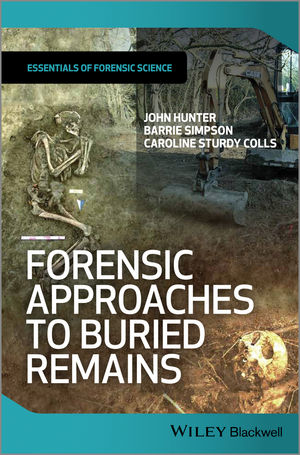
Forensic Approaches to Buried Remains (eBook)
John Wiley & Sons (Verlag)
978-1-118-37414-6 (ISBN)
The field of forensic archaeology has developed over recent years from being a branch of conventional archaeology into a well-established discipline in its own right. Forensic Approaches to Buried Remains takes an innovative approach to the subject by placing the role of the forensic archaeologist within the wider forensic environment; it identifies new areas of interdisciplinary research and practice, and evaluates practical difficulties.
The authors see this book as a reflection of the subject's development, and as a knowledge base for the next generation of forensic archaeologists. Areas covered include:
- Search logistics, integration and specialist search scenarios
- Levels of confidence in site search and elimination
- Urban and rural landscape reconstruction in both short and long term cases
- The integration of cadaver dogs and earth-moving machinery
- The recovery of multiple evidence types
- Sampling strategies, spatial relevance and dating
- Multiple burial scenarios
As part of the Essential Forensic Science book series this book will provide students and practitioners alike with an invaluable resource outlining both the major developments in the discipline, as well as original approaches to the search for, and recovery of buried remains.
AUTHORS
John Hunter MFL (Manlove Forensics Limited), Wantage, Oxfordshire, UK and University of Birmingham, Birmingham, UK
Barrie Simpson MFL (Manlove Forensics Limited), Wantage, Oxfordshire, UK
Caroline Sturdy Colls MFL (Manlove Forensics Limited), Wantage, Oxfordshire, UK and Staffordshire University, Stoke-on-Trent, Staffordshire, UK
The field of forensic archaeology has developed over recent years from being a branch of conventional archaeology into a well-established discipline in its own right. Forensic Approaches to Buried Remains takes an innovative approach to the subject by placing the role of the forensic archaeologist within the wider forensic environment; it identifies new areas of interdisciplinary research and practice, and evaluates practical difficulties. The authors see this book as a reflection of the subject s development, and as a knowledge base for the next generation of forensic archaeologists. Areas covered include: Search logistics, integration and specialist search scenarios Levels of confidence in site search and elimination Urban and rural landscape reconstruction in both short and long term cases The integration of cadaver dogs and earth-moving machinery The recovery of multiple evidence types Sampling strategies, spatial relevance and dating Multiple burial scenarios As part of the Essential Forensic Science book series this book will provide students and practitioners alike with an invaluable resource outlining both the major developments in the discipline, as well as original approaches to the search for, and recovery of buried remains.
AUTHORS John Hunter MFL (Manlove Forensics Limited), Wantage, Oxfordshire, UK and University of Birmingham, Birmingham, UK Barrie Simpson MFL (Manlove Forensics Limited), Wantage, Oxfordshire, UK Caroline Sturdy Colls MFL (Manlove Forensics Limited), Wantage, Oxfordshire, UK and Staffordshire University, Stoke-on-Trent, Staffordshire, UK
Forensic Approaches to Buried Remains 3
Contents 7
List of figures 9
Series foreword 13
Preface and acknowledgements 15
The authors 17
About the companion website 19
1 An introduction to buried remains 21
1.1 Questions of time 21
1.2 Questions of interpretation 22
1.3 Forensic archaeology 25
1.4 Legal issues and procedures 28
1.5 Decay dynamic 30
1.6 Search methods and adaptations 32
1.7 Recovery methods and adaptation 34
1.8 Mass graves 39
2 Search theory and the landscape 43
2.1 The theory 43
2.2 Landscape mapping 50
2.3 Remote sensing 57
3 Search application 69
3.1 Geophysical survey 69
3.2 Cadaver dogs 80
3.3 Mechanical excavation 88
3.4 Bodies in aqueous environments 93
4 Search design 97
4.1 Search design 97
4.1.1 Definition of search boundaries 97
4.1.2 Recording and archiving 98
4.1.3 Thoroughness 99
4.2 Interrogating landscapes 99
4.3 Balancing probabilities 113
5 Longer-term 'no body' cases 121
5.1 Introduction 121
5.2 History of cold case investigation 122
5.3 Cultural changes to rural landscapes 124
5.4 Natural changes to rural landscapes 128
5.5 Planning controls and building controls 136
5.6 Current planning arrangements 138
5.7 Planning records 140
5.8 Building records 141
5.9 Special circumstances 144
5.9.1 Archaeological investigation 144
5.9.2 Listed buildings 144
5.9.3 Ecclesiastical buildings 145
5.9.4 Burial grounds 146
5.10 Landfill sites and waste disposal 151
6 Recovery, stratigraphy and destruction 157
6.1 Stratigraphy 158
6.1.1 Layers and contamination 158
6.1.2 Fire scenes 173
6.1.3 Formal exhumations 178
6.2 The destructive process 180
6.2.1 Documentation 180
6.2.2 Planning and photography 189
Appendix: The forensic archaeologist's report (taken from Section 7 of the Standards and Guidance for Forensic Archaeologists) 198
7 Recovery, sampling and dating 201
7.1 Sieving 201
7.2 Sampling and forensic ecology 206
7.2.1 Entomology 207
7.2.2 Palynology 210
7.3 Essential taphonomics 213
7.3.1 Natural modifications 214
7.3.2 Anthropogenic modification 216
7.4 Physical anthropology, recovery and surface scatters 219
7.5 Dating 224
7.5.1 Relative dating 226
7.5.2 Absolute dating 228
8 The investigation of multiple burials 233
8.1 Diversity and challenges 233
8.2 Developments 238
8.3 Interrogating the evidence 241
8.4 The aftermath of conflict 245
8.5 Politics and Religion 247
8.6 Archives for history 248
Bibliography 253
Index 271
Supplemental Images 280
| Erscheint lt. Verlag | 20.8.2013 |
|---|---|
| Reihe/Serie | Essential Forensic Science |
| Essential Forensic Science | Essentials of Forensic Science |
| Sprache | englisch |
| Themenwelt | Studium ► 2. Studienabschnitt (Klinik) ► Rechtsmedizin |
| Naturwissenschaften ► Biologie | |
| Naturwissenschaften ► Chemie | |
| Recht / Steuern ► Strafrecht ► Kriminologie | |
| Sozialwissenschaften | |
| Schlagworte | APPROACHES • Archäologie • Archaeological Methods & Theory • archaeologist • archaeology • Archäologie • Areas • Biowissenschaften • Book • Branch • Conventional • difficulties • earth sciences • Field • Forensic • Forensic Science • Forensik • Geowissenschaften • identifies • Innovative Approach • interdisciplinary research • Life Sciences • Methoden u. Theorie der Archäologie • Methoden u. Theorie der Archäologie • New • Practical • remains • Role • Sedimentologie u. Stratigraphie • Sedimentology & Stratigraphy • Subject • subjects • wellestablished • years |
| ISBN-10 | 1-118-37414-2 / 1118374142 |
| ISBN-13 | 978-1-118-37414-6 / 9781118374146 |
| Informationen gemäß Produktsicherheitsverordnung (GPSR) | |
| Haben Sie eine Frage zum Produkt? |
 PDF (Adobe DRM)
Kopierschutz: Adobe-DRM
Adobe-DRM ist ein Kopierschutz, der das eBook vor Mißbrauch schützen soll. Dabei wird das eBook bereits beim Download auf Ihre persönliche Adobe-ID autorisiert. Lesen können Sie das eBook dann nur auf den Geräten, welche ebenfalls auf Ihre Adobe-ID registriert sind.
Details zum Adobe-DRM
Dateiformat: PDF (Portable Document Format)
Mit einem festen Seitenlayout eignet sich die PDF besonders für Fachbücher mit Spalten, Tabellen und Abbildungen. Eine PDF kann auf fast allen Geräten angezeigt werden, ist aber für kleine Displays (Smartphone, eReader) nur eingeschränkt geeignet.
Systemvoraussetzungen:
PC/Mac: Mit einem PC oder Mac können Sie dieses eBook lesen. Sie benötigen eine
eReader: Dieses eBook kann mit (fast) allen eBook-Readern gelesen werden. Mit dem amazon-Kindle ist es aber nicht kompatibel.
Smartphone/Tablet: Egal ob Apple oder Android, dieses eBook können Sie lesen. Sie benötigen eine
Geräteliste und zusätzliche Hinweise
Buying eBooks from abroad
For tax law reasons we can sell eBooks just within Germany and Switzerland. Regrettably we cannot fulfill eBook-orders from other countries.
aus dem Bereich