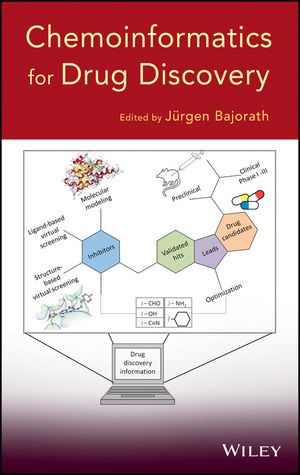
Chemoinformatics for Drug Discovery (eBook)
432 Seiten
John Wiley & Sons (Verlag)
978-1-118-74309-6 (ISBN)
results
With contributions from leading researchers in academia and the
pharmaceutical industry as well as experts from the software
industry, this book explains how chemoinformatics enhances drug
discovery and pharmaceutical research efforts, describing what
works and what doesn't. Strong emphasis is put on tested and proven
practical applications, with plenty of case studies detailing the
development and implementation of chemoinformatics methods to
support successful drug discovery efforts. Many of these case
studies depict groundbreaking collaborations between academia and
the pharmaceutical industry.
Chemoinformatics for Drug Discovery is logically
organized, offering readers a solid base in methods and models and
advancing to drug discovery applications and the design of
chemoinformatics infrastructures. The book features 15 chapters,
including:
* What are our models really telling us? A practical tutorial on
avoiding common mistakes when building predictive models
* Exploration of structure-activity relationships and transfer of
key elements in lead optimization
* Collaborations between academia and pharma
* Applications of chemoinformatics in pharmaceutical
research--experiences at large international pharmaceutical
companies
* Lessons learned from 30 years of developing successful
integrated chemoinformatic systems
Throughout the book, the authors present chemoinformatics
strategies and methods that have been proven to work in
pharmaceutical research, offering insights culled from their own
investigations. Each chapter is extensively referenced with
citations to original research reports and reviews.
Integrating chemistry, computer science, and drug discovery,
Chemoinformatics for Drug Discovery encapsulates the field
as it stands today and opens the door to further advances.
JÜRGEN BAJORATH, PhD, is Chair of Life Science Informatics at the University of Bonn and also an Affiliate Professor in the Department of Biological Structure at the University of Washington. In addition, he has more than 10 years' experience in drug disovery. His research focuses on the development of computational methods for medicinal chemistry and chemical biology. Dr. Bajorath holds 26 patents, has authored more than 400 scientific articles, and edited four books.
Preface vii
Contributors xiii
1 What Are Our Models Really Telling Us? A Practical Tutorial on Avoiding Common Mistakes when Building Predictive Models 1
W. Patrick Walters
2 The Challenge of Creativity in Drug Design 33
Ajay N. Jain
3 A Rough Set Theory Approach to the Analysis of Gene Expression Profiles 51
Joachim Petit, Nathalie Meurice, José Luis Medina-Franco, and Gerald M. Maggiora
4 Bimodal Partial Least-Squares Approach and Its Application to Chemogenomics Studies for Molecular Design 85
Kiyoshi Hasegawa and Kimito Funatsu
5 Stability in Molecular Fingerprint Comparison 97
Anthony Nicholls and Brian Kelley
6 Critical Assessment of Virtual Screening for Hit Identification 113
Dagmar Stumpfe and Jürgen Bajorath
7 Chemometric Applications of Naïve Bayesian Models in Drug Discovery: Beyond Compound Ranking 131
Eugen Lounkine, Peter S. Kutchukian, and Meir Glick
8 Chemoinformatics in Lead Optimization 149
Darren V. S. Green and Matthew Segall
9 Using Chemoinformatics Tools to Analyze Chemical Arrays in Lead Optimization 179
George Papadatos, Valerie J. Gillet, Christopher N. Luscombe, Iain M. McLay, Stephen D. Pickett, and Peter Willett
10 Exploration of Structure-Activity Relationships (SARs) and Transfer of Key Elements in Lead Optimization 205
Hans Matter, Stefan Güssregen, Friedemann Schmidt, Gerhard Hessler, Thorsten Naumann, and Karl-Heinz Baringhaus
11 Development and Applications of Global ADMET Models: In Silico Prediction of Human Microsomal Lability 245
Karl-Heinz Baringhaus, Gerhard Hessler, Hans Matter, and Friedemann Schmidt
12 Chemoinformatics and Beyond: Moving from Simple Models to Complex Relationships in Pharmaceutical Computational Toxicology 267
Catrin Hasselgren, Daniel Muthas, Ernst Ahlberg, Samuel Andersson, Lars Carlsson, Tobias Noeske, Jonna Stålring, and Scott Boyer
13 Applications of Cheminformatics in Pharmaceutical Research: Experiences at Boehringer Ingelheim in Germany 291
Bernd Beck, Michael Bieler, Peter Haebel, Andreas Teckentrup, Alexander Weber, and Nils Weskamp
14 Lessons Learned from 30 Years of Developing Successful Integrated Cheminformatic Systems 321
Michael S. Lajiness and Thomas R. Hagadone
15 Molecular Similarity Analysis 343
José L. Medina-Franco and Gerald M. Maggiora
Index 401
"Overall the book is well written, logically following the
larger storyline and most of the time offering high quality reviews
. . . Personally, I enjoyed reading this book and would recommend
it as a general introduction to the subject aimed especially for
post-graduate students and non-specialists working in the area of
drug design, but also for all of those who just want to update
their knowledge." (ChemMedChem, 1 June 2014)
| Erscheint lt. Verlag | 25.9.2013 |
|---|---|
| Sprache | englisch |
| Themenwelt | Naturwissenschaften ► Chemie |
| Technik | |
| Schlagworte | Biochemie u. Chemische Biologie • Biochemistry (Chemical Biology) • Chemie • Chemistry • Chemoinformatik • Computational Chemistry & Molecular Modeling • Computational Chemistry u. Molecular Modeling • Drug Discovery & Development • Wirkstoffforschung • Wirkstoffforschung u. -entwicklung |
| ISBN-10 | 1-118-74309-1 / 1118743091 |
| ISBN-13 | 978-1-118-74309-6 / 9781118743096 |
| Informationen gemäß Produktsicherheitsverordnung (GPSR) | |
| Haben Sie eine Frage zum Produkt? |
 EPUB (Adobe DRM)
Kopierschutz: Adobe-DRM
Adobe-DRM ist ein Kopierschutz, der das eBook vor Mißbrauch schützen soll. Dabei wird das eBook bereits beim Download auf Ihre persönliche Adobe-ID autorisiert. Lesen können Sie das eBook dann nur auf den Geräten, welche ebenfalls auf Ihre Adobe-ID registriert sind.
Details zum Adobe-DRM
Dateiformat: EPUB (Electronic Publication)
EPUB ist ein offener Standard für eBooks und eignet sich besonders zur Darstellung von Belletristik und Sachbüchern. Der Fließtext wird dynamisch an die Display- und Schriftgröße angepasst. Auch für mobile Lesegeräte ist EPUB daher gut geeignet.
Systemvoraussetzungen:
PC/Mac: Mit einem PC oder Mac können Sie dieses eBook lesen. Sie benötigen eine
eReader: Dieses eBook kann mit (fast) allen eBook-Readern gelesen werden. Mit dem amazon-Kindle ist es aber nicht kompatibel.
Smartphone/Tablet: Egal ob Apple oder Android, dieses eBook können Sie lesen. Sie benötigen eine
Geräteliste und zusätzliche Hinweise
Buying eBooks from abroad
For tax law reasons we can sell eBooks just within Germany and Switzerland. Regrettably we cannot fulfill eBook-orders from other countries.
aus dem Bereich