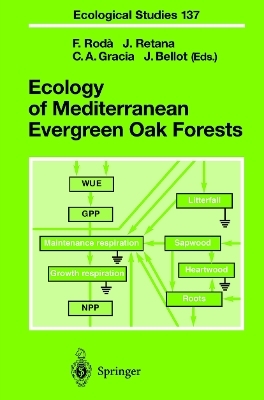
Ecology of Mediterranean Evergreen Oak Forests
Springer Berlin (Verlag)
978-3-642-63668-4 (ISBN)
1 Introduction.- 1 1 Holm Oak and Holm Oak Forests: An Introduction.- 2 Experimental Areas of Prades and Montseny.- 2 Stand Structure and Dynamics.- 3 Stand Structure, Aboveground Biomass and Production.- 4 Structure and Dynamics of the Root System.- 5 Resprouting Dynamics.- 6 Acorn Ecology.- 7 Seedling Recruitment.- 8 A Model of Stand Dynamics For Holm Oak-Aleppo Pine Forests.- 3 Light Harvesting and Gas Exchange.- 9 Leaf Traits and Canopy Organization.- 10 Gas Exchange and Water Relations.- 11 Modelling Canopy Gas Exchange During Summer Drought.- 12 GOTILWA: An Integrated Model of Water Dynamics and Forest Growth.- 4 Nutrient Cycling at the Stand Level.- 13 Water and Nutrient Limitations to Primary Production.- 14 Precipitation Chemistry and Air Pollution.- 15 Throughfall and Stemflow.- 16 Soil Nitrogen Dynamics.- 17 Soil Water Chemistry.- 18 Nutrient Distribution and Cycling.- 5 Hydrology and Biogeochemistry of Catchments.- 19 Water Balance in Catchments.- 20 Element Budgets in Catchments.- 21 Biogeochemical Models.- 6 Responses to Disturbances.- 22 Soil Fertility After Fire and Clear-Cutting.- 23 Functional Responses to Thinning.- 7 Animals in the Forest: Ecology of Two Main Groups.- 24 Soil Arthropods.- 25 Composition and Dynamics of the Bird Community.
| Erscheint lt. Verlag | 1.11.2012 |
|---|---|
| Reihe/Serie | Ecological Studies |
| Zusatzinfo | XXI, 377 p. |
| Verlagsort | Berlin |
| Sprache | englisch |
| Maße | 155 x 235 mm |
| Gewicht | 609 g |
| Themenwelt | Naturwissenschaften ► Biologie ► Ökologie / Naturschutz |
| Schlagworte | Biome • Cyclin • Ecology • ecosystem • Forest • Forest ecosystem • holm oak • Hydrology • Mediterranean • Mittelmeerraum • nitrogen • nutrient cycling • Ökosystem • Quercus ilex • Soil fertility • Steineiche • Waldökosysytem |
| ISBN-10 | 3-642-63668-3 / 3642636683 |
| ISBN-13 | 978-3-642-63668-4 / 9783642636684 |
| Zustand | Neuware |
| Informationen gemäß Produktsicherheitsverordnung (GPSR) | |
| Haben Sie eine Frage zum Produkt? |
aus dem Bereich