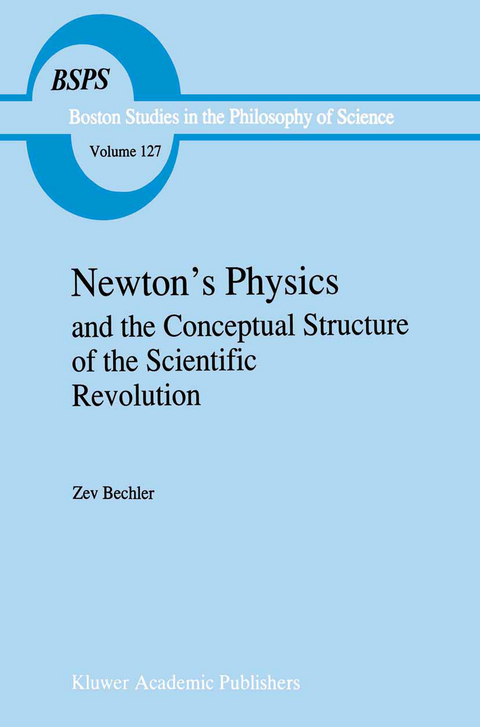
Newton’s Physics and the Conceptual Structure of the Scientific Revolution
Springer (Verlag)
978-94-010-5446-1 (ISBN)
Put near Meyerson's thesis, what Moody argued was a striking confirmation: it was the sheer irrationality of the Platonic tradition, leading from A vem- pace to Galileo, which was the working conceptual force behind the notion of a non-appearing nature, active all the time but always sub- merged, as it is embodied in the concept of void and motion in it.
I: The Tradition.- One: Aristotelian and Platonic Conceptions of Explanation.- Two: Aristotle’s Philosophy of Nature and Theory of Potentiality.- Three: Plato’s Concept of the Actual and His Philosophy of Nature.- II: The Logical Revolution.- Four: The Copernican Harmony.- Five: Bacon’s Informative Logic.- Six: Informativity and Paradox: Galileo’s Conception of the Nature of Physical Reality.- Seven: Descartes’ Informative Logic.- III: Newton’s Physics and its Critics.- Eight: Actual Infinity and Newton’s Calculus.- Nine: Newton’s Logic of Space and Time.- Ten: Modern Newtonian Historiography and the Puzzle of Newton’s Absolute Space.- Eleven: Absolute Motion and the Nature of Inertial Forces.- Twelve: Locke and the Meaning of “Empiricism”.- Thirteen: Newton’s Invention of the Problem of Induction.- Fourteen: Circularity and Newton’s Philosophy of Nature.- Fifteen: Leibniz’s Aristotelian Philosophy of Nature.- Sixteen: Berkeley’s Aristotelian Critique of Newton’s Physics.- Epilogue.- Appendix: Some Basic Ideas in Newton’s Physics.- Notes.
| Reihe/Serie | Boston Studies in the Philosophy of Science ; 127 |
|---|---|
| Zusatzinfo | XVIII, 588 p. |
| Verlagsort | Dordrecht |
| Sprache | englisch |
| Maße | 155 x 235 mm |
| Themenwelt | Geisteswissenschaften ► Geschichte |
| Geisteswissenschaften ► Philosophie ► Allgemeines / Lexika | |
| Naturwissenschaften | |
| Sozialwissenschaften ► Politik / Verwaltung ► Politische Theorie | |
| ISBN-10 | 94-010-5446-0 / 9401054460 |
| ISBN-13 | 978-94-010-5446-1 / 9789401054461 |
| Zustand | Neuware |
| Informationen gemäß Produktsicherheitsverordnung (GPSR) | |
| Haben Sie eine Frage zum Produkt? |
aus dem Bereich