


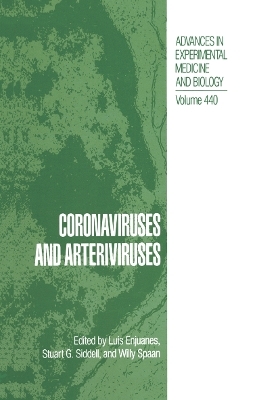
Coronaviruses and Arteriviruses
Seiten
2012
|
Softcover reprint of the original 1st ed. 1998
Springer-Verlag New York Inc.
978-1-4613-7432-9 (ISBN)
Springer-Verlag New York Inc.
978-1-4613-7432-9 (ISBN)
Proceedings of the VIIth International Symposium held in Segovia, Spain, May 10-15, 1997
Coronaviruses and arteriviruses have emerged as major virus families relevant in ani- mal and human health. The order Nidovirales, which includes the Coronaviridae and Ar- teriviridae, was recognized by the International Committee for the Taxonomy of Viruses (ICTV) in 1996 based on the striking features common to the two virus families. In accord- ance with this decision, the organizers of the coronavirus meeting, held every three years since 1980, invited colleagues working with both virus families to attend the VIIth Interna- tional Symposium on Coronaviruses and Arteriviruses, held in Segovia, Spain, in 1997. This symposium provided a stimulating forum for assessing the progress made since the last of the scientific meeting, which was held in Quebec, Canada. This volume is a collection papers presented at this symposium attended by 170 scientists from academia and industry. "Virus Entry" has been reviewed in the first section of this volume by studying the interaction between mutants of virus receptors and coronavirus spike protein. The neutrali- of virus by soluble receptors has been used to study this interaction.
Interestingly, zation the evolution of virus-receptor interaction leads to interspecies transfer of coronaviruses. Construction of chimeric aminopeptidase, the receptor of group I coronaviruses, has been useful in the identification of the virus-binding sites for coronaviruses of the porcine, ca- nine, feline, and human species. The progress in this area has revealed that the feline ami- nopeptidase is a receptor for all group I coronaviruses.
Coronaviruses and arteriviruses have emerged as major virus families relevant in ani- mal and human health. The order Nidovirales, which includes the Coronaviridae and Ar- teriviridae, was recognized by the International Committee for the Taxonomy of Viruses (ICTV) in 1996 based on the striking features common to the two virus families. In accord- ance with this decision, the organizers of the coronavirus meeting, held every three years since 1980, invited colleagues working with both virus families to attend the VIIth Interna- tional Symposium on Coronaviruses and Arteriviruses, held in Segovia, Spain, in 1997. This symposium provided a stimulating forum for assessing the progress made since the last of the scientific meeting, which was held in Quebec, Canada. This volume is a collection papers presented at this symposium attended by 170 scientists from academia and industry. "Virus Entry" has been reviewed in the first section of this volume by studying the interaction between mutants of virus receptors and coronavirus spike protein. The neutrali- of virus by soluble receptors has been used to study this interaction.
Interestingly, zation the evolution of virus-receptor interaction leads to interspecies transfer of coronaviruses. Construction of chimeric aminopeptidase, the receptor of group I coronaviruses, has been useful in the identification of the virus-binding sites for coronaviruses of the porcine, ca- nine, feline, and human species. The progress in this area has revealed that the feline ami- nopeptidase is a receptor for all group I coronaviruses.
Virus Entry.- Replication I: The Polymerase.- Replication II: RNA Synthesis.- Protein Expression and Assembly I: Expression.- Protein Expression and Assembly II: Assembly.- Pathogenesis I: The Immune System.- Pathogenesis II: Pathology.- Strategies to Control Coronavirus-Induced Diseases.- Variability and Evolution.- Participants Photograph.
| Reihe/Serie | Advances in Experimental Medicine and Biology ; 440 |
|---|---|
| Zusatzinfo | XVIII, 826 p. |
| Verlagsort | New York, NY |
| Sprache | englisch |
| Maße | 178 x 254 mm |
| Themenwelt | Naturwissenschaften ► Biologie ► Zoologie |
| ISBN-10 | 1-4613-7432-4 / 1461374324 |
| ISBN-13 | 978-1-4613-7432-9 / 9781461374329 |
| Zustand | Neuware |
| Informationen gemäß Produktsicherheitsverordnung (GPSR) | |
| Haben Sie eine Frage zum Produkt? |
Mehr entdecken
aus dem Bereich

aus dem Bereich


