


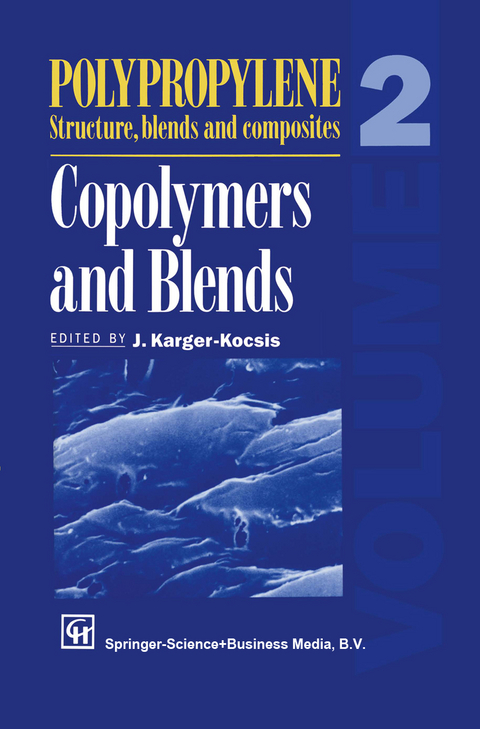
Polypropylene Structure, blends and Composites
Volume 2 Copolymers and Blends
Seiten
2012
|
Softcover reprint of the original 1st ed. 1995
Springer (Verlag)
978-94-010-4232-1 (ISBN)
Springer (Verlag)
978-94-010-4232-1 (ISBN)
Although polypropylene has been marketed since the 1950s, research and development in this area is still vigorous. The consumption of polypropylene over the years has been relatively high, mainly due to the steady improvement of its property profile. Polypropylene: Structures, Blends and Composites, in three separate volumes, reflects on the key factors which have contributed to the success of polypropylene, dealing with all aspects of structure-performance relationships relevant to thermoplastic polymers and related composites.
Volume 1, Structure and Morphology, deals with polymorphism in polypropylene homo- and copolymers, where molecular and supermolecular structures are covered, and the processing-induced structure development of polypropylene, showing the interrelation between the processing-induced morphology and mechanical performance.
Volume 2, Copolymers and Blends, contains comprehensive surveys of the nucleation and crystallisation behaviour of the related systems. It includes the development of morphology and its effects on rheological and mechanical properties of polypropylene-based alloys and blends and a review of polypropylene-based thermoplastic elastomers.
Volume 3, Composites, gives a comprehensive overview of filled and reinforced systems with polypropylene as a matrix material, with the main emphasis on processing-structure-property-interrelationships. Chapters cover all aspects of particulate filled, chopped fibre-, fibre mat- and continuous fibre-reinforced composites. Interfacial phenomena, such as adhesion, wetting and interfacial crystallisation, are also included as important aspects of this subject.
Volume 1, Structure and Morphology, deals with polymorphism in polypropylene homo- and copolymers, where molecular and supermolecular structures are covered, and the processing-induced structure development of polypropylene, showing the interrelation between the processing-induced morphology and mechanical performance.
Volume 2, Copolymers and Blends, contains comprehensive surveys of the nucleation and crystallisation behaviour of the related systems. It includes the development of morphology and its effects on rheological and mechanical properties of polypropylene-based alloys and blends and a review of polypropylene-based thermoplastic elastomers.
Volume 3, Composites, gives a comprehensive overview of filled and reinforced systems with polypropylene as a matrix material, with the main emphasis on processing-structure-property-interrelationships. Chapters cover all aspects of particulate filled, chopped fibre-, fibre mat- and continuous fibre-reinforced composites. Interfacial phenomena, such as adhesion, wetting and interfacial crystallisation, are also included as important aspects of this subject.
1. Manufacturing and properties of polypropylene copolymers.- 2. Primary spherulite nucleation in polypropylene-based blends and copolymers.- 3. Polypropylene alloys and blends with thermoplastics.- 4. Structure and properties of polypropylene—elastomer blends.- 5. Oriental drawing of polypropylene and its blends.- 6. Thermoplastic elastomers by blending and dynamic vulcanization.
| Zusatzinfo | XIII, 205 p. |
|---|---|
| Verlagsort | Dordrecht |
| Sprache | englisch |
| Maße | 155 x 235 mm |
| Themenwelt | Naturwissenschaften ► Chemie ► Organische Chemie |
| Naturwissenschaften ► Chemie ► Technische Chemie | |
| Technik ► Maschinenbau | |
| Technik ► Umwelttechnik / Biotechnologie | |
| ISBN-10 | 94-010-4232-2 / 9401042322 |
| ISBN-13 | 978-94-010-4232-1 / 9789401042321 |
| Zustand | Neuware |
| Informationen gemäß Produktsicherheitsverordnung (GPSR) | |
| Haben Sie eine Frage zum Produkt? |
Mehr entdecken
aus dem Bereich

aus dem Bereich


