


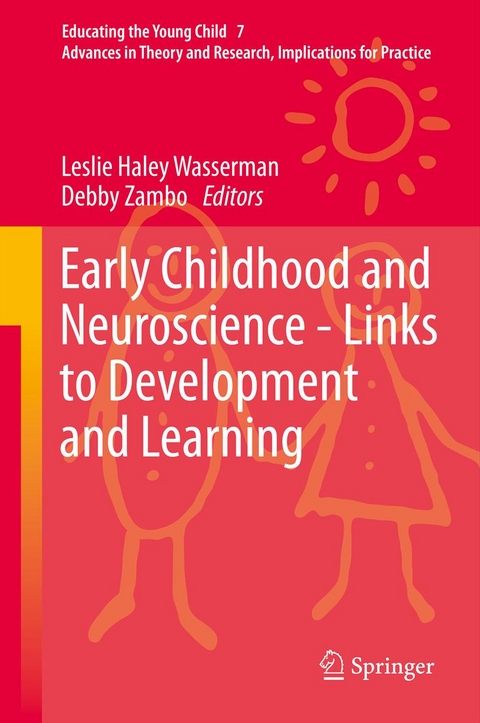
Early Childhood and Neuroscience - Links to Development and Learning (eBook)
XII, 220 Seiten
Springer Netherland (Verlag)
978-94-007-6671-6 (ISBN)
Information from neuroscience is growing and being properly used, and misused wich makes it imperative that educators receive accurate and practical information. This book provides the accurate and practical information educators (pre-service and in-service) and caregivers serving children birth through age 8 need to know. This volume takes a practical and cautionary stance. It reminds educators to consider the ethical implications of neuroscience when it is applied to education, reviews current findings from neuroscience and reveals the dangers of oversimplification and inappropriate extensions of neuroscience into curricula. It brings together a group of authors with varied expertise writing on an array of inter-related educational topics that will help educators use neuroscience to understand and address the cognitive, emotional, social, and behavioral needs of all young children, including those with exceptionalities. They believe neuroscience can be insightful and useful to educators if applied ethically and with care. The book offers strategies educators and caregivers can use to affect children today and the adults they can become.
Information from neuroscience is growing and being properly used, and misused wich makes it imperative that educators receive accurate and practical information. This book provides the accurate and practical information educators (pre-service and in-service) and caregivers serving children birth through age 8 need to know. This volume takes a practical and cautionary stance. It reminds educators to consider the ethical implications of neuroscience when it is applied to education, reviews current findings from neuroscience and reveals the dangers of oversimplification and inappropriate extensions of neuroscience into curricula. It brings together a group of authors with varied expertise writing on an array of inter-related educational topics that will help educators use neuroscience to understand and address the cognitive, emotional, social, and behavioral needs of all young children, including those with exceptionalities. They believe neuroscience can be insightful and useful to educators if applied ethically and with care. The book offers strategies educators and caregivers can use to affect children today and the adults they can become.
Acknowledgements.- Preface; Layne Kalbfleisch.- Introduction; Leslie Haley Wasserman and Debby Zambo.- 1. The Practical and Ethical Concerns of Using Neuroscience to Teach Young Children and Help them Self-Regulate; Debby Zambo.- 2. Neuroscience: The Genesis of Our Individual Brain Strengths; Diane Connell and Jena VanStelten.- 3. Reading and the Young Brain; Nancy Frey and Douglas Fisher.- 4. Brain Development in Early Childhood: A Critical Analysis; Valeri Farmer-Dougan and Larry Alferink.- 5. Addressing the Affective Domain: What Neuroscience says about Social/Emotional Development in Early Childhood; William A. Mosier.- 6. Early Literacy Trends for Children Identified as At-Risk for School Failure: Are They Consistent with Contemporary Neuroscience and Learning Theory?; Rae Ann Hirsh.- 7. Brain Differences in Children with Autism and the Subsequent Impact this has on Learning; Diane Branson.- 8. The Twice Exceptional Young Learner; Leslie Haley Wasserman.- 9. Making a Case for Early Intervention: The Role of Developmental Neuroscience; Niamh Stack.- 10. Effective Strategies to Help Teachers Learn about Brain Development; Billie Enz and Jill Stamm.- 11. Metaphors of Developmental Process for Brain-Savvy Teachers; George Hruby.- Closing Thoughts: Remaining Optimistic, Cautious and Active; Debby Zambo and Leslie Haley Wasserman.
| Erscheint lt. Verlag | 3.6.2013 |
|---|---|
| Reihe/Serie | Educating the Young Child | Educating the Young Child |
| Zusatzinfo | XII, 220 p. |
| Verlagsort | Dordrecht |
| Sprache | englisch |
| Themenwelt | Geisteswissenschaften ► Psychologie ► Entwicklungspsychologie |
| Geisteswissenschaften ► Psychologie ► Pädagogische Psychologie | |
| Medizin / Pharmazie | |
| Naturwissenschaften ► Biologie ► Humanbiologie | |
| Naturwissenschaften ► Biologie ► Zoologie | |
| Sozialwissenschaften ► Pädagogik ► Vorschulpädagogik | |
| Schlagworte | attention difficulties • Autism Spectrum Disorder (ASD) • brain-based learning • Brain Development • Childhood Education • critical/sensitive periods • DEV • developmental systems • early childhood and neuroscience • early childhood inclusion • ethics of neuroscience • Gifted and Talented • Human Capital • Learning and Instruction • mind-brain education • Multiple intelligences • Neural development |
| ISBN-10 | 94-007-6671-8 / 9400766718 |
| ISBN-13 | 978-94-007-6671-6 / 9789400766716 |
| Informationen gemäß Produktsicherheitsverordnung (GPSR) | |
| Haben Sie eine Frage zum Produkt? |
 PDF (Wasserzeichen)
DRM: Digitales Wasserzeichen
Dieses eBook enthält ein digitales Wasserzeichen und ist damit für Sie personalisiert. Bei einer missbräuchlichen Weitergabe des eBooks an Dritte ist eine Rückverfolgung an die Quelle möglich.
Dateiformat: PDF (Portable Document Format)
Mit einem festen Seitenlayout eignet sich die PDF besonders für Fachbücher mit Spalten, Tabellen und Abbildungen. Eine PDF kann auf fast allen Geräten angezeigt werden, ist aber für kleine Displays (Smartphone, eReader) nur eingeschränkt geeignet.
Systemvoraussetzungen:
PC/Mac: Mit einem PC oder Mac können Sie dieses eBook lesen. Sie benötigen dafür einen PDF-Viewer - z.B. den Adobe Reader oder Adobe Digital Editions.
eReader: Dieses eBook kann mit (fast) allen eBook-Readern gelesen werden. Mit dem amazon-Kindle ist es aber nicht kompatibel.
Smartphone/Tablet: Egal ob Apple oder Android, dieses eBook können Sie lesen. Sie benötigen dafür einen PDF-Viewer - z.B. die kostenlose Adobe Digital Editions-App.
Buying eBooks from abroad
For tax law reasons we can sell eBooks just within Germany and Switzerland. Regrettably we cannot fulfill eBook-orders from other countries.
aus dem Bereich


