


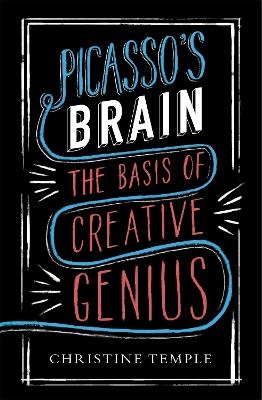
Picasso's Brain
The basis of creative genius
Seiten
2016
Robinson (Verlag)
978-1-78033-428-8 (ISBN)
Robinson (Verlag)
978-1-78033-428-8 (ISBN)
A fascinating study of the factors that contribute to creative genius from an eminent neuropsychologist, using Pablo Picasso as our case study
Where does creativity come from? Why are some people more creative than others?
Eminent neuropsychologist Christine Temple navigates a wide range of factors from the hard science (visual memory, spatial ability, brain functions) to the environmental (the 'mad genius' myth, and Gladwell's 10,000 hours of practice) in her study of what contributes to creativity.
Using Pablo Picasso as her model of a creative genius, she weighs up each theory as it applies to Picasso and shows how his own creativity came from a combination of many factors.
In this book, she looks at Picasso's playful mindset and passionate relationships, investigates the possibility that genius is genetic and can be inherited in families, considers whether creative genii perceive the world in a different way, and determines whether single-mindedness and focus play a part. This is the first book to look at a multitude of traits in creativity, and nail down the key factors that matter (and also which ones don't) to provide an overall picture of this fascinating area, linking the science to the personal.
Where does creativity come from? Why are some people more creative than others?
Eminent neuropsychologist Christine Temple navigates a wide range of factors from the hard science (visual memory, spatial ability, brain functions) to the environmental (the 'mad genius' myth, and Gladwell's 10,000 hours of practice) in her study of what contributes to creativity.
Using Pablo Picasso as her model of a creative genius, she weighs up each theory as it applies to Picasso and shows how his own creativity came from a combination of many factors.
In this book, she looks at Picasso's playful mindset and passionate relationships, investigates the possibility that genius is genetic and can be inherited in families, considers whether creative genii perceive the world in a different way, and determines whether single-mindedness and focus play a part. This is the first book to look at a multitude of traits in creativity, and nail down the key factors that matter (and also which ones don't) to provide an overall picture of this fascinating area, linking the science to the personal.
Christine Temple was a respected neuroscientist, who had worked at Oxford, London and was the Founding Professor and first Head of the Department of Psychology at Essex University. At 33, she was the youngest-ever holder of a UK Chair in Psychology. She was instrumental in the emergence of the field of developmental cognitive neuropsychology, and had published widely. More recently, she has been pro-vice chancellor at Essex University. This book grew from both her psychological research interests and her passion for art - she was a collector of Picasso prints. Christine died in October 2014, aged 56.
| Erscheint lt. Verlag | 8.12.2016 |
|---|---|
| Zusatzinfo | tbc |
| Verlagsort | London |
| Sprache | englisch |
| Maße | 150 x 232 mm |
| Gewicht | 380 g |
| Themenwelt | Sachbuch/Ratgeber ► Gesundheit / Leben / Psychologie ► Psychologie |
| Naturwissenschaften ► Biologie ► Humanbiologie | |
| Naturwissenschaften ► Biologie ► Zoologie | |
| ISBN-10 | 1-78033-428-1 / 1780334281 |
| ISBN-13 | 978-1-78033-428-8 / 9781780334288 |
| Zustand | Neuware |
| Informationen gemäß Produktsicherheitsverordnung (GPSR) | |
| Haben Sie eine Frage zum Produkt? |
Mehr entdecken
aus dem Bereich


aus dem Bereich
Buch | Softcover (2021)
Kohlhammer (Verlag)
CHF 39,95
Spektrum, Ursachen, Diagnose, Therapie und Beratung
Buch | Softcover (2024)
Kohlhammer (Verlag)
CHF 39,95
Imagery Rescripting & Reprocessing Therapy bei Traumafolgestörungen, …
Buch | Softcover (2025)
Klett-Cotta (Verlag)
CHF 76,95


