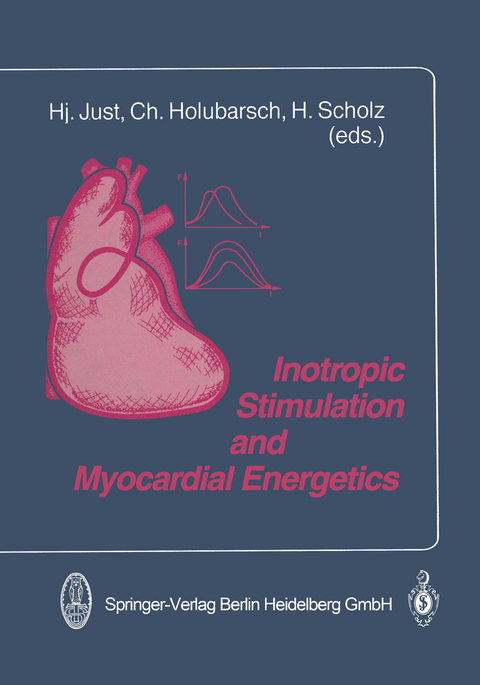
Inotropic Stimulation and Myocardial Energetics
Steinkopff (Verlag)
978-3-662-07910-2 (ISBN)
Introduction: Mechanisms of positive inotropic effects.- Adrenoceptors in myocardial regulation: concomitant contribution from both Alpha- and betaadrenoceptor stimulation to the inotropic response.- Studies on the cellular mechanisms of action of positive and negative inotropic agents.- On the mechanism of positive inotropic effects of alpha-adrenoceptor agonists.- Cytosolic sodium concentration regulates contractility of cardiac muscle.- Energy requirements of contraction and relaxation: implications for inotropic stimulation of the failing heart.- Genetic and non-genetic control of myocardial calcium.- Regulation of force and intracellular calcium transients by cyclic AMP generated by forskolin, MDL 17,043 and isoprenaline, and its modulation by muscarinic receptor agents: a novel mechanism for accentuated antagonism.- Studies on the mechanism of action of the bipyridine milrinone on the heart.- Ca-Agonists: a new class of inotropic drugs.- Myofibrillar Ca++ activation and heart failure - Ca++ sensitization by the cardiotonic agent APP 201-533.- Positive inotropic stimulation in the normal and insufficient human myocardium.- Do human cardiac beta-2 adrenoceptors play a (patho)physiological role in regulation of heart rate and/or contractility?.- Influence of isoproterenol on myocardial energetics. Experimental and clinical investigations.- Effects of long-term xamoterol therapy on the left ventricular mechanical efficiency in patients with ischemic heart disease.- Modulation of the autonomic control of the failing heart.- Dopexamine in congestive heart failure: how do the pharmacological activities translate into the clinical situation?.- The use of levodopa, an oral dopamine precursor, in congestive heart failure.- Clinical relevance of long-term therapy withlevodopa and orally active dopamine analogues in patients with chronic congestive heart failure.- Cardiovascular effects of forskolin and phosphodiesterase-III inhibitors.- Phosphodiesterase inhibitors: alterations in systemic and coronary hemodynamics.- Influence of the calcium-sensitizer UDCG-115 on hemodynamics and myocardial energetics in patients with idiopathic dilated cardiomyopathy. Comparison with nitroprusside.- Myocardial energetics: experimental and clinical studies to address its determinants and aerobic limit.- Use of a conductance catheter to detect increased left ventricular inotropic state by end-systolic pressure-volume analysis.- Separation between vasodilation and positive inotropism by assessment of myocardial energetics in patients with dilated cardiomyopathy.
| Erscheint lt. Verlag | 28.12.2012 |
|---|---|
| Zusatzinfo | IX, 273 p. 29 illus. |
| Verlagsort | Heidelberg |
| Sprache | englisch |
| Gewicht | 494 g |
| Themenwelt | Medizinische Fachgebiete ► Innere Medizin ► Kardiologie / Angiologie |
| Studium ► 1. Studienabschnitt (Vorklinik) ► Physiologie | |
| Naturwissenschaften ► Biologie ► Humanbiologie | |
| Schlagworte | Arrhythmia • heart • Heart Failure • Hydra • Metabolism |
| ISBN-10 | 3-662-07910-0 / 3662079100 |
| ISBN-13 | 978-3-662-07910-2 / 9783662079102 |
| Zustand | Neuware |
| Informationen gemäß Produktsicherheitsverordnung (GPSR) | |
| Haben Sie eine Frage zum Produkt? |
aus dem Bereich