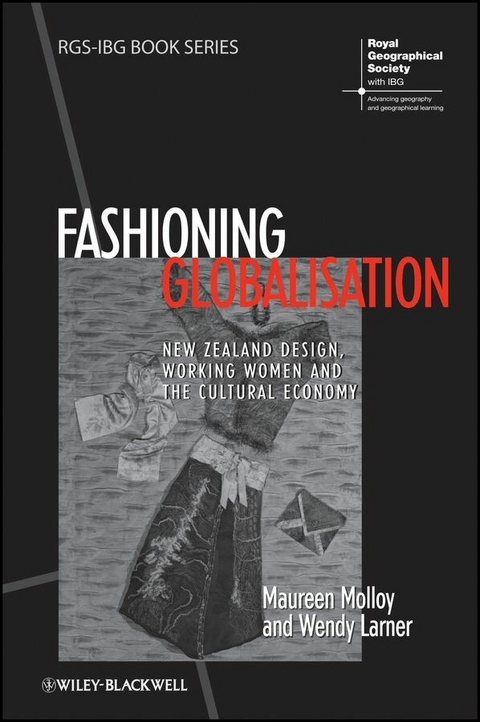
Fashioning Globalisation (eBook)
John Wiley & Sons (Verlag)
978-1-118-29577-9 (ISBN)
- A major conceptual contribution to the literatures on globalisation, fashion and gender, analysing the ways in which women’s entry into the labour force over the past thirty years in the developed world has underpinned new forms of aestheticised production and consumption as well as the growth of ‘work-style’ businesses
- A vital contribution to the burgeoning literature on culture and creative industries which often ignores the significant roles taken by women as entrepreneurs and designers rather than mere consumers
- Introduces fashion scholars and economic geographers to a paradigmatic example of the new designer fashion industries emerging in a range of countries not traditionally associated with fashion
Takes a fresh perspective on an industry in which Third World garment workers have been the subject of exhaustive analysis but first world women have been largely ignored
Maureen Molloy is Professor of Women’s Studies at the University of Auckland. Her work has focused on the relationships between academic ideas, policy contexts, and popular culture. Her most recent book is On Creating a Usable Culture: Margaret Mead and the Origins of American Cosmopolitanism (2008).
Wendy Larner is Professor of Human Geography and Sociology at the University of Bristol, UK. She is internationally recognized for her innovative scholarship on globalization, neoliberalism and governance, and has published in a wide range of international journals, and edited books across the social sciences. She is an Honorary Fellow of the Royal Society of New Zealand and an Academician of the UK’s Academy of Social Sciences.
Drastic changes in the career aspirations of women in the developed world have resulted in a new, globalised market for off-the-peg designer clothes created by independent artisans. This book reports on a phenomenon that seems to exemplify the twin imperatives of globalisation and female emancipation. A major conceptual contribution to the literatures on globalisation, fashion and gender, analysing the ways in which women s entry into the labour force over the past thirty years in the developed world has underpinned new forms of aestheticised production and consumption as well as the growth of work-style businesses A vital contribution to the burgeoning literature on culture and creative industries which often ignores the significant roles taken by women as entrepreneurs and designers rather than mere consumers Introduces fashion scholars and economic geographers to a paradigmatic example of the new designer fashion industries emerging in a range of countries not traditionally associated with fashion Takes a fresh perspective on an industry in which Third World garment workers have been the subject of exhaustive analysis but first world women have been largely ignored
Maureen Molloy is Professor of Women's Studies at the University of Auckland. Her work has focused on the relationships between academic ideas, policy contexts, and popular culture. Her most recent book is On Creating a Usable Culture: Margaret Mead and the Origins of American Cosmopolitanism (2008). Wendy Larner is Professor of Human Geography and Sociology at the University of Bristol, UK. She is internationally recognized for her innovative scholarship on globalization, neoliberalism and governance, and has published in a wide range of international journals, and edited books across the social sciences. She is an Honorary Fellow of the Royal Society of New Zealand and an Academician of the UK's Academy of Social Sciences.
List of Figures and Credits ix
Preface xi
Series Editors' Preface xiv
Acknowledgements xv
1 What We Saw and Why We Started this Project 1
2 Global Aspirations: Theorising the New Zealand Designer Fashion Industry 19
3 Policy for a New Economy: 'After Neoliberalism' and the Designer Fashion Industry 43
with Richard Le Heron and Nick Lewis
4 Cultivating Urbanity: Fashion in a Not-so-global City 69
with Alison Goodrum
5 Gendering the 'Virtuous Circle': Production, Mediation and Consumption in the Cultural Economy 99
6 Creating Global Subjects: The Pedagogy of Fashionability 125
7 Lifestyle or Workstyle? Female Entrepreneurs in New Zealand Designer Fashion 153
8 Conclusion: An Unlikely Success Story? 179
Index 191
"Fashioning Globalisationprovides a comprehensive and fascinating view of an industry which provides new insights into the ways in which globalization proceeds and provides an alternative and authoritative account of the role of the fashion design industry in a globalising world." (New Zealand Geographer, 24 April 2015)
'This is a wonderful and timely contribution to fashion
scholarship and to cultural geography and sociology. The authors
produce a highly original and meticulously researched account of
the entrepreneurial activities of women fashion designer in New
Zealand while also raising many issues about work and employment in
this sector as a whole.'--Angela McRobbie,
Professor of Communications, Goldsmiths, University of London,
UK
'In this path breaking book, Molloy and Larner weave a
theoretically sophisticated and empirically rich account of gender
and globalisation that captures the diverse forms of embodied
subjectivity and work that characterise the global fashion
industry. While previous studies of fashion emphasise first world
consumers and third world workers, Molloy and Larner illustrate how
globalisation has impacted the lives of female fashion designers in
New Zealand, giving rise to new possibilities as well as
constraints. They present a fascinating account of how a
female-dominated creative industry gained a high profile within
neoliberal policy-making circles in New Zealand, a story that
illuminates the impossibility of separating the material and the
symbolic, economy and culture, and production and consumption in an
understanding of globalisation.'--Deborah
Leslie, Professor of Geography, University of Toronto,
Canada
| Erscheint lt. Verlag | 20.6.2013 |
|---|---|
| Reihe/Serie | RGS-IBG Book Series | RGS-IBG Book Series |
| Sprache | englisch |
| Themenwelt | Naturwissenschaften ► Geowissenschaften ► Geografie / Kartografie |
| Sozialwissenschaften ► Politik / Verwaltung | |
| Sozialwissenschaften ► Soziologie ► Makrosoziologie | |
| Wirtschaft | |
| Schlagworte | Creative Cities • culture and creative industries • economic geographers • fashion and gender • Fashion Industry • fashion scholars • Fashion Studies • garment industry • Geographie • Geography • globalisation and female emancipation • labour force • off-the-peg designer clothes • Social & Cultural Geography • Sociology • Sociology of Organizations & Work • Soziologie • Soziologie am Arbeitsplatz • Sozio- u. Kulturgeographie • sweat shops • Third World garment workers • women designers • Women entrepreneurs |
| ISBN-10 | 1-118-29577-3 / 1118295773 |
| ISBN-13 | 978-1-118-29577-9 / 9781118295779 |
| Informationen gemäß Produktsicherheitsverordnung (GPSR) | |
| Haben Sie eine Frage zum Produkt? |
 EPUB (Adobe DRM)
Größe: 1,4 MB
Kopierschutz: Adobe-DRM
Adobe-DRM ist ein Kopierschutz, der das eBook vor Mißbrauch schützen soll. Dabei wird das eBook bereits beim Download auf Ihre persönliche Adobe-ID autorisiert. Lesen können Sie das eBook dann nur auf den Geräten, welche ebenfalls auf Ihre Adobe-ID registriert sind.
Details zum Adobe-DRM
Dateiformat: EPUB (Electronic Publication)
EPUB ist ein offener Standard für eBooks und eignet sich besonders zur Darstellung von Belletristik und Sachbüchern. Der Fließtext wird dynamisch an die Display- und Schriftgröße angepasst. Auch für mobile Lesegeräte ist EPUB daher gut geeignet.
Systemvoraussetzungen:
PC/Mac: Mit einem PC oder Mac können Sie dieses eBook lesen. Sie benötigen eine
eReader: Dieses eBook kann mit (fast) allen eBook-Readern gelesen werden. Mit dem amazon-Kindle ist es aber nicht kompatibel.
Smartphone/Tablet: Egal ob Apple oder Android, dieses eBook können Sie lesen. Sie benötigen eine
Geräteliste und zusätzliche Hinweise
Buying eBooks from abroad
For tax law reasons we can sell eBooks just within Germany and Switzerland. Regrettably we cannot fulfill eBook-orders from other countries.
 PDF (Adobe DRM)
Kopierschutz: Adobe-DRM
Adobe-DRM ist ein Kopierschutz, der das eBook vor Mißbrauch schützen soll. Dabei wird das eBook bereits beim Download auf Ihre persönliche Adobe-ID autorisiert. Lesen können Sie das eBook dann nur auf den Geräten, welche ebenfalls auf Ihre Adobe-ID registriert sind.
Details zum Adobe-DRM
Dateiformat: PDF (Portable Document Format)
Mit einem festen Seitenlayout eignet sich die PDF besonders für Fachbücher mit Spalten, Tabellen und Abbildungen. Eine PDF kann auf fast allen Geräten angezeigt werden, ist aber für kleine Displays (Smartphone, eReader) nur eingeschränkt geeignet.
Systemvoraussetzungen:
PC/Mac: Mit einem PC oder Mac können Sie dieses eBook lesen. Sie benötigen eine
eReader: Dieses eBook kann mit (fast) allen eBook-Readern gelesen werden. Mit dem amazon-Kindle ist es aber nicht kompatibel.
Smartphone/Tablet: Egal ob Apple oder Android, dieses eBook können Sie lesen. Sie benötigen eine
Geräteliste und zusätzliche Hinweise
Buying eBooks from abroad
For tax law reasons we can sell eBooks just within Germany and Switzerland. Regrettably we cannot fulfill eBook-orders from other countries.
aus dem Bereich