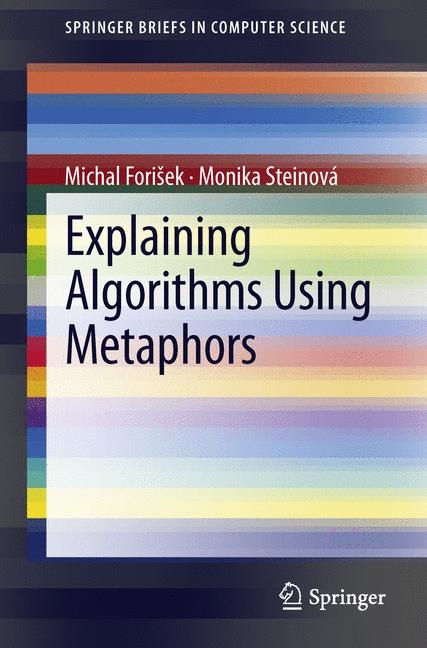
Explaining Algorithms Using Metaphors (eBook)
X, 94 Seiten
Springer London (Verlag)
978-1-4471-5019-0 (ISBN)
There is a significant difference between designing a new algorithm, proving its correctness, and teaching it to an audience. When teaching algorithms, the teacher's main goal should be to convey the underlying ideas and to help the students form correct mental models related to the algorithm. This process can often be facilitated by using suitable metaphors. This work provides a set of novel metaphors identified and developed as suitable tools for teaching many of the 'classic textbook' algorithms taught in undergraduate courses worldwide. Each chapter provides exercises and didactic notes for teachers based on the authors' experiences when using the metaphor in a classroom setting.
There is a significant difference between designing a new algorithm, proving its correctness, and teaching it to an audience. When teaching algorithms, the teacher's main goal should be to convey the underlying ideas and to help the students form correct mental models related to the algorithm. This process can often be facilitated by using suitable metaphors. This work provides a set of novel metaphors identified and developed as suitable tools for teaching many of the "e;classic textbook"e; algorithms taught in undergraduate courses worldwide. Each chapter provides exercises and didactic notes for teachers based on the authors' experiences when using the metaphor in a classroom setting.
IntroductionGraph AlgorithmsComputational GeometryStrings and SequencesSolutions to Exercises
| Erscheint lt. Verlag | 9.4.2013 |
|---|---|
| Reihe/Serie | SpringerBriefs in Computer Science | SpringerBriefs in Computer Science |
| Zusatzinfo | X, 94 p. 59 illus. |
| Verlagsort | London |
| Sprache | englisch |
| Themenwelt | Schulbuch / Wörterbuch ► Unterrichtsvorbereitung ► Unterrichts-Handreichungen |
| Mathematik / Informatik ► Informatik | |
| Naturwissenschaften | |
| Sozialwissenschaften ► Pädagogik | |
| Schlagworte | algorithms • Analogies • mental models • metaphors • Physics Analogies • Teaching Algorithms |
| ISBN-10 | 1-4471-5019-8 / 1447150198 |
| ISBN-13 | 978-1-4471-5019-0 / 9781447150190 |
| Informationen gemäß Produktsicherheitsverordnung (GPSR) | |
| Haben Sie eine Frage zum Produkt? |
 PDF (Wasserzeichen)
DRM: Digitales Wasserzeichen
Dieses eBook enthält ein digitales Wasserzeichen und ist damit für Sie personalisiert. Bei einer missbräuchlichen Weitergabe des eBooks an Dritte ist eine Rückverfolgung an die Quelle möglich.
Dateiformat: PDF (Portable Document Format)
Mit einem festen Seitenlayout eignet sich die PDF besonders für Fachbücher mit Spalten, Tabellen und Abbildungen. Eine PDF kann auf fast allen Geräten angezeigt werden, ist aber für kleine Displays (Smartphone, eReader) nur eingeschränkt geeignet.
Systemvoraussetzungen:
PC/Mac: Mit einem PC oder Mac können Sie dieses eBook lesen. Sie benötigen dafür einen PDF-Viewer - z.B. den Adobe Reader oder Adobe Digital Editions.
eReader: Dieses eBook kann mit (fast) allen eBook-Readern gelesen werden. Mit dem amazon-Kindle ist es aber nicht kompatibel.
Smartphone/Tablet: Egal ob Apple oder Android, dieses eBook können Sie lesen. Sie benötigen dafür einen PDF-Viewer - z.B. die kostenlose Adobe Digital Editions-App.
Buying eBooks from abroad
For tax law reasons we can sell eBooks just within Germany and Switzerland. Regrettably we cannot fulfill eBook-orders from other countries.
aus dem Bereich