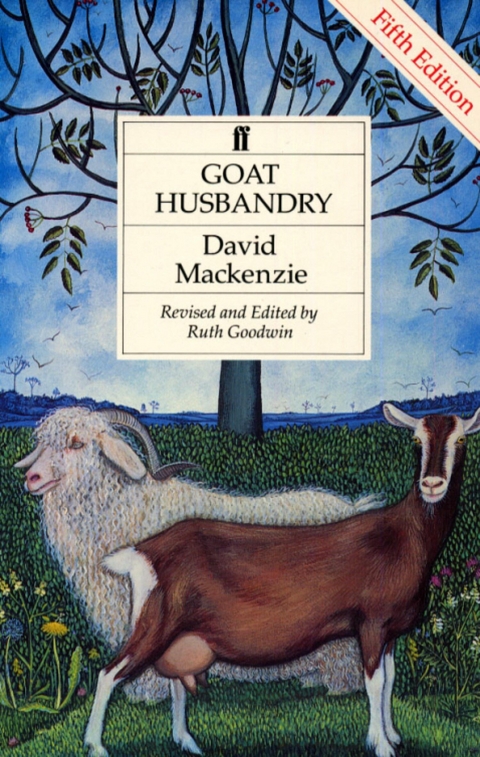
Goat Husbandry (eBook)
200 Seiten
Faber & Faber (Verlag)
978-0-571-26585-5 (ISBN)
David MacKenzie
This is a book every goat-keeper should have. The latest edition has been extensively revised by Ruth Goodwin, a well-known expert, to reflect the changes in the goat-keeping world since publication of the previous edition. She has incorporated her revisions with great skill without losing the character of what is a classic work.
When man began his farming operations in the dawn of history, the goat was the kingpin of the pastoral life, making possible the conquest of desert and mountain and the occupation of the fertile land that lay beyond. The first of man’s domestic animals to colonize the wilderness, the goat is the last to abandon the deserts that man leaves behind him. For ever the friend of the pioneer and the last survivor, the goat was never well loved by arable farmers on fertile land. When agriculture produces crops that man, cow and sheep can consume with more profit, the goat retreats to the mountain tops and the wilderness, rejected and despised – hated too, as the emblem of anarchy.
During the last hundred years much has been done to improve the productivity of goats in Northern Europe, North America and Australia, where the modern dairy goat can convert the best of pastures and fodder crops into milk as efficiently as the modern dairy cow. Like most small production units, the goat is expensive with labour, but in its use of raw materials it rivals the cow, even when the raw materials are those best suited to the cows’ requirements.
In developing countries, where there is normally an embarrassing surplus of suitable labour, the high labour requirement of goat dairying is a social virtue. If the land be arid or mountainous, the goat may prove to be the only economic source of milk. The authors of national development plans and international aid projects are not so starry-eyed today as they were ten years ago; the cow dairy farm in the desert and the steel mill in the jungle are giving way to reality and goat improvement schemes.
In the advanced countries, medical research has been discreetly lifting the lid off the consequences of our peculiar practice of snatching the newborn infant from its mother’s breast and fostering it on the first available cow. The consequences may be grim, or may persist throughout life, unless goats’ milk comes to the rescue. In Britain and the USA there is a growing demand for goats’ milk for therapeutic use, which cannot afford to be deterred by the higher labour costs of goats’-milk production.
Unfortunately, this new resurgence of interest in goat dairying may, in the present state of goat breeding, wreak havoc. The last great resurgence of goatkeeping met the wartime challenge of food shortage, and culminated, in 1949, in the legal black market in dairy produce. From that date we mark a steady decline in the quality of the yields of pedigree goats in Britain, a decline which still continues. The new goatkeepers of 1949 were taught to feed their goats as miniature cows, and proceeded to breed them selectively for their response to this feeding. With honourable exceptions, the goat breeders of 1965 maintained this destructive tradition. An expansion of goat breeding within this tradition can only result in establishing a strain of goats which do, in fact, perform like miniature cows. A good cow, miniaturized to goat size, could produce no more than 6 pints a day on the best feeding. A good goat can produce twice as much.
The relationship between size and efficiency in all productive farm animals is so well established in both theory and practice that, when confronted with the performance of the modern dairy goat, the nutritional scientist and the farmer tend to regard it as a somewhat indecent Act of God, unrelated to His regular arrangements. For the rule is adamant: provided the feeding is sufficient, the big animal must outyield the little one; the big one has a smaller surface area in proportion to its bulk and potential food capacity, and so uses less of its food to keep itself warm and more to make meat or milk. Friesians replace Ayrshires as pastures are improved; low-ground sheep are bigger than mountain breeds; every beast, ideally, is as big as its pasture permits. But fifteen 1-cwt [50·8 kg] goats will make rather more milk out of the ration of a 15-cwt [762 kg] Friesian cow than the cow can. Yet the rule is unbroken; for it applies only between animals of the same species: a kind Providence has decreed that goats are very far from being miniature cows.
A goat, however ‘modern’ and ‘dairy-bred’, is a goat, a member of the species familiarized in nursery picture books and biblical illustrations, target of laughter and abuse for countless centuries, Crusoe’s salvation and mankind’s first foster mother, the Common Goat.
The processes of history have greatly reduced the goat in Britain; agricultural textbooks have exiled the hardy ruffians for half a century; scientists have used the modern dairy goat as an expendable model cow, but done little to investigate the basic attributes of the goat as such. The purpose of this book is to drag this half-mythical creature out into the light of present-day animal husbandry, that we may know it, use it and care for it more effectively.
We must begin by evicting from our minds the false analogies between goat and cow and between goat and sheep. We can hardly do better than refer back to Thomas Bewick’s History of Quadrupeds, published at the beginning of the nineteenth century, when the Common Goat was still common in Britain.
This lively, playful and capricious creature occupies the next place in the great scale of nature; and though inferior to the sheep in value, in various instances bears a strong affinity to that useful animal.
The Goat is much more hardy than the sheep, and is in every respect more fitted to a life of liberty. It is not easily confined to a flock, but chooses its own pasture, straying wherever its appetite or inclination leads. It chiefly delights in wild and mountainous regions, climbing the loftiest rocks and standing secure on the verge of inaccessible and dangerous precipices; although, as Ray observes, one would hardly expect that their feet were adapted to such perilous achievements; yet, upon nearer inspection we find that Nature has provided them with hoofs well calculated for the purpose of climbing; they are hollow underneath, with sharp edges like the inside of a spoon, which prevent them from sliding off the rocky eminences they frequent.
The Goat is an animal easily sustained, and is therefore chiefly the property of those who inhabit wild and uncultivated regions, where it finds an ample supply of food from the spontaneous production of nature, in situations inaccessible to other quadrupeds. It delights in the healthy mountain or the shrubby rock, rather than the fields cultivated by human industry. Its favourite food is the tops of the boughs or the tender bark of young trees. It bears a warm climate better than the sheep, and frequently sleeps exposed to the hottest rays of the sun.
The milk of the Goats is sweet, nourishing and medicinal, and is found highly beneficial in consumptive cases; it is not so apt to curdle on the stomach as that of the Cow. From the shrubs and heath on which it feeds, the milk of the Goat acquires a flavour and wildness of taste very different from that of the Sheep or Cow, and is highly pleasing to such as have accustomed themselves to its use; it is made into whey for those whose digestion is too weak to bear it in its primitive state. Several places in the North of England and in the mountainous parts of Scotland are much resorted to for the purpose of drinking the milk of the Goat; and its effects have been often salutary in vitiated and debilitated habits.
In many parts of Ireland and in the Highlands of Scotland, their Goats make the chief possessions of the inhabitants; and in most of the mountainous parts of Europe supply the natives with many of the necessaries of life: they lie upon beds made of their skins, which are soft, clean and wholesome; they live upon their milk and oat bread; they convert part of it into butter and some into cheese. The flesh of the Kid is considered as a great delicacy; and when properly prepared is esteemed by some as little inferior to venison.
The Goat produces generally two young at a time, sometimes three, rarely four; in warmer climates it is more prolific and produces four or five at once. The male is capable of propagating at one year old and the female at seven months; but the fruits of a generation so premature are generally weak and defective; their best time is at the age of two years or eighteen months at least.
The Goat is a short-lived animal, full of ardour, but soon enervated. His appetite for the female is excessive, so that one buck is sufficient for one hundred and fifty females.
Thomas Bewick’s account of the goat suffers little from the passage of nearly two hundred years. The wildness of taste which he attributes to goats’ milk can be tamed by dairy hygiene, mineral supplement and surgical operation, but many newcomers to goats’ milk can still catch his meaning. The resident population of the ‘wild and uncultivated regions’ has been eroded by hunger and administration, but the ‘healthy mountain and shrubby rock’ are still good dairy pastures for a goat. Bewick’s few paragraphs contain clues to the peculiarities of goat digestion, housing requirements, and control, and to the phenomenal productivity of the modern dairy goat.
In following up these clues in subsequent chapters, the assumption is that goat farming can and will develop into a considerable branch of agriculture. As such, goat farms must be mainly in the hands of established farmers with a general knowledge of crop and stock, and utter ignorance of goats. Such knowledge and ignorance is assumed; but a chapter on cropping for goats is included to help the domestic and small-scale goatkeeper in...
| Erscheint lt. Verlag | 20.10.2011 |
|---|---|
| Zusatzinfo | 18 black and white photographs, 22 figures and 13 tables |
| Verlagsort | London |
| Sprache | englisch |
| Themenwelt | Naturwissenschaften ► Biologie |
| Technik | |
| Weitere Fachgebiete ► Land- / Forstwirtschaft / Fischerei | |
| Schlagworte | animals • farming |
| ISBN-10 | 0-571-26585-5 / 0571265855 |
| ISBN-13 | 978-0-571-26585-5 / 9780571265855 |
| Informationen gemäß Produktsicherheitsverordnung (GPSR) | |
| Haben Sie eine Frage zum Produkt? |
 EPUB (Adobe DRM)
Kopierschutz: Adobe-DRM
Adobe-DRM ist ein Kopierschutz, der das eBook vor Mißbrauch schützen soll. Dabei wird das eBook bereits beim Download auf Ihre persönliche Adobe-ID autorisiert. Lesen können Sie das eBook dann nur auf den Geräten, welche ebenfalls auf Ihre Adobe-ID registriert sind.
Details zum Adobe-DRM
Dateiformat: EPUB (Electronic Publication)
EPUB ist ein offener Standard für eBooks und eignet sich besonders zur Darstellung von Belletristik und Sachbüchern. Der Fließtext wird dynamisch an die Display- und Schriftgröße angepasst. Auch für mobile Lesegeräte ist EPUB daher gut geeignet.
Systemvoraussetzungen:
PC/Mac: Mit einem PC oder Mac können Sie dieses eBook lesen. Sie benötigen eine
eReader: Dieses eBook kann mit (fast) allen eBook-Readern gelesen werden. Mit dem amazon-Kindle ist es aber nicht kompatibel.
Smartphone/Tablet: Egal ob Apple oder Android, dieses eBook können Sie lesen. Sie benötigen eine
Geräteliste und zusätzliche Hinweise
Buying eBooks from abroad
For tax law reasons we can sell eBooks just within Germany and Switzerland. Regrettably we cannot fulfill eBook-orders from other countries.
aus dem Bereich