


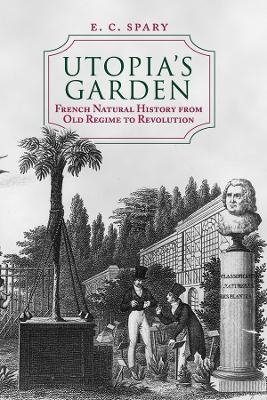
Utopia's Garden
French Natural History from Old Regime to Revolution
Seiten
2000
University of Chicago Press (Verlag)
978-0-226-76863-2 (ISBN)
University of Chicago Press (Verlag)
978-0-226-76863-2 (ISBN)
This work traces the scientific, administrative, and political strategies that enabled the foundation of the Museum d'Histoire Naturelle. It argues that agriculture and animal breeding rank alongside classification and collections in explaining why natural history was important for French rulers.
The royal Parisian botanical garden, the Jardin du Roi, was a jewel in the crown of the French Old Regime, praised by both rulers and scientific practitioners. Yet unlike many such institutions, the Jardin not only survived the French Revolution but by 1800 had become the world's leading public establishment of natural history: the Muséum d'Histoire Naturelle.
E. C. Spary traces the scientific, administrative, and political strategies that enabled the foundation of the Muséum, arguing that agriculture and animal breeding rank alongside classification and collections in explaining why natural history was important for French rulers. But the Muséum's success was also a consequence of its employees' Revolutionary rhetoric: by displaying the natural order, they suggested, the institution could assist in fashioning a self-educating, self-policing Republican people. Natural history was presented as an indispensable source of national prosperity and individual virtue.
Spary's fascinating account opens a new chapter in the history of France, science, and the Enlightenment.
The royal Parisian botanical garden, the Jardin du Roi, was a jewel in the crown of the French Old Regime, praised by both rulers and scientific practitioners. Yet unlike many such institutions, the Jardin not only survived the French Revolution but by 1800 had become the world's leading public establishment of natural history: the Muséum d'Histoire Naturelle.
E. C. Spary traces the scientific, administrative, and political strategies that enabled the foundation of the Muséum, arguing that agriculture and animal breeding rank alongside classification and collections in explaining why natural history was important for French rulers. But the Muséum's success was also a consequence of its employees' Revolutionary rhetoric: by displaying the natural order, they suggested, the institution could assist in fashioning a self-educating, self-policing Republican people. Natural history was presented as an indispensable source of national prosperity and individual virtue.
Spary's fascinating account opens a new chapter in the history of France, science, and the Enlightenment.
E. C. Spary is a senior researcher at the Max Planck Institute for History of Science, Berlin, Germany. She is coeditor of Cultures of Natural History.
| Erscheint lt. Verlag | 15.12.2000 |
|---|---|
| Sprache | englisch |
| Maße | 17 x 23 mm |
| Gewicht | 539 g |
| Themenwelt | Sachbuch/Ratgeber ► Natur / Technik ► Natur / Ökologie |
| Geschichte ► Allgemeine Geschichte ► Neuzeit (bis 1918) | |
| Geisteswissenschaften ► Geschichte ► Regional- / Ländergeschichte | |
| Geschichte ► Teilgebiete der Geschichte ► Kulturgeschichte | |
| Naturwissenschaften | |
| ISBN-10 | 0-226-76863-5 / 0226768635 |
| ISBN-13 | 978-0-226-76863-2 / 9780226768632 |
| Zustand | Neuware |
| Informationen gemäß Produktsicherheitsverordnung (GPSR) | |
| Haben Sie eine Frage zum Produkt? |
Mehr entdecken
aus dem Bereich



aus dem Bereich
Geschichte einer wilden Handlung
Buch | Hardcover (2024)
C.H.Beck (Verlag)
CHF 47,60


