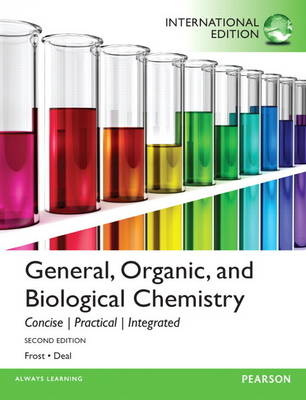
General, Organic and Biological Chemistry, plus MasteringChemistry with Pearson eText
Pearson Education Limited
978-1-4479-5428-6 (ISBN)
- Titel wird leider nicht erscheinen
- Artikel merken
Frost and Deal's General, Organic, and Biological Chemistry gives students a focused introduction to the fundamental and relevant connections between chemistry and life. Emphasizing the development of problem-solving skills with distinct Inquiry Questions and Activities, this text empowers students to solve problems in different and applied contexts relating to health and biochemistry. Integrated coverage of biochemical applications throughout keeps students interested in the material and allow for a more efficient progression through the topics.
Concise, practical, and integrated, Frost's streamlined approach offers students a clear path through the content. Applications throughout the narrative, the visual program, and problem-solving support in each chapter improve their retention of the concepts and skills as they master them. General, organic, and biological chemistry topics are integrated throughout each chapter to create a seamless framework that immediately relates chemistry to students' future allied health careers and their everyday lives.
MyLab and Mastering from Pearson improve results for students and educators. Used by over ten million students, they effectively engage learners at every stage.
With proven success, Mastering has helped students make strides in learning for over 10 years. MasteringChemistry has immersive content and tools that are so engaging that Ann Verner, at the University of Toronto Scarborough, Canada, said, "MasteringChemistry is the best online chemistry homework program that I have used. The structure of the questions and the hints motivate the students to continue working on the problems, and the immediate feedback increases their confidence."
With MasteringChemistry, students gain knowledge that they will use throughout their lives, and universities gain a partner deeply committed to helping students and educators achieve their goals.
For students
Pearson eText gives you access to an eBook that can be used on the go, and allows you to highlight, search and take notes as you read online. Access to the eBook depends on the package you have bought.
You can work through the problems at your own pace, opening hints if you need help. If you make an error, you are given feedback based on that specific mistake so you can learn from it.
PhET simulations let you to get hands on to understand how the theory and daily life link up. These fun, interactive, research-based simulations of physical phenomena come from the PhET (TM) project at the University of Colorado.
For educators
Online assignments, tests, quizzes can be easily created and assigned to students.
Gradebook: Assignments are automatically graded and visible at a glance.
Register now to benefit from these resources.
A student access code card is included with your textbook at a reduced cost. To register with your code, visit www.masteringchemistry.com.
For educator access, contact your Pearson account manager. To find out who your account manager is, visit www.pearsoned.co.uk/replocator
For more instructor resources available with this title, visit www.pearsoned.co.uk
Laura D. Frost is a Professor of Chemistry at Florida Gulf Coast University. She received her bachelor's degree in chemistry from Kutztown University and a Ph.D. in chemistry with a biophysical focus from the University of Pennsylvania. Professor Frost is actively engaged in the teaching and learning of chemistry and uses a guided inquiry approach in her classes. Dr. Frost is a member of the American Chemical Society and its Chemical Education division and the Biophysical Society. In 2007, she was honored with the Regent's Award for the Scholarship of Teaching and Learning by the University System of Georgia and was inducted into the Regent's Hall of Fame for Teaching Excellence. She is an advocate for increased student learning in science, technology, engineering, and mathematics (STEM) disciplines using guided inquiry and has spoken at numerous conferences and workshops on this topic. Todd S. Deal received his B.S. degree in chemistry in 1986 from Georgia Southern College (now University) in Statesboro, Georgia, and his Ph.D. in chemistry in 1990 from The Ohio State University. He joined the faculty of his undergraduate alma mater in 1992, where he currently serves as Director of the Office of Student Leadership and Civic Engagement. Professor Deal has taught chemistry to allied health and preprofessional students for 20 years. In 1994, he was selected Professor of the Year by the students at Georgia Southern University. Professor Deal is also the recipient of the Allen E. Paulson College of Science and Technology's Award for Excellence in Teaching (2003), the Georgia Southern University Award for Excellence in Contributions to Instruction (2003), and the Allen E. Paulson College of Science and Technology's Award for Excellence in Service (2006). Karen Timberlake is Professor Emerita of chemistry at Los Angeles Valley College, where she taught chemistry for allied health and preparatory chemistry for 36 years. Professor Timberlake has been writing chemistry textbooks for 33 years. She is known for her strategic use of pedagogical tools that promote student success in chemistry and the application of chemistry to real-life situations. More than one million students have learned chemistry using texts, laboratory manuals, and study guides written by Karen Timberlake.
Chapter 1: Chemistry Basics: Matter and Measurement
1.1 Classifying Matter: Mixture or Pure Substance
1.2 Elements, Compounds, and the Periodic Table
1.3 Math Counts
1.4 Matter: The "Stuff" of Chemistry
1.5 Measuring Matter
1.6 How Matter Changes
Chapter 2: Atoms and Radioactivity
2.1 Atoms and Their Components
2.2 Atomic Number and Mass Number
2.3 Isotopes and Atomic Mass
2.4 Radioactivity and Radioisotopes
2.5 Nuclear Equations and Radioactive Decay
2.6 Radiation Units and Half-Lives
2.7 Medical Applications for Radioisotopes
Chapter 3: Compounds: Putting Particles Together
3.1 Electron Arrangements and the Octet Rule
3.2 In Search of an Octet, Part 1: Ion Formation
3.3 Ionic Compounds-Electron Give and Take
3.4 In Search of an Octet, Part 2: Covalent Bonding
3.5 The Mole: Counting Atoms and Compounds
3.6 Getting Covalent Compounds into Shape
3.7 Electronegativity and Molecular Polarity
Chapter 4: Introduction to Organic Compounds
4.1 Alkanes: The Simplest Organic Compounds
4.2 Representing the Structures of Organic Compounds
4.3 Families of Organic Compounds-Functional Groups
4.4 Nomenclature of Simple Alkanes
4.5 Isomerism in Organic Compounds
Chapter 5: Chemical Reactions
5.1 Thermodynamics
5.2 Chemical Reactions: Kinetics
5.3 Overview of Chemical Reactions
5.4 Oxidation and Reduction
5.5 Organic Reactions: Condensation and Hydrolysis
5.6 Organic Addition Reactions to Alkenes
Chapter 6: Carbohydrates: Life's Sweet Molecules
6.1 Classes of Carbohydrates
6.2 Functional Groups in Monosaccharides
6.3 Stereochemistry in Monosaccharides
6.4 Reactions of Monosaccharides
6.5 Disaccharides
6.6 Polysaccharides
6.7 Carbohydrates and Blood
Chapter 7: What's the Attraction? State Changes, Solubility, and Lipids
7.1 Types of Attractive Forces
7.2 Liquids and Solids: Attractive Forces are Everywhere
7.3 Attractive Forces and Solubility
7.4 Gases: Attractive Forces are Limited
7.5 Dietary Lipids and Trans Fats
7.6 Attractive Forces and the Cell Membrane
Chapter 8: Solution Chemistry: How Sweet is Your Tea?
8.1 Solutions are Mixtures
8.2 Formation of Solutions
8.3 Chemical Equations for Solution Formation
8.4 Concentrations
8.5 Dilution
8.6 Osmosis and Diffusion
8.7 Transport Across Cell Membranes
Chapter 9: Acids, Bases, and Buffers in the Body
9.1 Acids and Bases- Definitions
9.2 Strong Acids and Bases
9.3 Chemical Equilibrium
9.4 Weak Acids and Bases
9.5 pH and the pH Scale
9.6 pKa
9.7 Amino Acids: Common Biological Weak Acids
9.8 Buffers and Blood: The Bicarbonate Buffer System
Chapter 10: Proteins: Workers of the Cell
10.1 Amino Acids-A Second Look
10.2 Protein Formation
10.3 The Three-Dimensional
Structure of Proteins
10.4 Denaturation of Proteins
10.5 Protein Functions
10.6 Enzymes-Life's Catalysts
10.7 Factors That Affect Enzyme Activity
Chapter 11: Nucleic Acids: Big Molecules with a Big Role
10.1 Components of Nucleic Acids
10.2 Nucleic Acid Formation
10.3 DNA
10.4 RNA and Protein Synthesis
11.5 Putting It Together:
The Genetic Code and
Protein Synthesis
11.6 Genetic Mutations
11.7 Viruses
11.8 Recombinant DNA Technology
Chapter 12: Food as Fuel: A Metabolic Overview
12.1 How Metabolism Works
12.2 Metabolically Relevant Nucleotides
12.3 Digestion-From Food Molecules to Hydrolysis
Products
12.4 Glycolysis-From Hydrolysis Products to Common
Metabolites
12.5 The Citric Acid Cycle-Central Processing
12.6 Electron Transport and Oxidative
Phosphorylation
12.7 ATP Production
12.8 Other Fuel Choices
| Erscheint lt. Verlag | 2.10.2013 |
|---|---|
| Verlagsort | Harlow |
| Sprache | englisch |
| Themenwelt | Naturwissenschaften ► Chemie |
| ISBN-10 | 1-4479-5428-9 / 1447954289 |
| ISBN-13 | 978-1-4479-5428-6 / 9781447954286 |
| Zustand | Neuware |
| Informationen gemäß Produktsicherheitsverordnung (GPSR) | |
| Haben Sie eine Frage zum Produkt? |
aus dem Bereich