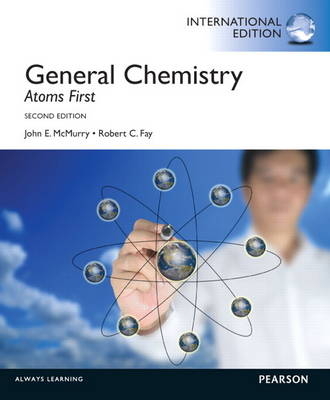
General Chemistry, plus MasteringChemistry with Pearson eText
Pearson Education Limited
978-1-4479-5427-9 (ISBN)
- Titel wird leider nicht erscheinen
- Artikel merken
General Chemistry: Atoms First starts from the building blocks of chemistry, the atom, allowing the authors to tell a cohesive story that progresses logically through molecules and compounds to help students intuitively follow complex concepts more logically. This unified thread of ideas helps students build a better foundation and ultimately gain a deeper understanding of chemical concepts. Students can more easily understand the microscopic-to-macroscopic connections between unobservable atoms and the observable behavior of matter in daily life, and are brought immediately into real chemistry-instead of being forced to memorize facts.
Reflecting a true atoms first perspective, the Second Edition features experienced atoms-first authors, incorporates recommendations from a panel of atoms-first experts, and follows historical beliefs in teaching chemistry concepts based and real experimental data first. This approach distinguishes this text in the market based whereby other authors teach theory first, followed by experimental data.
MyLab and Mastering from Pearson improve results for students and educators. Used by over ten million students, they effectively engage learners at every stage.
With proven success, Mastering has helped students make strides in learning for over 10 years. MasteringChemistry has immersive content and tools that are so engaging that Ann Verner, at the University of Toronto Scarborough, Canada, said, "MasteringChemistry is the best online chemistry homework program that I have used. The structure of the questions and the hints motivate the students to continue working on the problems, and the immediate feedback increases their confidence."
With MasteringChemistry, students gain knowledge that they will use throughout their lives, and universities gain a partner deeply committed to helping students and educators achieve their goals.
For students
Pearson eText gives you access to an eBook that can be used on the go, and allows you to highlight, search and take notes as you read online. Access to the eBook depends on the package you have bought.
You can work through the problems at your own pace, opening hints if you need help. If you make an error, you are given feedback based on that specific mistake so you can learn from it.
PhET simulations let you to get hands on to understand how the theory and daily life link up. These fun, interactive, research-based simulations of physical phenomena come from the PhET (TM) project at the University of Colorado.
For educators
Online assignments, tests, quizzes can be easily created and assigned to students.
Gradebook: Assignments are automatically graded and visible at a glance.
Register now to benefit from these resources.
A student access code card is included with your textbook at a reduced cost. To register with your code, visit www.masteringchemistry.com.
For educator access, contact your Pearson account manager. To find out who your account manager is, visit www.pearsoned.co.uk/replocator
For more instructor resources available with this title, visit www.pearsoned.co.uk
Educated at Harvard and Columbia,John McMurry has taught approximately 17,000 students in general and organic chemistry over a 30-year period. A Professor of Chemistry at Cornell University since 1980, Dr. McMurry previously spent 13 years on the faculty at the University of California at Santa Cruz. He has received numerous awards, including the Alfred P. Sloan Fellowship (1969-71), the National Institute of Health Career Development Award (1975-80), the Alexander von Humboldt Senior Scientist Award (1986-87), and the Max Planck Research Award (1991). Professor of Chemistry Robert C. Fay has been teaching general and inorganic chemistry at Cornell University since 1962. Known for his clear, well-organized lectures, Dr. Fay was the 1980 recipient of the Clark Distinguished Teaching Award. He has also taught as a visiting professor at Harvard University and the University of Bologna, Italy. He has been an NSF Science Faculty Fellow at the University of East Anglia and the University of Sussex, England, and a NATO/Heineman Senior Fellow at Oxford University.
Chapter 0 - Chemical Tools: Experimentation and Measurement
Chapter 1 - The Structure and Stability of Atoms
Chapter 2 - Periodicity and the Electronic Structure Atomic Structure
Chapter 3 - Atoms and Ionic Bonds
Chapter 4 - Atoms and Covalent Bonds
Chapter 5 - Covalent Bonds and Molecular Structure
Chapter 6 - Chemical Arithmetic: Stoichiometry
Chapter 7 - Reactions in Aqueous Solution
Chapter 8 - Thermochemistry: Chemical Energy
Chapter 9 - Gases: Their Properties and Behavior
Chapter 10 - Liquids, Solids, and Phase Changes
Chapter 11- Solutions and Their Properties
Chapter 12 - The Rates and Mechanisms of Chemical Reactions
Chapter 13 - Chemical Equilibrium,: The Extent of Chemical Reactions
Chapter 14 - Aqueous Equilibria: Acids and Bases
Chapter 15 - Applications of Aqueous Equilibria
Chapter 16 - Thermodynamics: Entropy, Free Energy, and Equilibrium
Chapter 17 - Electrochemistry
Chapter 18 - Hydrogen, Oxygen, and Water
Chapter 19 - The Main-Group Elements
Chapter 20 - Transition Elements and Coordination Chemistry
Chapter 21 - Metals and Solid-State Materials
Chapter 22 - Nuclear Chemistry
Chapter 23 - Organic and Biological Chemistry
| Erscheint lt. Verlag | 3.6.2013 |
|---|---|
| Verlagsort | Harlow |
| Sprache | englisch |
| Themenwelt | Naturwissenschaften ► Chemie |
| ISBN-10 | 1-4479-5427-0 / 1447954270 |
| ISBN-13 | 978-1-4479-5427-9 / 9781447954279 |
| Zustand | Neuware |
| Informationen gemäß Produktsicherheitsverordnung (GPSR) | |
| Haben Sie eine Frage zum Produkt? |
aus dem Bereich