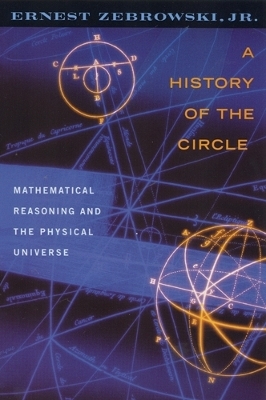
A History of the Circle
Rutgers University Press (Verlag)
978-0-8135-2898-4 (ISBN)
The concept of the circle is ubiquitous. It can be described mathematically, represented physically, and employed technologically. The circle is an elegant, abstract form that has been transformed by humans into tangible, practical forms to make our lives easier.
And yet no one has ever discovered a true mathematical circle. Rainbows are fuzzy; car tires are flat on the bottom, and even the most precise roller bearings have measurable irregularities. Ernest Zebrowski, Jr., discusses why investigations of the circle have contributed enormously to our current knowledge of the physical universe. Beginning with the ancient mathematicians and culminating in twentieth-century theories of space and time, the mathematics of the circle has pointed many investigators in fruitful directions in their quests to unravel nature’s secrets. Johannes Kepler, for example, triggered a scientific revolution in 1609 when he challenged the conception of the earth’s circular motion around the sun. Arab and European builders instigated the golden age of mosque and cathedral building when they questioned the Roman structural arches that were limited to geometrical semicircles.
Throughout his book, Zebrowski emphasizes the concepts underlying these mathematicians’ calculations, and how these concepts are linked to real-life examples. Substantiated by easy-to-follow mathematical reasoning and clear illustrations, this accessible book presents a novel and interesting discussion of the circle in technology, culture, history, and science.
Ernest Zebrowski Jr. holds professorships in science and mathematics education at Southern University in Baston Rouge, and in physics at Pennsylvania College of Technology of the Pennsylvania State University. He is the author of Perils of a Restless Planet: Scientific Perspectives on Natural Disasters and several science textbooks.
The quest for pi
Rollers, wheels, and bearings
The celestial clock
Mathematics and the physical world
Charting the planet
Surface and space
Celestial orbs
From conics to gravity
Oscillations
Waves
Artificial and natural structures
The real and conjectured universe
Appendix A: Formulas for the areas of common shapes
Appendix B: Formulas for the volumes of common solids
Appendix C: Algebraic equations for the conic sections
| Erscheint lt. Verlag | 30.9.2000 |
|---|---|
| Verlagsort | New Brunswick NJ |
| Sprache | englisch |
| Maße | 152 x 229 mm |
| Gewicht | 399 g |
| Themenwelt | Mathematik / Informatik ► Mathematik ► Geometrie / Topologie |
| Naturwissenschaften | |
| ISBN-10 | 0-8135-2898-4 / 0813528984 |
| ISBN-13 | 978-0-8135-2898-4 / 9780813528984 |
| Zustand | Neuware |
| Informationen gemäß Produktsicherheitsverordnung (GPSR) | |
| Haben Sie eine Frage zum Produkt? |
aus dem Bereich