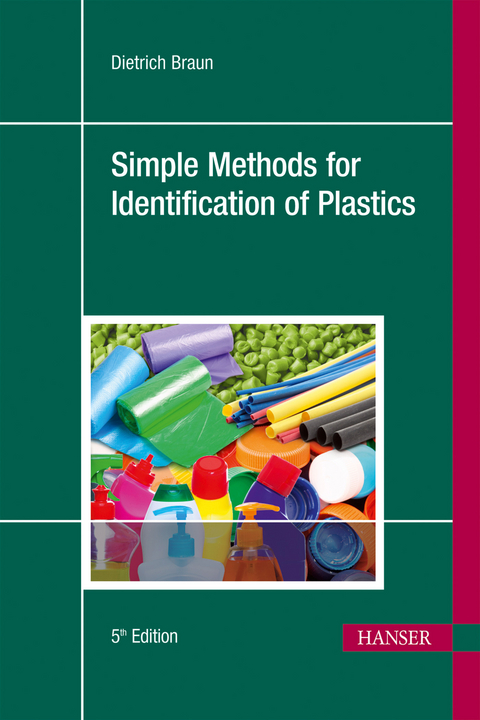
Simple Methods for Identification of Plastics (eBook)
140 Seiten
Carl Hanser Fachbuchverlag
978-1-56990-542-5 (ISBN)
Prof. Dr. Dietrich Braun was the director of the plastics institute (Deutschen Kunststoff-Instituts (DKI)) in Darmstadt until 2000. He is also the author of many reference books and textbooks. For years, Dr. Braun has chaired workshops in plastics technology for business people as well as for first-time users, which is the basis for this book.
Prof. Dr. Dietrich Braun was the director of the plastics institute (Deutschen Kunststoff-Instituts (DKI)) in Darmstadt until 2000. He is also the author of many reference books and textbooks. For years, Dr. Braun has chaired workshops in plastics technology for business people as well as for first-time users, which is the basis for this book.
Preface 6
Contents 8
1 Plastics and Their Characteristics 12
2 General Introduction to the Analysis of Plastics 26
2.1 Analytical Procedure 26
2.2 Sample Preparation 27
3 Screening Tests 30
3.1 Solubility 30
3.2 Density 33
3.3 Behavior on Heating 36
3.3.1 Pyrolysis Tests 38
3.3.2 Flame Test 39
3.3.3 Melting Behavior 41
4 Testing for Heteroatoms 48
5 Analytical Procedures 54
5.1 Analysis by Groups 55
6 Specific Identification Tests 60
6.1 General Identification Reactions 60
6.1.1 Liebermann-Storch-Morawski Reaction 60
6.1.2 Color Reaction with p-Dimethylaminobenzaldehyde 60
6.1.3 The Gibbs Indophenol Test 61
6.1.4 Formaldehyde Test 61
6.2 Specific Plastics 62
6.2.1 Polyolefins 62
6.2.2 Polystyrene 63
6.2.3 Polymethyl Methacrylate 63
6.2.4 Polyacrylonitrile 64
6.2.5 Polyvinyl Acetate 65
6.2.6 Polyvinyl Alcohol 66
6.2.7 Polymers Containing Chlorine 66
6.2.8 Polyoxymethylene 68
6.2.9 Polycarbonates 68
6.2.10 Polyamides 68
6.2.11 Polyurethanes 70
6.2.12 Phenolics 70
6.2.13 Aminoplastics 71
6.2.14 Epoxy Resins 72
6.2.15 Polyesters 73
6.2.16 Cellulose Derivatives 74
6.2.17 Silicones 75
6.2.18 Rubberlike Plastics 75
6.2.19 High Temperature-Resistant (HT) Thermoplastics 77
6.2.20 Fibers 80
6.3 Polymer Blends 80
6.4 Detection of Metals in Polyvinyl Chloride (PVC) 83
7 Identification of Historic Plastic Objects 86
7.1 General 87
7.1.1 Dating 87
7.1.2 Visual Appearance 87
7.1.2.1 Transparency 88
7.1.2.2 Hardness 89
7.1.2.3 Odor 89
7.1.2.4 Density 89
7.1.2.5 How to Distinguish Between Thermoplastics and Duroplastics 89
7.1.2.6 Material Behavior on Heating 90
7.2 A Few Simple Chemical Tests to Identify Early Plastic Articles 92
7.2.1 Protein Derivatives 92
7.2.2 Natural Resins 93
8 Advanced Analytical Methods 96
8.1 Overview 96
8.2 Infrared Spectroscopy 98
8.3 IR-Spectra 102
9 Appendix 114
9.1 Plastics Identification Table 114
9.2 Chemicals 123
9.2.1 Acids and Bases 123
9.2.2 Inorganic Chemicals 125
9.2.3 Organic Solvents 126
9.2.4 Organic Reagents 127
9.2.5 Miscellaneous 128
9.3 Laboratory Aids and Equipment 128
9.3.1 Basic Equipment 129
9.3.2 Optional Equipment 130
9.4 Selected Polymer Acronyms 130
10 Literature 134
Index 136
- Plastics and their Characteristics
- General Introduction to the Analysis of Plastics
- Screening Tests
- Testing for Heteroatoms
- Analytical Procedures
- Specific Identification Tests
- References of Historic Plastic Obje
| Erscheint lt. Verlag | 4.4.2013 |
|---|---|
| Verlagsort | München |
| Sprache | deutsch |
| Original-Titel | Erkennen von Kunststoffen |
| Themenwelt | Naturwissenschaften ► Chemie |
| Technik | |
| Schlagworte | Analytik • Kunststoffanalytik • Kunststoffe |
| ISBN-10 | 1-56990-542-8 / 1569905428 |
| ISBN-13 | 978-1-56990-542-5 / 9781569905425 |
| Informationen gemäß Produktsicherheitsverordnung (GPSR) | |
| Haben Sie eine Frage zum Produkt? |
 PDF (Wasserzeichen)
DRM: Digitales Wasserzeichen
Dieses eBook enthält ein digitales Wasserzeichen und ist damit für Sie personalisiert. Bei einer missbräuchlichen Weitergabe des eBooks an Dritte ist eine Rückverfolgung an die Quelle möglich.
Dateiformat: PDF (Portable Document Format)
Mit einem festen Seitenlayout eignet sich die PDF besonders für Fachbücher mit Spalten, Tabellen und Abbildungen. Eine PDF kann auf fast allen Geräten angezeigt werden, ist aber für kleine Displays (Smartphone, eReader) nur eingeschränkt geeignet.
Systemvoraussetzungen:
PC/Mac: Mit einem PC oder Mac können Sie dieses eBook lesen. Sie benötigen dafür einen PDF-Viewer - z.B. den Adobe Reader oder Adobe Digital Editions.
eReader: Dieses eBook kann mit (fast) allen eBook-Readern gelesen werden. Mit dem amazon-Kindle ist es aber nicht kompatibel.
Smartphone/Tablet: Egal ob Apple oder Android, dieses eBook können Sie lesen. Sie benötigen dafür einen PDF-Viewer - z.B. die kostenlose Adobe Digital Editions-App.
Buying eBooks from abroad
For tax law reasons we can sell eBooks just within Germany and Switzerland. Regrettably we cannot fulfill eBook-orders from other countries.
aus dem Bereich