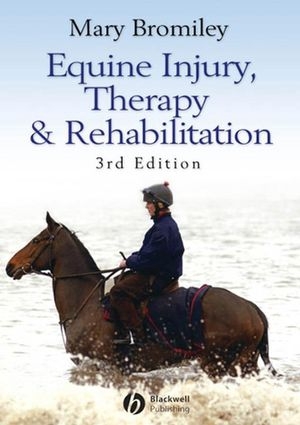
Equine Injury, Therapy and Rehabilitation (eBook)
John Wiley & Sons (Verlag)
978-1-118-70836-1 (ISBN)
- The original edition was the first book on the subject and it has continued to be a bestseller.
- Covers a subject that is of worldwide interest.
- The author is recognised as a pioneer at the forefront of this type of treatment.
Mary Bromiley is a Chartered Physiotherapist. In 1984 she built Downs House Equine Rehabilitation Centre, now located on Exmoor, a world first for the treatment and rehabilitation of both horse and rider. She has written six books, and has been published internationally in six languages. She lectures world wide and for 18 years travelled as therapist to the medal winning New Zealand 3 day event team.
Mary Bromiley's book remains essential reading for both professionals and the general riding community. This new edition builds on the huge success of the previous editions, first published in 1987. Fully updated to reflect recent technological advances in diagnostic ability, as well as the proven physiological effects of light, magnetic fields and electrical currents on body tissues. This information allows readers to both understand and make an informed choice of appropriate therapy following a diagnosed injury. The original edition was the first book on the subject and it has continued to be a bestseller. Covers a subject that is of worldwide interest. The author is recognised as a pioneer at the forefront of this type of treatment.
Mary Bromiley is a Chartered Physiotherapist. In 1984 she built Downs House Equine Rehabilitation Centre, now located on Exmoor, a world first for the treatment and rehabilitation of both horse and rider. She has written six books, and has been published internationally in six languages. She lectures world wide and for 18 years travelled as therapist to the medal winning New Zealand 3 day event team.
Foreword by Martin Pipe CBEB ix
Preface x
Acknowledgements xii
1 The Musculoskeletal System Explained 1
Introduction 1
Members of the team 5
Interdependence of the body systems 9
Cells 9
Bones 11
Joints 11
Ligaments 12
Muscle 13
Tendons 14
The respiratory system 15
The heart 15
Circulation 16
The lymphatic system 18
The nervous system 19
The skeleton 19
The hind limbs 21
The forelimbs 22
Skeletal muscle 23
Reflex movement patterns 24
2 Injury - Effects, Repair and Causes 26
Common musculoskeletal injuries 26
Injury and repair 31
Possible causes of injury 35
Stable injuries 37
All-weather surfaces and gallops 38
Tooth problems as a cause of injury 39
The foot and shoe as a possible cause of injury 41
Saddles as a cause of injury 44
3 Problem Assessment 47
Soft tissue examination 48
Imaging as an aid to diagnosis 59
Ultrasonic scanning 60
Heart rate computers 61
4 Common Sites of Injury in the Horse 64
5 Therapy 76
First aid 80
Treatment 82
Massage 82
Hand massage 83
Mechanical massagers 86
Cold and heat 88
Cold and its uses 89
Methods of employing ice/water therapy 92
Heat 93
Cellular effects in response to varied stimulation 95
Magnetic field therapy, PMF (pulsed magnetic flow) and static magnet fields 96
Ultrasound 100
Light therapy 106
Laser therapy 109
Light emitting diodes 115
Electrical stimulation of muscle 115
Transcutaneous electrical nerve stimulators (TENS) 128
Manipulation 129
6 Rehabilitation 130
Reflex action 130
Muscle re-education 132
Passive movements 133
Rehabilitation aids 134
Hydrotherapy 137
Thalassotherapy 143
Long reining 149
Ridden work 158
Summary 159
7 The Back - Horse and Human 160
The horse 160
The human back 168
8 Common Rider Injuries 175
Rider injuries 175
Types of injury 180
General rehabilitation 184
Appendix I The Veterinary Act 185
Veterinary surgeons, guide to professional conduct 185
Treatment of animals by non veterinary surgeons 185
Appendix II Bandaging 187
Types of bandage 188
Appendix III Cupping 190
Appendix Iv Points for Those Treating Horses 191
Machines 192
General points 192
The owner 193
Appendix V Use of Anti-Concussion Pads 194
Appendix Vi Suppliers of Machines Suitable for Animal Physiotherapy 196
General suppliers UK 196
Bibliography 199
Glossary 202
Index 211
"This is still the original work on equine physical therapy and rehabilitation ... .The many therapies are well described." Doody's Book Reviews
2
Injury – Effects, Repair and Causes
Common musculoskeletal injuries
Bone damage
Damage to bone equals loss of support in the framework/leverage system. Bone breaks are known as fractures. There are many different types of fracture. In a complete fracture, the line of the break passes through the bone in its entirety; bones may be broken in one or more places, they may also be crushed, or just cracked.
Bone is slow to heal but, provided the ends are approximated – that is, opposite each other – and movement between the bone ends, or between the bone particles/pieces is eliminated, healing will normally occur.
Diagnostic imaging has progressed, whereas previously the density of equine tissue masses meant that only rather poor quality X-rays were available, now with the advancement of technology perfect images can be obtained. In most referral centres there is the capacity to use magnetic resonance imaging, computed tomography, ultrasonography, nuclear scintigraphy, thermography. The advances in technology have expanded diagnostic parameters which have resulted in significant advances in the knowledge of musculoskeletal disease (Fig 2.1).
Images of the neck and back are now possible; problems with or injury to soft tissue, as well as bone and joints, can also be identified, resulting in improved treatments.
Repair phases of the recovery of bone are similar to those of soft tissue. In the case of bone, the end result is probably the most perfect for similarity of original structure. Complete fractures usually need to be immobilised for good repair. In a weight bearing limb this was, in the past, almost impossible but, with the expansion of veterinary orthopaedic surgery, and improvements in anaesthesia, the use of pins and plates are now commonplace. By the use of pins, plates and screws,a great number of horses, whose injuries would formerly have required that they be euthanised are now operated on and saved.
Fig. 2.1 The bones of a foot imaged using a portable radiography system.
Sore shins
Incomplete fractures, such as minute cracks, can be treated without the need for the limb to be immobilised. Of these, the most common condition is that of sore shins. Localised stresses (an occupational hazard of athletic bone) cause minute cracks in the cannon bone. Early radiographs often appear normal but subsequent examination may show callus formation where the tiny cracks are trying to heal. In American terminology, this condition is called bucked shins.
Early lameness denoting this condition may be minimal, but the pain may suddenly rise to a crescendo, with lameness and hypersensitivity to touch. A history of pain and tenderness should lead to at least three weeks of reduced activity. Shock wave therapy has proved beneficial.
Sites of bone inflammation
Other bone sites can cause problems, often giving rise to unexplained lameness in the early stages of bone inflammation. The patella ligament in the horse is the conjunction of three ligaments which are inserted into the tibial tubercle, as in the human model. Irritation of this bone area, described as Osgood-Schlatter’s disease, occurs in teenage human athletes and is considered to be associated with strong muscle traction on immature bone. In the young horse a similar inflammatory response appears to occur, suggesting, as in the teenage athlete, possible skeletal immaturity, with the bone unable to withstand the massive contractile forces of the quadricep muscles.
A curb occurs at the insertion of the extensors of the hock conjoined as the common calcaneal tendon.
Stress fractures which continue to give trouble, however minor, should not be ignored, the state of general maturity, diet, in particular mineral requirement, and exercise protocol, all require consideration, lest a spontaneous, complete fracture occurs.
Damage to the periosteum
The periosteum is the outer covering, or the outer skin, of the bones. Muscles, ligaments and tendons are contiguous with the periosteum at their origins and insertions. Tears, pulls or knocks cause rupture of small blood vessels, with consequent local bleeding. This free blood acts as a chemical irritant and in response to the chemical signals new bone grows, forming small ridges or lumps. These may interfere with normal function if adjacent to a joint or tendon. Bleeding between the bone and the inelastic periosteum also causes severe pain (Fig 2.2).
Damage to the epiphyseal plates
The long bones of the horse have not achieved full development before the age of two; in some breeds growth continues for several years.
Long bones, or limb bones, grow from specialist-type plates called epiphyseal plates. Under certain stress conditions, in particular diet related, and with over-training, these plates become irritated and inflamed. This condition is termed epiphysitis – that is, inflammation of the epiphyseal plate.
Damage to bursae
Bursae are small sacs of fluid, positioned at various points of the body, in areas of possible friction. Their function is to stop the underlying bone rubbing, and so damaging, the under surface of an overlying muscle or tendon. Bursae can become inflamed. If this occurs, they swell, causing severe pain and restricted movement.
The navicular bursa is the culprit in some cases of foot related lameness.
Fig. 2.2 Periosteal bruising to front of cannon hind right. Action in the fetlock joint of the injured side was severely compromised.
Fluid contained in the supraspinous bursa, positioned at the highest point of the withers, and damaged, in earlier times by ill fitting tack, tracked down between the posterior thoracic spines, with no available exit route often becoming infected and causing the condition described as wither fistula. The condition can occur following wither fracture.
There are two bursae sited at the poll, the cranial and caudal nuchal bursae, a horse which pulls back may damage either or both of these if the restraint tie does not break. Bruising results in discomfort to pressure and the horse may become bridle shy and/or head shy.
Damage to joints
The terminology to denote joint damage is arthritis (arth = joint, itis = inflammation). An inflamed joint is an arthritic joint. Unless the word arthritis has a descriptive adjective attached, the term does not necessarily mean that there will be irreversible joint changes.
One irreversible joint change is called osteoarthritis. In this case, areas of bone or the bones involved in the formation of a joint have formed irregularities on their circumference. These areas of irregular bone growth impede the normal movement of the joint. Unfortunately, the inflammatory processes in this condition are not confined to bone alone; the synovial fluid (joint oil) and the hyaline cartilage, coating the articular surfaces of the joint in question, may also be affected. Other types of arthritis may be described as traumatic, septic or infective.
Joints are sprained when put through a range of motion greater than they were anatomically designed to perform. This excessive movement may damage the supporting ligaments and surrounding muscle tissue.
Damage to ligament
Ligaments support joints. Overstretched ligaments therefore lead to loss of stability in their joint. In the case of the suspensory ligament stability is lost at the fetlock joint and below.
Damage to inter-osseous ligaments
These ligaments lie between two adjacent bones (inter = between, osseous = bone); for example, between the splint and the cannon bone. Tears of an inter-osseous ligament cause pain in the first instance and development of new bone in the second; depending on the position of the new growth, interference with normal function may occur. Some degree of pain is usually present in the early active stage of injury.
Damage to muscle
Muscle damage causes ineffective, incorrect and unbalanced movement patterns. Fatigue, bruising, loss of nerve communication and a variety of conditions, for example motor neurone disease and polysaccharide storage myopathy all damage muscle.
Muscle atrophy (loss of muscle tissue) occurs as a result of disuse, loss of communication due to damage to motor nerves or damage to the joint or joints which the muscle influences.
Damage to tendon
Damage to a tendon at the area where the structure inserts to bone or at the muscular tendon junction, occurs in the most part, due to over stretch forces associated with a weak or fatigued parent muscle.
The deep and superficial digital flexor tendons of the limbs may be damaged as a result of impact or more commonly appear to break down as a result of strain, following excessive loading.
To date, no treatment method or chemical stimulant has stimulated the components of the digital flexor tendons in a manner which has caused the original fibre type to reform following damage.
Very recent research looks more promising because considerable advances have been made in the understanding of the factors involved in tendon physiology at molecular level. It is also possible that stem cell therapy may turn out to be of benefit.
Damage to nerve
All body functions are dependent on a normal nerve supply. Any form of damage involving the specialist nerve tissues of the brain or spinal cord, the central nervous system (CNS), results in paralysis. The extent of the paralysis is determined by the area or level at which the damage has occurred, and it is the function of the body parts distal to the...
| Erscheint lt. Verlag | 27.3.2013 |
|---|---|
| Sprache | englisch |
| Themenwelt | Medizin / Pharmazie |
| Naturwissenschaften ► Biologie | |
| Veterinärmedizin ► Pferd | |
| Schlagworte | Ability • Advances • Body • bromileys book • builds • Community • currents • Diagnostic • Edition • Editions • Effects • Electrical • Equine • Essential • huge • Injury • light • Mary • New • Pferd • Pferdeforschung • Physiological • previous • Professionals • proven • Reflect • technological • Tissues |
| ISBN-10 | 1-118-70836-9 / 1118708369 |
| ISBN-13 | 978-1-118-70836-1 / 9781118708361 |
| Informationen gemäß Produktsicherheitsverordnung (GPSR) | |
| Haben Sie eine Frage zum Produkt? |
 EPUB (Adobe DRM)
Kopierschutz: Adobe-DRM
Adobe-DRM ist ein Kopierschutz, der das eBook vor Mißbrauch schützen soll. Dabei wird das eBook bereits beim Download auf Ihre persönliche Adobe-ID autorisiert. Lesen können Sie das eBook dann nur auf den Geräten, welche ebenfalls auf Ihre Adobe-ID registriert sind.
Details zum Adobe-DRM
Dateiformat: EPUB (Electronic Publication)
EPUB ist ein offener Standard für eBooks und eignet sich besonders zur Darstellung von Belletristik und Sachbüchern. Der Fließtext wird dynamisch an die Display- und Schriftgröße angepasst. Auch für mobile Lesegeräte ist EPUB daher gut geeignet.
Systemvoraussetzungen:
PC/Mac: Mit einem PC oder Mac können Sie dieses eBook lesen. Sie benötigen eine
eReader: Dieses eBook kann mit (fast) allen eBook-Readern gelesen werden. Mit dem amazon-Kindle ist es aber nicht kompatibel.
Smartphone/Tablet: Egal ob Apple oder Android, dieses eBook können Sie lesen. Sie benötigen eine
Geräteliste und zusätzliche Hinweise
Buying eBooks from abroad
For tax law reasons we can sell eBooks just within Germany and Switzerland. Regrettably we cannot fulfill eBook-orders from other countries.
aus dem Bereich