


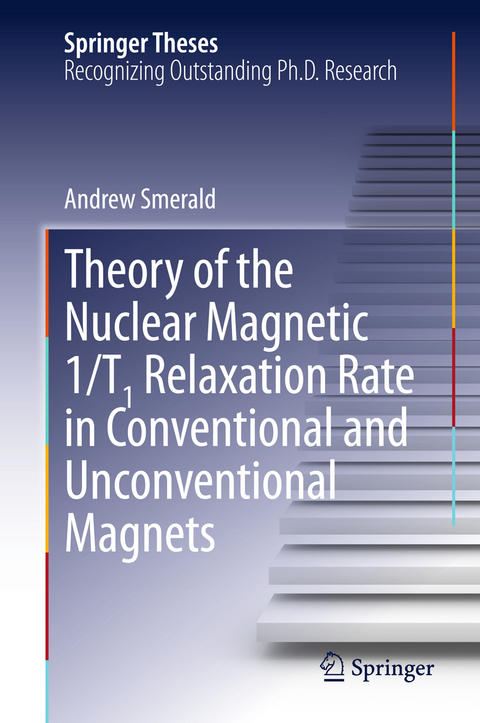
Theory of the Nuclear Magnetic 1/T1 Relaxation Rate in Conventional and Unconventional Magnets
Seiten
2013
Springer International Publishing (Verlag)
978-3-319-00433-4 (ISBN)
Springer International Publishing (Verlag)
978-3-319-00433-4 (ISBN)
This book develops a detailed, quantitative theory of NMR 1/T1 relaxation rates and shows how they could be used to measure the speed at which energy travels in a wide range of magnetic materials.
One of the best ways to "lift the lid" on what is happening inside a given material is to study it using nuclear magnetic resonance (NMR). Of particular interest are NMR 1/T1 relaxation rates, which measure how fast energy stored in magnetic nuclei is transferred to surrounding electrons.
This thesis develops a detailed, quantitative theory of NMR 1/T1 relaxation rates, and shows for the first time how they could be used to measure the speed at which energy travels in a wide range of magnetic materials.
This theory is used to make predictions for"Quantum Spin Nematics", an exotic form of quantum order analogous to a liquid crystal. In order to do so, it is first necessary to unravel how spin nematics transport energy. This thesis proposes a new way to do this, based on the description of quarks in high-energy physics.
Experiments to test the ideas presented are now underway in laboratories across the world.
One of the best ways to "lift the lid" on what is happening inside a given material is to study it using nuclear magnetic resonance (NMR). Of particular interest are NMR 1/T1 relaxation rates, which measure how fast energy stored in magnetic nuclei is transferred to surrounding electrons.
This thesis develops a detailed, quantitative theory of NMR 1/T1 relaxation rates, and shows for the first time how they could be used to measure the speed at which energy travels in a wide range of magnetic materials.
This theory is used to make predictions for"Quantum Spin Nematics", an exotic form of quantum order analogous to a liquid crystal. In order to do so, it is first necessary to unravel how spin nematics transport energy. This thesis proposes a new way to do this, based on the description of quarks in high-energy physics.
Experiments to test the ideas presented are now underway in laboratories across the world.
What is frustrated magnetism and why should you care?.- An introduction to field theory in magnetic systems: the Néel antiferromagnet.- Angle-resolved NMR: a theory of the 1/T1 relaxation rate in magnetic systems.- Theory of the NMR relaxation rate in magnetic Fe pnictides.- Field theoretical description of quantum spin-nematic order.- How to recognise the quantum spin-nematic state.
| Erscheint lt. Verlag | 21.8.2013 |
|---|---|
| Reihe/Serie | Springer Theses |
| Zusatzinfo | XVI, 165 p. |
| Verlagsort | Cham |
| Sprache | englisch |
| Maße | 155 x 235 mm |
| Gewicht | 456 g |
| Themenwelt | Naturwissenschaften ► Physik / Astronomie ► Atom- / Kern- / Molekularphysik |
| Naturwissenschaften ► Physik / Astronomie ► Elektrodynamik | |
| Naturwissenschaften ► Physik / Astronomie ► Hochenergiephysik / Teilchenphysik | |
| Naturwissenschaften ► Physik / Astronomie ► Quantenphysik | |
| Schlagworte | Field Theory of Quantum Spin Nematic State • Frustrated Magnet • neutron scattering • NMR Form Factor • NMR in Pnictide Materials • NMR Relaxation Rate • Non-linear Sigma Model • Spin Nematic |
| ISBN-10 | 3-319-00433-6 / 3319004336 |
| ISBN-13 | 978-3-319-00433-4 / 9783319004334 |
| Zustand | Neuware |
| Informationen gemäß Produktsicherheitsverordnung (GPSR) | |
| Haben Sie eine Frage zum Produkt? |
Mehr entdecken
aus dem Bereich
aus dem Bereich
Buch | Softcover (2024)
Wiley-VCH (Verlag)
CHF 83,85
Introduction to Quantum Electrodynamics
Buch | Softcover (2024)
Wiley-VCH GmbH (Verlag)
CHF 156,75


