Zum Hauptinhalt springen
Nicht aus der Schweiz? Besuchen Sie lehmanns.de
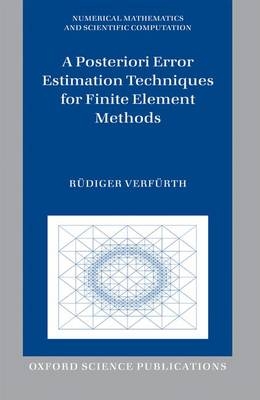
Posteriori Error Estimation Techniques for Finite Element Methods -  Rudiger Verfurth

Posteriori Error Estimation Techniques for Finite Element Methods (eBook)

eBook Download: PDF
2013
416 Seiten
OUP Oxford (Verlag)
9780191668760 (ISBN)
Systemvoraussetzungen
110,34 inkl. MwSt
(CHF 107,80)
Der eBook-Verkauf erfolgt durch die Lehmanns Media GmbH (Berlin) zum Preis in Euro inkl. MwSt.
  • Download sofort lieferbar
  • Zahlungsarten anzeigen
Self-adaptive discretization methods are now an indispensable tool for the numerical solution of partial differential equations that arise from physical and technical applications. The aim is to obtain a numerical solution within a prescribed tolerance using a minimal amount of work. The main tools in achieving this goal are a posteriori error estimates which give global and local information on the error of the numerical solution and which can easily be computed from the given numerical solution and the data of the differential equation. This book reviews the most frequently used a posteriori error estimation techniques and applies them to a broad class of linear and nonlinear elliptic and parabolic equations. Although there are various approaches to adaptivity and a posteriori error estimation, they are all based on a few common principles. The main aim of the book is to elaborate these basic principles and to give guidelines for developing adaptive schemes for new problems. Chapters 1 and 2 are quite elementary and present various error indicators and their use for mesh adaptation in the framework of a simple model problem. The basic principles are introduced using a minimal amount of notations and techniques providing a complete overview for the non-specialist. Chapters 4-6 on the other hand are more advanced and present a posteriori error estimates within a general framework using the technical tools collected in Chapter 3. Most sections close with a bibliographical remark which indicates the historical development and hints at further results.
PDFPDF (Adobe DRM)

Kopierschutz: Adobe-DRM
Adobe-DRM ist ein Kopierschutz, der das eBook vor Mißbrauch schützen soll. Dabei wird das eBook bereits beim Download auf Ihre persönliche Adobe-ID autorisiert. Lesen können Sie das eBook dann nur auf den Geräten, welche ebenfalls auf Ihre Adobe-ID registriert sind.
Details zum Adobe-DRM

Dateiformat: PDF (Portable Document Format)
Mit einem festen Seiten­layout eignet sich die PDF besonders für Fach­bücher mit Spalten, Tabellen und Abbild­ungen. Eine PDF kann auf fast allen Geräten ange­zeigt werden, ist aber für kleine Displays (Smart­phone, eReader) nur einge­schränkt geeignet.

Systemvoraussetzungen:
PC/Mac: Mit einem PC oder Mac können Sie dieses eBook lesen. Sie benötigen eine Adobe-ID und die Software Adobe Digital Editions (kostenlos). Von der Benutzung der OverDrive Media Console raten wir Ihnen ab. Erfahrungsgemäß treten hier gehäuft Probleme mit dem Adobe DRM auf.
eReader: Dieses eBook kann mit (fast) allen eBook-Readern gelesen werden. Mit dem amazon-Kindle ist es aber nicht kompatibel.
Smartphone/Tablet: Egal ob Apple oder Android, dieses eBook können Sie lesen. Sie benötigen eine Adobe-ID sowie eine kostenlose App.
Geräteliste und zusätzliche Hinweise

Buying eBooks from abroad
For tax law reasons we can sell eBooks just within Germany and Switzerland. Regrettably we cannot fulfill eBook-orders from other countries.

Mehr entdecken
aus dem Bereich