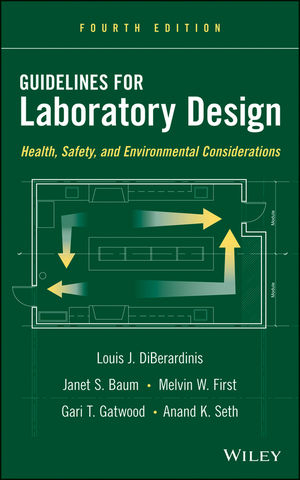
Guidelines for Laboratory Design (eBook)
560 Seiten
John Wiley & Sons (Verlag)
978-1-118-63388-5 (ISBN)
scientific investigations
Now in its Fourth Edition, Guidelines for Laboratory
Design continues to enable readers to design labs that make it
possible to conduct scientific investigations in a safe and healthy
environment. The book brings together all the professionals who are
critical to a successful lab design, discussing the roles of
architects, engineers, health and safety professionals, and
laboratory researchers. It provides the design team with the
information needed to ask the right questions and then determine
the best design, while complying with current regulations and best
practices.
Guidelines for Laboratory Design features concise,
straightforward advice organized in an easy-to-use format that
facilitates the design of safe, efficient laboratories. Divided
into five sections, the book records some of the most important
discoveries and achievements in:
* Part IA, Common Elements of Laboratory Design, sets forth
technical specifications that apply to most laboratory buildings
and modules
* Part IB, Common Elements of Renovations, offers general design
principles for the renovation and modernization of existing
labs
* Part II, Design Guidelines for a Number of Commonly Used
Laboratories, explains specifications, best practices, and
guidelines for nineteen types of laboratories, with three new
chapters covering nanotechnology, engineering, and autopsy
labs
* Part III, Laboratory Support Services, addresses design issues
for imaging facilities, support shops, hazardous waste facilities,
and laboratory storerooms
* Part IV, HVAC Systems, explains how to heat, cool, and
ventilate labs with an eye towards energy conservation
* Part V, Administrative Procedures, deals with bidding
procedures, final acceptance inspections, and sustainability
The final part of the book features five appendices filled with
commonly needed data and reference materials.
This Fourth Edition is indispensable for all laboratory
design teams, whether constructing a new laboratory or renovating
an old facility to meet new objectives.
LOUIS J. DiBERARDINIS, BS, MS, CIH, CSP, is the Director of Environment, Health, and Safety at MIT. He is a visiting lecturer at Harvard University School of Public Health and Adjunct Professor at the University of Massachusetts Lowell in the Department of the Work Environment. He received his BS in chemical engineering from Northeastern University and an MS in industrial hygiene from Harvard University. JANET S. BAUM, BS, MArch, AiA, currently teaches part-time at Harvard University School of Public Health and at both the Graduate School of Architecture and Urban Design and the Institute of Public Health, Washington University in St. Louis. She earned her BS in architectural sciences at Washington University in St. Louis and her master of architecture at Harvard University Graduate School of Design. The late MELVIN W. FIRST, ScD, CIH, PE, was a researcher and professor of environmental health Engineering at the Harvard School of Public Health for almost sixty years and was actively involved in research until a week before his death. GARI T. GATWOOD, BSME, CSP (retired), is a consultant in safety engineering. He has forty years of safety experience in missile defense, commercial chemicals, laboratories, and university programs. He holds a degree in mechanical engineering from the Missouri School of Mines and Metallurgy in Rolla, Missouri. Anand K. Seth, BS, MS, PE, CEM, CPE, is currently an Engineering Principal in Cannon Design, an international architectural/engineering firm. Seth worked at Massachusetts General Hospital as director of engineering and at Harvard University. He holds a master of science in mechanical engineering from the University of Maine and has done postgraduate work at other universities.
"In summary, this edition of the book addresses a broad
spectrum of end users including administrators, researchers,
instructors, engineers, and environment health officers. The book
is a useful comprehensive reference for academic institutions, but
perhaps not for individual instructors." (Journal of
Chemical Education, 1 January 2014)
| Erscheint lt. Verlag | 6.3.2013 |
|---|---|
| Sprache | englisch |
| Themenwelt | Naturwissenschaften ► Chemie |
| Technik ► Architektur | |
| Wirtschaft | |
| Schlagworte | Arbeitsplatzgestaltung • Arbeitssicherheit • Arbeitssicherheit u. Umweltschutz i. d. Chemie • Architecture • Architecture Special Topics • Architektur • Chemical and Environmental Health and Safety • Chemie • Chemistry • Lab Automation & Miniaturization • Laboratorium • Laborautomatisierung u. Miniaturisierung • Spezialthemen Architektur |
| ISBN-10 | 1-118-63388-1 / 1118633881 |
| ISBN-13 | 978-1-118-63388-5 / 9781118633885 |
| Informationen gemäß Produktsicherheitsverordnung (GPSR) | |
| Haben Sie eine Frage zum Produkt? |
 PDF (Adobe DRM)
Kopierschutz: Adobe-DRM
Adobe-DRM ist ein Kopierschutz, der das eBook vor Mißbrauch schützen soll. Dabei wird das eBook bereits beim Download auf Ihre persönliche Adobe-ID autorisiert. Lesen können Sie das eBook dann nur auf den Geräten, welche ebenfalls auf Ihre Adobe-ID registriert sind.
Details zum Adobe-DRM
Dateiformat: PDF (Portable Document Format)
Mit einem festen Seitenlayout eignet sich die PDF besonders für Fachbücher mit Spalten, Tabellen und Abbildungen. Eine PDF kann auf fast allen Geräten angezeigt werden, ist aber für kleine Displays (Smartphone, eReader) nur eingeschränkt geeignet.
Systemvoraussetzungen:
PC/Mac: Mit einem PC oder Mac können Sie dieses eBook lesen. Sie benötigen eine
eReader: Dieses eBook kann mit (fast) allen eBook-Readern gelesen werden. Mit dem amazon-Kindle ist es aber nicht kompatibel.
Smartphone/Tablet: Egal ob Apple oder Android, dieses eBook können Sie lesen. Sie benötigen eine
Geräteliste und zusätzliche Hinweise
Buying eBooks from abroad
For tax law reasons we can sell eBooks just within Germany and Switzerland. Regrettably we cannot fulfill eBook-orders from other countries.
aus dem Bereich