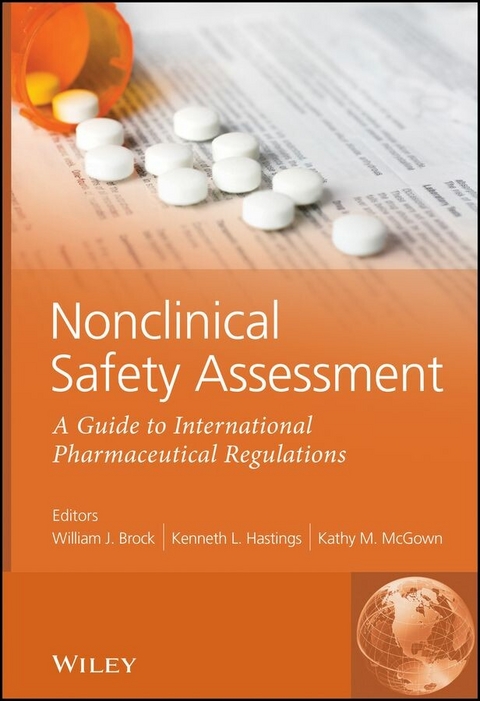
Nonclinical Safety Assessment (eBook)
John Wiley & Sons (Verlag)
978-1-118-51701-7 (ISBN)
It includes:
- ICH - the International Conference on Harmonisation of Technical Requirements for Registration of Pharmaceuticals for Human Use
- National regulations, including US FDA, Canada, Mercosur and Brazil, South Africa, China, Japan, India and Australia
- Repeated dose toxicity studies
- Carcinogenicity; Genotoxicity; Developmental and reproductive toxicology; Immunotoxicology
- Biotechnology-derived pharmaceuticals
- Vaccine development
- Phototoxicity and photocarcinogenicity
- Degradants, impurities, excipients and metabolites
Primarily intended for those professionals actively involved in the nonclinical and clinical development of a pharmaceutical product, including toxicologists, pharmacologists, clinicians and project managers, this book provides a roadmap for successful new drug approval and marketing.
Dr. William J Brock, Brock Scientific Consulting, USA
Dr. Bill Brock is Principal of Brock Scientific Consulting and manages R&D programs for clients in the pharmaceutical, chemical, food and consumer product industries. He is the Past-President of American Board of Toxicology, serves on the Board of Directors for the Academy of Toxicological Sciences and is an Associate Editor for the International Journal of Toxicology. Dr. Brock has served in a leadership capacity in various organizations within the Society of Toxicology, the American College of Toxicology and is co-chair of the nonclinical section of the Drug Information Association.
Dr. Kenneth Hastings, sanofi-aventis, USA
Dr Hastings was Associate Director for Pharmacology/Toxicology in the Office of New Drugs, US Food and Drug Administration, from 2003 to 2007. He currently is Associate Vice President for Regulatory Policy at sanofi-aventis. He has served in several professional societies, including the American Board of Toxicology (currently President), the American College of Toxicology (currently President-Elect), the Society of Toxicology (Past President of the Immunotoxicology Specialty Section), and as Co-Chair of the Nonclinical Special Interest Committee of the Drug Information Association.
Nonclinical Safety Assessment Nonclinical Safety Assessment A Guide to International Pharmaceutical Regulations Bringing a new drug to market is a costly time-consuming process. Increased regional and international regulation over the last twenty years, while necessary, has only served to amplify these costs. In response to this escalation, developmental strategies have shifted towards a more global approach. In order to create the most cost-effective and safe processes, it is critical for those bringing drugs to market to understand both the globally accepted regulations and the local variations. Nonclinical Safety Assessment: A Guide to International Pharmaceutical Regulations provides a practical description of nonclinical drug development regulations and requirements in the major market regions. It includes: ICH the International Conference on Harmonisation of Technical Requirements for Registration of Pharmaceuticals for Human Use National regulations, including US FDA, Canada, Mercosur and Brazil, South Africa, China, Japan, India and Australia Repeated dose toxicity studies Carcinogenicity; Genotoxicity; Developmental and reproductive toxicology; Immunotoxicology Biotechnology-derived pharmaceuticals Vaccine development Phototoxicity and photocarcinogenicity Degradants, impurities, excipients and metabolites Primarily intended for those professionals actively involved in the nonclinical and clinical development of a pharmaceutical product, including toxicologists, pharmacologists, clinicians and project managers, this book provides a roadmap for successful new drug approval and marketing.
Editors William J. Brock Brock Scientific Consulting, Montgomery Village, USA Kenneth L. Hastings Sanofi, Bethesda, USA Kathy M. McGown FoxKiser, USA
Nonclinical Safety Assessment: A Guide to International Pharmaceutical Regulations 1
Contents 7
List of Contributors 19
Preface 21
Part I: International Regulations and Nonclinical Studies for Pharmaceuticals 23
1 Introduction 25
1.1 The Global Pharmaceutical Market 28
1.2 Looking to the Future 31
1.3 Legal and Regulatory Considerations in Drug Development 32
1.4 The Drug Development Process – General Considerations 34
References 37
2 ICH: History and Nonclinical Guidances 39
2.1 Introduction 39
2.2 Organization of the ICH 41
2.3 The ICH Process 42
2.4 Animal Welfare and Alternative Methods 44
2.5 ICH M3 45
2.6 New Initiatives and Topics 46
References 47
3 Food and Drug Administration: Nonclinical Program and Pharmaceutical Approval 49
3.1 Legislative Authority of the FDA 49
3.2 Nonclinical Drug Development and the FDA 53
3.3 Nonclinical Testing: General Conditions and Considerations 56
3.4 Toxicity Testing: Small Molecules and Traditional Pharmaceuticals 56
3.5 Toxicity Testing of Pharmaceuticals – The General Approach 57
3.6 First-in-Human Dosing: Results from Nonclinical Studies 59
References 60
4 Nonclinical Pharmaceutical Development in MERCOSUR and Brazil 63
4.1 Introduction 63
4.2 MERCOSUR 63
4.3 Brazil 66
4.3.1 Brazilian Regulatory Aspects 66
4.3.2 Nonclinical Studies Required for Drug Registration 70
4.3.3 Comparison with Other Agencies and Harmonization Institutes 73
4.3.4 Regional Reality of Drug Registration – Final Comments 75
References 76
5 Nonclinical Safety Assessment: Canada 79
5.1 Introduction 79
5.2 Organization of Health Canada 80
5.2.1 Therapeutic Products Directorate 80
5.2.2 Biologics and Genetic Therapies Directorate 82
5.2.3 Natural Health Products Directorate 82
5.3 The Regulatory Framework for Drug Approval in Canada 82
5.3.1 The Food and Drugs Act 82
5.3.2 The Food and Drug Regulations 83
5.4 Nonclinical Assessment in Canada 86
5.4.1 Canada and the International Conference on Harmonization 86
5.4.2 Good Laboratory Practices in Canada 88
5.4.3 Case Studies and Summary Basis of Decision 89
5.5 Clinical Trial Applications 92
5.5.1 History and Regulations 92
5.5.2 Clinical Trial Application Overview 93
5.5.3 Pre-Submission Meetings and Consultations 93
5.5.4 CTA Content and Format 94
5.5.5 Nonclinical Aspects of the CTA/CTA-A Process 95
5.5.6 CTA-A Content and Format 95
5.5.7 CTA and CTA-A Review Process 95
5.6 Special Regulatory Considerations 96
5.6.1 Generic Drugs 96
5.6.2 Subsequent Entry Biologics in Canada 96
5.6.3 Orphan Drugs in Canada 99
References 100
6 European Pharmaceutical Regulation – Nonclinical Testing Requirements 101
6.1 Introduction 101
6.1.1 Definitions 103
6.2 Regulation of Medicinal Products in the European Union 104
6.2.1 Overview 104
6.2.2 Role of the European Medicines Agency in the Regulation of Medicines 104
6.2.3 Scientific Structure of the EMA 105
6.2.4 Regulatory Process in the EU 107
6.3 Nonclinical Testing in the Support of Clinical Trials 108
6.3.1 Role of Individual Country Regulatory Agencies/Authorities 109
6.3.2 Risk Mitigation in Nonclinical Development of Medicinal Products 111
6.4 Overview 118
References 118
7 South Africa 121
7.1 Introduction 121
7.2 Country Information 122
7.2.1 Description 122
7.2.2 Economy 122
7.2.3 Country Organization 122
7.2.4 The Rainbow Nation 122
7.2.5 Health and Medicines 122
7.3 The Regulatory Aspects 123
7.3.1 The Registration of Medicines: Introduction and Scope 123
7.3.2 The Legal Framework 123
7.3.3 Role, Structure and Organization of the MCC 124
7.3.4 The Regulatory Procedures 125
7.3.5 The Registration Requirements for Preparation of the Application Package 126
7.3.6 The Registration Process: Several Steps of Review 130
7.4 The Nonclinical Safety Assessment 131
7.4.1 Introduction 131
7.4.2 Nonclinical Evaluation 131
7.4.3 Content of the Application for Safety Assessment 132
7.4.4 The Focus of the Nonclinical Evaluation 135
7.4.5 Pharmacology Testing 136
7.4.6 Toxicology Testing 136
7.5 Conclusion 136
7.5.1 Withdrawals 137
7.5.2 Consequences 137
7.5.3 New Safety Approach 137
8 Asia Pacific: China 139
8.1 Introduction 139
8.2 History of Drug Administration 140
8.3 The Provisions for Drug Registration 144
8.4 The SFDA 145
8.5 The SFDA Affiliated Organizations 145
8.5.1 Center for Drug Evaluation (CDE) 145
8.5.2 Center for Drug Re-evaluation (CDR) 146
8.5.3 Certification Committee for Drugs (CCD) 146
8.5.4 National Institutes for Food and Drug Control (NIFDC) 146
8.6 General Registration Procedures 147
8.7 Pharmaceutical Application 147
8.8 Import Drug Application 149
8.9 Testing Guidelines and Safety Evaluation 151
8.10 GLP Compliance in China 153
8.11 Animal Welfare Requirements 155
References 155
9 Pharmaceutical Regulations for Nonclinical Safety Assessment in Japan 157
9.1 History of Regulation for Nonclinical Safety Assessment in Japan 157
9.2 Approval Application of New Drugs in Japan 158
9.2.1 Nonclinical Safety Studies Required for Drug Approval 158
9.3 Current Nonclinical Safety Guidelines Available in Japan 161
9.4 Current Trends of Conduct of Nonclinical Safety Evaluation in Japan 161
9.4.1 Single-Dose Toxicity Studies 161
9.4.2 Nonclinical Evaluation of the Potential for QT Interval Prolongation 161
9.4.3 Carcinogenicity Studies 162
9.4.4 Safety Evaluation of Drug Metabolites 162
9.4.5 Phototoxicity Studies 162
9.4.6 Skin Sensitization Studies 163
9.4.7 Nonclinical Evaluation of Paediatric Drugs 163
9.4.8 Antigenicity Studies 163
9.4.9 Safety Evaluation of Chiral Pharmaceuticals 163
9.4.10 Safety Evaluation of Impurities 163
9.4.11 Other Studies 163
9.5 Safety Assessment of Unapproved Drugs 164
9.6 Necessity of 3Rs (Reduction/Refinement/Replacement) of Animal Studies 164
9.7 Attitude of Japanese Pharmaceutical Companies and the Regulatory Agency toward Nonclinical Safety Assessment 164
References 165
10 Indian Regulatory Process for Nonclinical Drug Development 167
10.1 Introduction 167
10.2 Drug Development 168
10.3 Quality Systems 169
10.4 Nonclinical Drug Development – Key Regulatory Requirements 170
10.5 Nonclinical Safety Assessment – Key Approval Requirements 171
10.6 Data Required for Clinical Study Approval 173
10.6.1 Animal Toxicity Studies as Mandated by Clinical Phases 174
10.6.2 Animal Toxicity Studies as Mandated by Proposed Route and Duration of Administration 174
10.7 Animal Toxicology 176
10.7.1 Systemic Toxicity Studies 177
10.7.2 Male Fertility Study 181
10.7.3 Female Reproduction and Developmental Toxicity Studies 181
10.7.4 Local Tolerance Studies 183
10.7.5 Allergenicity/Hypersensitivity 185
10.7.6 Genotoxicity 185
10.7.7 Carcinogenicity 187
10.8 Animal Pharmacology 188
10.8.1 General Principles 188
10.8.2 Specific Pharmacological Actions 188
10.8.3 General Pharmacological Actions – Essential Safety Pharmacology 188
10.8.4 Follow-up and Supplemental Safety Pharmacology Studies 189
10.8.5 Conditions under which Safety Pharmacology Studies are not Necessary 190
10.8.6 Timing of Safety Pharmacology Studies in Relation to Clinical Development 190
10.9 Safety Assessment Requirements: Indian Schedule Yand International Guidelines 190
10.10 Good Laboratory Practice Quality System in India 190
10.10.1 Indian National Compliance Monitoring Authority (NGCMA) 190
10.10.2 Mutual Acceptance of Data (MAD) 193
10.11 Safety Assessment Test Facilities in India 193
10.12 Investigational New Drug Application for Undertaking Clinical Trials 195
References 195
11 Asia Pacific: Australia 197
11.1 Introduction 197
11.2 Australian Therapeutic Goods Administration (TGA) 198
11.2.1 Introduction 198
11.2.2 Legislative Backing 198
11.2.3 Information to be Supplied to the TGA to Support Inclusion of Therapeutic Goods in the ARTG 200
11.2.4 Evaluation Categories 202
11.2.5 Evaluation Fees and Timeframes 205
11.3 Clinical Trials in Australia 205
11.3.1 Introduction 205
11.3.2 Clinical Trial Schemes in Australia 205
11.3.3 Clinical Trial Process 206
11.3.4 CTN Scheme 207
11.3.5 CTX Scheme 208
11.3.6 Conducting Clinical Trials in Australia 209
11.4 Nonclinical Data to Support the Conduct of Clinical Trials in Australia and Marketing Application to the TGA 210
11.4.1 Introduction 210
11.4.2 Chemistry, Manufacturing and Controls 210
11.4.3 Nonclinical Pharmacology and Pharmacokinetics 211
11.4.4 Nonclinical Toxicology 212
11.4.5 Nonclinical Toxicology Studies 213
References 217
Part II Toxicology Studies Supporting Clinical Development 219
12 Repeated-Dose Toxicity Studies in Nonclinical Drug Development 221
12.1 Introduction 221
12.2 General Considerations 222
12.2.1 Duration and Timing of Repeated-Dose Toxicology Studies 222
12.2.2 Anticancer Therapeutics 223
12.2.3 Assessment of Systemic Exposure 224
12.2.4 Qualification of Drug Substance and Product 225
12.2.5 Other Types of Applications/Submissions 225
12.3 Study Design Considerations 227
12.3.1 Selection of Animal Model 227
12.3.2 Size of Treatment Groups 228
12.3.3 Dose and Administration 230
12.3.4 Dose Selection 231
12.3.5 Test Article (Drug Substance) and Drug Formulation 232
12.4 Study Observations and Assessments 233
12.4.1 General 233
12.4.2 Clinical Observations 233
12.4.3 Food Consumption/Body Weight 235
12.4.4 Clinical Chemistry 235
12.4.5 Haematology 235
12.4.6 Urinalysis 235
12.4.7 Ophthalmologic Examinations 236
12.4.8 Electrocardiographic Examinations 236
12.4.9 Macroscopic Examination 236
12.4.10 OrganWeights 236
12.4.11 Histopathology 237
12.4.12 Additional Parameters 237
12.4.13 Medical Devices 238
Acknowledgement 238
References 238
13 Evaluation of Potential Carcinogenicity 241
13.1 Introduction 241
13.1.1 Short History of Carcinogenicity Testing 241
13.1.2 Objective of Carcinogenicity Testing 243
13.1.3 Overview of Regulatory Guidelines for Testing Carcinogenicity of Pharmaceuticals 244
13.2 Preparation for the Carcinogenicity Study 245
13.2.1 Timing in Relation to the Regulatory Submission 245
13.2.2 Evaluation of Available Toxicology Data 246
13.3 Elements of the Protocol/Study Plan 250
13.3.1 Species and Strain Selection 250
13.3.2 Route of Administration 251
13.3.3 Analysis of Drug and Dosage Formulation 252
13.3.4 Age of Animals 252
13.3.5 Group Size 252
13.3.6 Control Groups 253
13.3.7 Food Restriction 253
13.3.8 Routine Measurements 254
13.3.9 Dose Selection 254
13.3.10 Toxicokinetics 256
13.3.11 Clinical Pathology 256
13.3.12 Pathology 257
13.3.13 Satellite Groups for Mechanistic Studies 259
13.3.14 Review of Study Plan 259
13.3.15 Summary of Development of a Study Plan 263
13.4 Study Performance 263
13.4.1 Study Oversight During the In-Life Phase 263
13.4.2 Pathological Evaluation 264
13.5 Alternative Models to Evaluate Potential Carcinogenicity in Lieu of a 2-Year Mouse Study 266
13.6 Special Consideration for Carcinogenicity Evaluation of Biotherapeutics 269
13.7 Regulatory Implications of a Study Identifying an Animal Carcinogenic Response 270
13.8 Interpreting the Relevance of Positive Results for Human Safety 271
13.9 Communicating the Results in the Product Label 273
References 274
14 Genetic Toxicology 277
14.1 Background 277
14.2 Regulations Guiding Drug Development 278
14.2.1 Genetic Toxicology Assays 278
14.2.2 ICH Genetic Toxicology Battery 280
14.2.3 Positive Results and Follow-up 281
14.2.4 Timing 283
14.3 Genotoxic Impurities 283
14.3.1 In Silico Predictions 283
14.3.2 Empirical Testing 284
14.3.3 Safe Levels of Genotoxic Impurities 284
14.4 Regulatory Decision Making 285
References 285
15 Developmental and Reproductive Toxicology 287
15.1 Introduction 287
15.2 Standard Reproduction and Developmental Toxicity Study Designs 288
15.2.1 ICH 4.1.1 The Fertility and General Reproductive Performance Study (“Segment I” Stages A to B)
15.2.2 ICH 4.1.2. The Prenatal and Postnatal Study (“Segment III” Stages C to F)
15.2.3 ICH 4.1.3 The Developmental Toxicity or Embryotoxicity Study (“Segment II” Stages C to D)
15.3 Timing of Preclinical Developmental and Reproductive Toxicity Studies 295
15.3.1 Based on Sex and Reproductive Potential 295
15.4 Based on Disease Indication 297
15.4.1 Anticancer Pharmaceuticals 297
15.4.2 Topical Microbicides Intended for Prevention of Viral Sexually Transmitted Diseases Including Human Immunodeficiency Virus (HIV) 299
15.4.3 Drugs Intended to Prevent the Transmission of Sexually Transmitted Diseases (STD) and/or for the Development of Drugs Intended to Act as Vaginal Contraceptives 299
15.4.4 Human Insulin Analogues 300
15.5 Based on Pharmaceutical Characteristic 301
15.5.1 Biotechnology-derived Products 301
15.5.2 Biosimilars 304
15.5.3 Vaccines 305
15.5.4 Botanical Drug Products 312
15.5.5 Contraceptive Steroids 312
15.5.6 Synthetic Sex Steroids Used in Food-Producing Animals 313
15.6 Other Reasons to Conduct Preclinical Reproductive and Developmental Toxicity Studies 313
15.6.1 Drug Combinations 313
15.6.2 Drug Metabolites 315
15.7 Excipients 315
15.8 Conclusion 315
References 316
16 Juvenile Animal Toxicity Studies: Regulatory Expectations, Decision Strategies and Role in Paediatric Drug Development 319
16.1 Introduction 319
16.2 Regulatory Environment 320
16.2.1 US Paediatric Laws: PREA and BPCA 320
16.2.2 EU Regulation 322
16.2.3 Guidances for Conduct of Juvenile Animal Studies 323
16.3 Relevance and Place in Drug Development 324
16.4 Strategies for Decision Making: When are Studies Needed and Appropriate? 326
16.4.1 Study Approach and Design 327
16.5 Case Studies: Application of Data Review and Decision Making 329
16.5.1 Adequacy of Existing Data to Support Clinical Development in Paediatric Populations 329
16.5.2 Nonclinical Juvenile Safety Testing to Support Clinical Development 330
16.5.3 Nonclinical Juvenile Safety Testing in Two Species 331
16.6 Summary 331
References 332
17 Immunotoxicology 335
17.1 Introduction 335
17.2 Regulatory Expectations for the Immunotoxicology Evaluation of Pharmaceuticals 336
17.2.1 Adverse (Unintended) Immunomodulation – ICH S8, the Weight of Evidence Review, and Determination of “Cause for Concern” 336
17.2.2 Hypersensitivity 353
17.2.3 Autoimmunity 356
17.3 Special Considerations 357
17.3.1 Immunomodulatory Drugs 357
17.3.2 Biopharmaceuticals 357
17.3.3 Drugs in Pregnancy and Children – Developmental Immunotoxicology 360
17.4 Summary 364
References 364
18 Nonclinical Safety Assessment: Biotechnology-Derived Pharmaceuticals 369
18.1 Introduction 369
18.2 Unique Characteristics of Biopharmaceuticals 370
18.3 Species Selection 371
18.3.1 Defining a Pharmacologically Relevant Species 372
18.3.2 Alternative Approaches 374
18.3.3 Utilizing Non-Pharmacologically Relevant Species 377
18.3.4 Additional Alternatives 377
18.4 Immunogenicity 378
18.5 Biological Activity/Pharmacodynamics 380
18.6 Pharmacokinetics/Toxicokinetics 381
18.7 Nonclinical Safety Assessment 384
18.7.1 General Principles 384
18.7.2 Study Design Considerations 385
18.7.3 Specialized Studies 390
18.8 Tissue Cross-Reactivity (TCR) 393
18.9 Clinical Starting Dose Selection for Biopharmaceuticals 395
18.10 Comparability 397
References 399
19 International Safety Regulations for Vaccine Development 403
19.1 Introduction 403
19.2 What “Toxicities” have been Attributed to Vaccination? 403
19.2.1 Immune System “Overload” 404
19.2.2 Increase in Allergy/Atopy 404
19.2.3 Autism 404
19.3 How Vaccines are (Slightly) Different from Other Biopharmaceuticals 405
19.4 Regulatory Framework for Assessing Safety of Vaccines 405
19.4.1 Quality Testing 406
19.4.2 Toxicology Testing 407
19.4.3 General Toxicology Study Design Considerations 408
19.5 Parameters Monitored 409
19.5.1 Safety Testing for Adjuvants 410
19.5.2 Reproductive Toxicology 410
19.5.3 Immunotoxicity 411
19.5.4 Genotoxicity 411
19.6 Clinical Safety Assessment of Vaccines 411
19.7 Summary 412
References 412
20 Phototoxicity and Photocarcinogenicity 415
20.1 History of Phototoxicity, Photocarcinogenicity and Photogenotoxicity Testing at the US Food and Drug Administration (FDA) 415
20.2 FDA Photosafety Testing Guidance 419
20.2.1 Status of In Vitro and In Vivo Phototoxicity Testing 422
20.3 Status of In Vivo Testing for Photocarcinogenesis 439
20.4 Photocarcinogenesis Study Designs 440
20.5 Photo Co-Carcinogenesis 440
20.6 Future Testing Concepts, with Emphasis on Biomarkers 445
References 447
21 Degradants, Impurities, Excipients and Metabolites 453
21.1 Degradants, Impurities, and Excipients 453
21.1.1 Introduction and History 453
21.1.2 ICH Impact 456
21.1.3 Impurities/Degradants in Drug/Biological Products 456
21.1.4 Impurities in New Drug Substances 457
21.1.5 Impurities in New Drug Products 459
21.1.6 Residual Solvents 460
21.1.7 Extractables and Leachables 461
21.2 Metabolites 464
21.2.1 Metabolites and Nonclinical Evaluation 464
21.2.2 The FDA and ICH 464
21.2.3 Systemic Exposure Threshold 465
21.2.4 Safety Assessment Strategy 465
21.2.5 Timing 465
21.2.6 Exceptions 466
21.2.7 Data Collection 466
21.2.8 In Vitro Data 466
21.2.9 In Vivo Metabolite Data 466
21.2.10 Regulatory Decision Making 467
References 468
Index 471
"As a toxicologist with a quarter-century of experience in
pharmaceutical drug development, I found the reading of this book
thoroughly enjoyable and useful." (British
Toxicology Society Newsletter, 1 October 2013)
| Erscheint lt. Verlag | 20.2.2013 |
|---|---|
| Sprache | englisch |
| Themenwelt | Medizin / Pharmazie ► Medizinische Fachgebiete ► Pharmakologie / Pharmakotherapie |
| Naturwissenschaften ► Chemie | |
| Recht / Steuern ► EU / Internationales Recht | |
| Recht / Steuern ► Privatrecht / Bürgerliches Recht ► Medizinrecht | |
| Technik | |
| Schlagworte | Chemie • Chemistry • Drug Discovery & Development • Gewerblicher Rechtsschutz • Intellectual Property Law • Law • Nonclinical Safety Assessment, William Brock, Kenneth Hastings, drug safety, World Health Organization, WHO, EMEA guidance, U.S. FDA, ICH • Rechtswissenschaft • Toxicology • Toxikologie • Wirkstoffforschung • Wirkstoffforschung u. -entwicklung |
| ISBN-10 | 1-118-51701-6 / 1118517016 |
| ISBN-13 | 978-1-118-51701-7 / 9781118517017 |
| Informationen gemäß Produktsicherheitsverordnung (GPSR) | |
| Haben Sie eine Frage zum Produkt? |
 PDF (Adobe DRM)
Kopierschutz: Adobe-DRM
Adobe-DRM ist ein Kopierschutz, der das eBook vor Mißbrauch schützen soll. Dabei wird das eBook bereits beim Download auf Ihre persönliche Adobe-ID autorisiert. Lesen können Sie das eBook dann nur auf den Geräten, welche ebenfalls auf Ihre Adobe-ID registriert sind.
Details zum Adobe-DRM
Dateiformat: PDF (Portable Document Format)
Mit einem festen Seitenlayout eignet sich die PDF besonders für Fachbücher mit Spalten, Tabellen und Abbildungen. Eine PDF kann auf fast allen Geräten angezeigt werden, ist aber für kleine Displays (Smartphone, eReader) nur eingeschränkt geeignet.
Systemvoraussetzungen:
PC/Mac: Mit einem PC oder Mac können Sie dieses eBook lesen. Sie benötigen eine
eReader: Dieses eBook kann mit (fast) allen eBook-Readern gelesen werden. Mit dem amazon-Kindle ist es aber nicht kompatibel.
Smartphone/Tablet: Egal ob Apple oder Android, dieses eBook können Sie lesen. Sie benötigen eine
Geräteliste und zusätzliche Hinweise
Buying eBooks from abroad
For tax law reasons we can sell eBooks just within Germany and Switzerland. Regrettably we cannot fulfill eBook-orders from other countries.
aus dem Bereich