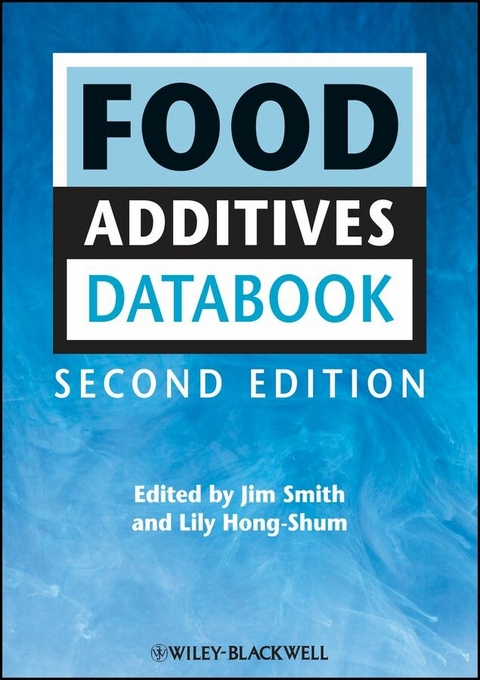
Food Additives Data Book (eBook)
John Wiley & Sons (Verlag)
978-1-4443-9772-7 (ISBN)
The revised second edition of this major reference work covers all the 'must-have' technical data on food additives. Compiled by food industry experts with a proven track record of producing high quality reference work, this volume is the definitive resource for technologists in small, medium and large companies, and for workers in research, government and academic institutions.
Coverage is of Preservatives, Enzymes, Gases, Nutritive additives, Emulsifiers, Flour additives, Acidulants, Sequestrants, Antioxidants, Flavour enhancers, Colour, Sweeteners, Polysaccharides, Solvents.
Entries include information on: Function and Applications, Safety issues, International legal issues, Alternatives, Synonyms, Molecular Formula and mass, Alternative forms, Appearance, Boiling, melting, and flash points, density, purity, water content, solubility, Synergists, Antagonists, and more with full and easy-to-follow-up references.
Reviews of the first edition:
'Additives have their advantages for the food industry in order to provide safe and convenient food products. It is therefore essential that as much information as possible is available to allow an informed decision on the selection of an additive for a particular purpose. This data book provides such information - consisting of over 1000 pages and covering around 350 additives.
This data book does provide a vast amount of information; it is what it claims to be!
Overall, this is a very useful publication and a good reference book for anyone working in the food and dairy industry.'
-International Journal of Dairy Technology, Volume 59 Issue 2, May 2006
'This book is the best I have ever seen ... a clear winner over all other food additive books .... a superb edition.'
-SAAFOST (South African Association for Food Science and Technology)
Jim Smith studied Food Science in Glasgow, Winnipeg and Nottingham and has worked in the food ingredients industry as technical manager as well as in a scotch whisky distillery in both production and quality control. He taught, researched and consulted at Strathclyde and Caledonian Universities in Glasgow for six years before moving to the Prince Edward Island Food Technology Centre, Canada as Senior Food Scientist in 1988. He has been Executive Director of the Centre since 2003. Jim is a member of the United Nations/World Health Organisation Joint Expert Committee on Food Additives and has edited three books on food additives. He is President of the Canadian Institute of Food Science & Technology and vice-chair of FoodTech Canada, a newly-formed network of Canada's food tech centres whose aim is to commercialise new food products.
Lily Hong-Shum is a professional food and sensory scientist for the Food Technology Center in Prince Edward, Atlantic Canada. She has worked extensively with government and industry supported research and global strategic alliance projects that have focused on value-added product and process development, additive and preservative application for post-harvest stabilization of food commodities, frozen/chilled shelf-life extension, sensory evaluation, and commercial scale production.
The use of additives in food is a dynamic one, as consumers demand fewer additives in foods and as governments review the list of additives approved and their permitted levels. Scientists also refine the knowledge of the risk assessment process as well as improve analytical methods and the use of alternative additives, processes or ingredients. Since the first edition of the Food Additives Databook was published, there have been numerous changes due to these developments and some additives are no longer permitted, some have new permitted levels of use and new additives have been assessed and approved. The revised second edition of this major reference work covers all the "e;must-have"e; technical data on food additives. Compiled by food industry experts with a proven track record of producing high quality reference work, this volume is the definitive resource for technologists in small, medium and large companies, and for workers in research, government and academic institutions. Coverage is of Preservatives, Enzymes, Gases, Nutritive additives, Emulsifiers, Flour additives, Acidulants, Sequestrants, Antioxidants, Flavour enhancers, Colour, Sweeteners, Polysaccharides, Solvents. Entries include information on: Function and Applications, Safety issues, International legal issues, Alternatives, Synonyms, Molecular Formula and mass, Alternative forms, Appearance, Boiling, melting, and flash points, density, purity, water content, solubility, Synergists, Antagonists, and more with full and easy-to-follow-up references. Reviews of the first edition: "e;Additives have their advantages for the food industry in order to provide safe and convenient food products. It is therefore essential that as much information as possible is available to allow an informed decision on the selection of an additive for a particular purpose. This data book provides such information - consisting of over 1000 pages and covering around 350 additives. This data book does provide a vast amount of information; it is what it claims to be! Overall, this is a very useful publication and a good reference book for anyone working in the food and dairy industry."e; International Journal of Dairy Technology, Volume 59 Issue 2, May 2006 "e;This book is the best I have ever seen ... a clear winner over all other food additive books .... a superb edition."e; SAAFOST (South African Association for Food Science and Technology)
Jim Smith studied Food Science in Glasgow, Winnipeg and Nottingham and has worked in the food ingredients industry as technical manager as well as in a scotch whisky distillery in both production and quality control. He taught, researched and consulted at Strathclyde and Caledonian Universities in Glasgow for six years before moving to the Prince Edward Island Food Technology Centre, Canada as Senior Food Scientist in 1988. He has been Executive Director of the Centre since 2003. Jim is a member of the United Nations/World Health Organisation Joint Expert Committee on Food Additives and has edited three books on food additives. He is President of the Canadian Institute of Food Science & Technology and vice-chair of FoodTech Canada, a newly-formed network of Canada's food tech centres whose aim is to commercialise new food products. Lily Hong-Shum is a professional food and sensory scientist for the Food Technology Center in Prince Edward, Atlantic Canada. She has worked extensively with government and industry supported research and global strategic alliance projects that have focused on value-added product and process development, additive and preservative application for post-harvest stabilization of food commodities, frozen/chilled shelf-life extension, sensory evaluation, and commercial scale production.
How to Use This Book.
Part 1. Acidulants.
Part 2. Antioxidants.
Part 3. Colourings.
Part 4. Emulsifiers.
Part 5. Enzymes.
Part 6. Flavour Enhancers.
Part 7. Flour Additives.
Part 8. Gases.
Part 9. Nutritive Additives.
Part 10. Polysaccharides.
Part 11. Preservatives.
Part 12. Sequestrants.
Part 13. Solvents.
Part 14. Sweeteners.
Index
"This reference provides practicing and student food technologists
information about a wide range of food additives with articles
arranged by function, such as antioxidants, flavor enhancers,
preservatives, and sweeteners . . . The index is very detailed."
(Book News, 1 August 2011)
| Erscheint lt. Verlag | 8.4.2011 |
|---|---|
| Sprache | englisch |
| Themenwelt | Naturwissenschaften ► Biologie |
| Technik ► Lebensmitteltechnologie | |
| Weitere Fachgebiete ► Land- / Forstwirtschaft / Fischerei | |
| Schlagworte | Additives • additives databook • Analytical • Assessment • changes • Consumers • Due • dynamic • Edition • fewer • First • Food • Foods • Food Science & Technology • IMPROVE • ingredients • Knowledge • Lebensmittelforschung u. -technologie • levels • List • longer • Methods • numerous • Process • Risk • scientists • use • Zusatzstoffe |
| ISBN-10 | 1-4443-9772-9 / 1444397729 |
| ISBN-13 | 978-1-4443-9772-7 / 9781444397727 |
| Informationen gemäß Produktsicherheitsverordnung (GPSR) | |
| Haben Sie eine Frage zum Produkt? |
 PDF (Adobe DRM)
Kopierschutz: Adobe-DRM
Adobe-DRM ist ein Kopierschutz, der das eBook vor Mißbrauch schützen soll. Dabei wird das eBook bereits beim Download auf Ihre persönliche Adobe-ID autorisiert. Lesen können Sie das eBook dann nur auf den Geräten, welche ebenfalls auf Ihre Adobe-ID registriert sind.
Details zum Adobe-DRM
Dateiformat: PDF (Portable Document Format)
Mit einem festen Seitenlayout eignet sich die PDF besonders für Fachbücher mit Spalten, Tabellen und Abbildungen. Eine PDF kann auf fast allen Geräten angezeigt werden, ist aber für kleine Displays (Smartphone, eReader) nur eingeschränkt geeignet.
Systemvoraussetzungen:
PC/Mac: Mit einem PC oder Mac können Sie dieses eBook lesen. Sie benötigen eine
eReader: Dieses eBook kann mit (fast) allen eBook-Readern gelesen werden. Mit dem amazon-Kindle ist es aber nicht kompatibel.
Smartphone/Tablet: Egal ob Apple oder Android, dieses eBook können Sie lesen. Sie benötigen eine
Geräteliste und zusätzliche Hinweise
Buying eBooks from abroad
For tax law reasons we can sell eBooks just within Germany and Switzerland. Regrettably we cannot fulfill eBook-orders from other countries.
aus dem Bereich