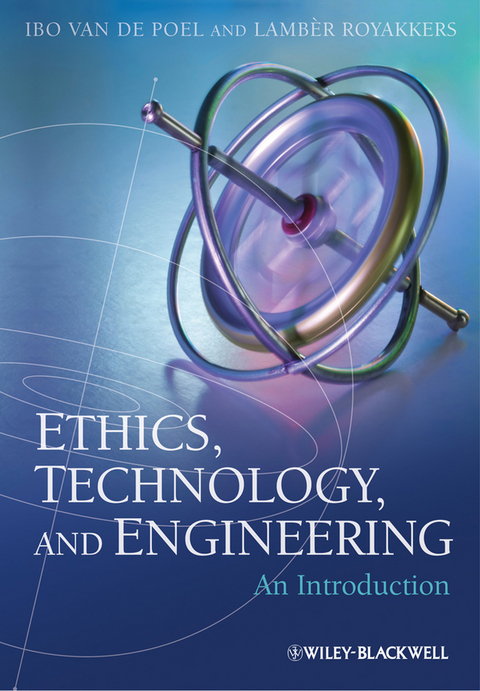
Ethics, Technology, and Engineering (eBook)
John Wiley & Sons (Verlag)
978-1-4443-9570-9 (ISBN)
- Utilizes a systematic approach to ethical case analysis -- the ethical cycle -- which features a wide range of real-life international case studies including the Challenger Space Shuttle, the Herald of Free Enterprise and biofuels.
- Covers a broad range of topics, including ethics in design, risks, responsibility, sustainability, and emerging technologies
- Can be used in conjunction with the online ethics tool Agora (http://www.ethicsandtechnology.com)
- Provides engineering students with a clear introduction to the main ethical theories
- Includes an extensive glossary with key terms
Ibo van de Poel is Associate Professor in Ethics and Technology at Delft University of Technology. He is an associate editor of the Handbook of Philosophy of Technology and the Engineering Sciences (2009) and co-editor of Philosophy and Engineering (2010).
Lambèr Royakkers is Associate Professor in Ethics of Technology at Eindhoven University of Technology, and Associate Professor in Military Ethics at Netherlands Defense Academy. He is also Project Leader of the research programme Moral Fitness of Military Personnel in a Networked Environment, sponsored by the Netherlands Organization for Scientific Research.
Ibo van de Poel is Associate Professor in Ethics and Technology at Delft University of Technology. He is an associate editor of the Handbook of Philosophy of Technology and the Engineering Sciences (2009) and co-editor of Philosophy and Engineering (2010). Lambèr Royakkers is Associate Professor in Ethics of Technology at Eindhoven University of Technology, and Associate Professor in Military Ethics at Netherlands Defense Academy. He is also Project Leader of the research programme Moral Fitness of Military Personnel in a Networked Environment, sponsored by the Netherlands Organization for Scientific Research.
Acknowledgments.
Introduction.
1 The Responsibilities of Engineers.
1.1 Introduction.
1.2 Responsibility.
1.3 Passive Responsibility.
1.4 Active Responsibility and the Ideals of Engineers.
1.5 Engineers versus Managers.
1.6 The Social Context of Technological Development.
1.7 Chapter Summary.
2 Codes of Conduct.
2.1 Introduction.
2.2 Codes of Conduct.
2.3 Possibilities and Limitations of Codes of Conduct.
2.4 Codes of Conduct in an International Context.
2.5 Chapter Summary.
3 Normative Ethics.
3.1 Introduction.
3.2 Ethics and Morality.
3.3 Descriptive and Normative Judgments.
3.4 Points of Departure: Values, Norms, and Virtues.
3.5 Relativism and Absolutism.
3.6 Ethical Theories.
3.7 Utilitarianism.
3.8 Kantian Theory.
3.9 Virtue Ethics.
3.10 Care Ethics.
3.11 Applied Ethics.
3.12 Chapter Summary.
4 Normative Argumentation.
4.1 Introduction.
4.2 Valid Arguments.
4.3 Deductive and Non-Deductive Arguments.
4.4 Arguments in Ethical Theories.
4.5 Fallacies.
4.6 Chapter Summary.
5 The Ethical Cycle.
5.1 Introduction.
5.2 Ill-Structured Problems.
5.3 The Ethical Cycle.
5.4 An Example.
5.5 Collective Moral Deliberation and Social Arrangements.
5.6 Chapter Summary.
6 Ethical Questions in the Design of Technology.
6.1 Introduction.
6.2 Ethical Issues During the Design Process.
6.3 Trade-offs and Value Conflicts.
6.4 Regulatory Frameworks: Normal and Radical Design.
6.5 Chapter Summary.
7 Designing Morality (Peter-Paul Verbeek).
7.1 Introduction.
7.2 Ethics as a Matter of Things.
7.3 Technological Mediation.
7.4 Moralizing Technology.
7.5 Designing Mediations.
7.6 Chapter Summary.
8 Ethical Aspects of Technical Risks.
8.1 Introduction.
8.2 Definitions of Central Terms.
8.3 The Engineer's Responsibility for Safety.
8.4 Risk Assessment.
8.5 When are Risks Acceptable?
8.6 Risk Communication.
8.7 Dealing with Uncertainty and Ignorance.
8.8 Chapter Summary.
9 The Distribution of Responsibility in Engineering.
9.1 Introduction.
9.2 The Problem of Many Hands.
9.3 Responsibility and the Law.
9.4 Responsibility in Organizations.
9.5 Responsibility Distributions and Technological Designs.
9.6 Chapter Summary.
10 Sustainability, Ethics, and Technology (MichielBrumsen).
10.1 Introduction.
10.2 Environmental Ethics?
10.3 Environmental Problems.
10.4 Sustainable Development.
10.5 Can a Sustainable Society be Realized?
10.6 Engineers and Sustainability.
10.7 Chapter Summary.
Study Questions.
Discussion Questions.
Appendix I: Engineering Qualifications and Organizations in aNumber of Countries.
Appendix II: NSPE Code of Ethics for Engineers.
Appendix III: FEANI Position Paper on Code of Conduct: Ethicsand Conduct of Professional Engineers.
Appendix IV: Shell Code of Conduct.
Appendix V: DSM Values and Whistle Blowing Policy.
Glossary.
References.
Index of Cases.
Index.
"Ethics, Technology, and Engineering: An Introduction is a
genuine contribution to an already substantial literature on ethics
in the techno-lifeworld. Arising from within a world where humans
live more intensely integrated with and thoughtfully reliant on
technology than anywhere else on the planet, this volume
constitutes a new realization of historico-philosophical
promise."
--Carl Mitcham, Colorado School of Mines
"Ethics, Technology, and Engineering takes undergraduate
education in engineering ethics to a new level. It shows why
engineers need to reflect seriously on ethics, and provides them
with the tools they need to do so. This is exactly what we need to
teach ethics to engineers."
--Sven Ove Hansson, Royal Institute of
Technology, Sweden
"Van de Poel and Royakkers have written a most comprehensive,
up-to-date, and readable text. Their discussion of the different
grounds for, and ways of framing, moral problems likely to be
encountered in engineering covers all the bases; their illustrative
cases, drawn in the main from contemporary practice, are treated
circumspectly and will no doubt provoke the kind of open discussion
of engineering decision-making they intend. It is the best
treatment of this subject geared toward the undergraduate I have
encountered."
--Louis L. Bucciarelli, MIT
| Erscheint lt. Verlag | 25.2.2011 |
|---|---|
| Sprache | englisch |
| Themenwelt | Geisteswissenschaften ► Philosophie ► Allgemeines / Lexika |
| Geisteswissenschaften ► Philosophie ► Erkenntnistheorie / Wissenschaftstheorie | |
| Geisteswissenschaften ► Philosophie ► Ethik | |
| Naturwissenschaften | |
| Technik | |
| Schlagworte | engineers, codes of conduct, normative ethics, sustainability, design, risk, applied • Philosophie • Philosophie i. d. Technik • Philosophy • Philosophy of Technology |
| ISBN-10 | 1-4443-9570-X / 144439570X |
| ISBN-13 | 978-1-4443-9570-9 / 9781444395709 |
| Informationen gemäß Produktsicherheitsverordnung (GPSR) | |
| Haben Sie eine Frage zum Produkt? |
 PDF (Adobe DRM)
Kopierschutz: Adobe-DRM
Adobe-DRM ist ein Kopierschutz, der das eBook vor Mißbrauch schützen soll. Dabei wird das eBook bereits beim Download auf Ihre persönliche Adobe-ID autorisiert. Lesen können Sie das eBook dann nur auf den Geräten, welche ebenfalls auf Ihre Adobe-ID registriert sind.
Details zum Adobe-DRM
Dateiformat: PDF (Portable Document Format)
Mit einem festen Seitenlayout eignet sich die PDF besonders für Fachbücher mit Spalten, Tabellen und Abbildungen. Eine PDF kann auf fast allen Geräten angezeigt werden, ist aber für kleine Displays (Smartphone, eReader) nur eingeschränkt geeignet.
Systemvoraussetzungen:
PC/Mac: Mit einem PC oder Mac können Sie dieses eBook lesen. Sie benötigen eine
eReader: Dieses eBook kann mit (fast) allen eBook-Readern gelesen werden. Mit dem amazon-Kindle ist es aber nicht kompatibel.
Smartphone/Tablet: Egal ob Apple oder Android, dieses eBook können Sie lesen. Sie benötigen eine
Geräteliste und zusätzliche Hinweise
Buying eBooks from abroad
For tax law reasons we can sell eBooks just within Germany and Switzerland. Regrettably we cannot fulfill eBook-orders from other countries.
aus dem Bereich