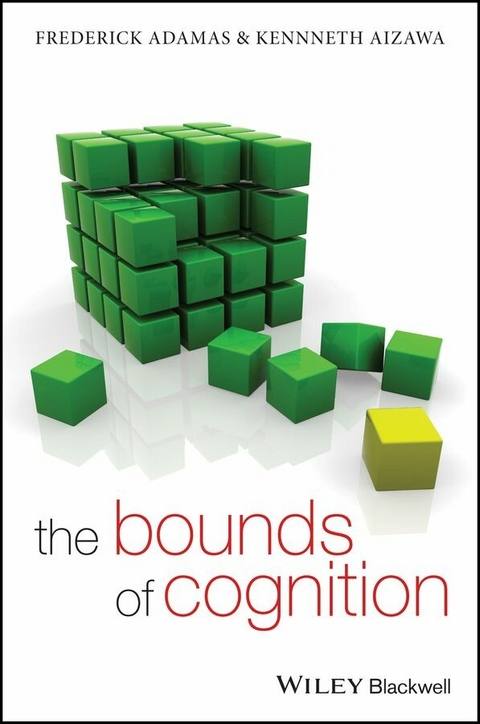
The Bounds of Cognition (eBook)
John Wiley & Sons (Verlag)
978-1-4443-5730-1 (ISBN)
- A timely and relevant study that exposes the need to develop a more sophisticated theory of cognition, while pointing to a bold new direction in exploring the nature of cognition
- Articulates and defends the “mark of the cognitive”, a common sense theory used to distinguish between cognitive and non-cognitive processes
- Challenges the current popularity of extended cognition theory through critical analysis and by pointing out fallacies and shortcoming in the literature
- Stimulates discussions that will advance debate about the nature of cognition in the cognitive sciences
Frederick Adams is Professor of Cognitive Science & Philosophy and Chair of Linguistics and Cognitive Science at the University of Delaware. He is also director of the Delaware Program in Cognitive Science. He publishes in epistemology, philosophy of language, philosophy of mind, and philosophy of science.
Kenneth Aizawa is Charles T. Beaird Professor of Philosophy in the Department of Philosophy at Centenary College of Louisiana and is the author of The Systematicity Arguments (2003).
An alarming number of philosophers and cognitive scientists have argued that mind extends beyond the brain and body. This book evaluates these arguments and suggests that, typically, it does not. A timely and relevant study that exposes the need to develop a more sophisticated theory of cognition, while pointing to a bold new direction in exploring the nature of cognition Articulates and defends the mark of the cognitive , a common sense theory used to distinguish between cognitive and non-cognitive processes Challenges the current popularity of extended cognition theory through critical analysis and by pointing out fallacies and shortcoming in the literature Stimulates discussions that will advance debate about the nature of cognition in the cognitive sciences
FREDERICK ADAMS is Professor of Cognitive Science & Philosophy and Chair of Linguistics and Cognitive Science at the University of Delaware. He is also director of the Delaware Program in Cognitive Science. He publishes in epistemology, philosophy of language, philosophy of mind, and philosophy of science. KENNETH AIZAWA is Charles T. Beaird Professor of Philosophy in the Department of Philosophy at Centenary College of Louisiana and is the author of The Systematicity Arguments (2003).
Preface vii
Acknowledgments xii
1 Introduction 1
2 Refining the Issues 16
2.1 What are the Boundaries? 16
2.2 What is Cognition? 22
2.3 The Possibility of Extended Cognition 25
2.4 Conclusion 29
3 Original Content 31
3.1 Part of the Mark of the Cognitive: Non-Derived Content 32
3.2 The Basics on Derived and Underived Content 35
3.3 Dennett's Critique of Original Content 39
3.4 Clark's Critique of Original Content 46
3.5 Anti-Representationalism in Dynamical Systems and Mobile Robotics 51
3.6 Conclusion 55
4 Cognitive Processes 57
4.1 Individuating Process Types in Science 58
4.2 Individuating Processes in Cognitive Psychology 60
4.3 A Broader Category of Cognition 70
4.4 Conclusion 74
5 The Mark of the Cognitive, Extended Cognition Style 76
5.1 Cognition as Information Processing, as Computation, and as Abiding in the Meaningful 76
5.2 Operationalism 79
5.3 Is This Merely a Terminological Issue? 83
5.4 Conclusion 85
6 The Coupling-Constitution Fallacy 88
6.1 Some Examples of the Coupling-Constitution Fallacy 93
6.2 Replies to the Coupling-Constitution Fallacy 99
6.3 Conclusion 105
7 Extended Cognitive Systems and Extended Cognitive Processes 106
7.1 Dynamical Systems Theory and Coupling 107
7.2 Haugeland's Theory of Systems and the Coupling of Components 112
7.3 Clark's Theories of Systems and Coupling 119
7.4 Conclusion 130
8 Cognitive Equivalence, Complementarity, and Evolution 133
8.1 Cognitive Equivalence 133
8.2 The Complementarity Argument 143
8.3 Evolutionary Arguments 147
8.4 Conclusion: The Importance of the Mark of the Cognitive 150
9 Inference to the Best Explanation and Extended Cognition 152
9.1 What is the Theory of Enactive Perception? 153
9.2 Noë's Evidence for Enactive Perception 156
9.3 The Case against Enactive Perception: Paralysis 166
9.4 Conclusion 172
10 Future Directions 174
Bibliography 180
Index 187
"Where is human cognition located? Is human cognitive processing
literally constituted (at least partly) by non-neural portions of
the environment? The contemporary debate about extended cognition
and the extended mind focuses on these questions, among others.
Frederick Adams and Kenneth Aizawa's new book, The Bounds of
Cognition (BC), contributes wonderfully to this debate. The book is
critical of the extended approach; but Adams and Aizawa (A&A)
also work toward a positive view, one that allows, in principle,
for extended cognition, while yielding very little of it when fed
the empirical facts."(Philosophical Psychology, November
2010)
"The Bounds of Cognition is the most thorough-going,
forceful, and compelling critique of EMH so far." (
Erkenntnis, September 2009)
"[This book] is without question a worthy and timely challenge
to extended cognition, as well as to areas in related enterprises
such as embodied cognition, situated cognition, dynamical systems
theory and artificial life.... I recommend the book highly to
anyone interested in these issues." (Phenomenology and the
Cognitive Sciences, June 2009)
"This is a well written, well argued book. Written by
philosophers mainly for philosophers.... It makes a serious
contribution to the extended cognition debate that anyone with a
serious interest in the issue needs to study." (Journal of
Consciousness Studies, January 2009)
"Advocates of EMT must undoubtedly examine the arguments and
criticisms that Adams and Aizawa offer in careful detail, because
The Bounds of Cognition is the most forceful and most
convincing criticism of their position so far."
(Metapsychology, October 2008)
"The [authors] wrote this book as a reasoned challenge
... .[It] offers an excellent overview of the promise, limits,
and problems of bounded cognition. Recommended."
(Choice)
"Adams and Aizawa have written a book that is going to leave more
than a few researchers in the burgeoning field of embodied
cognition scratching their heads and wondering how they could have
said those things. In a detailed study, Adams and Aizawa question
the very foundations of embodied cognition while on the way
elaborating a series of challenges that those who wish to continue
in the pursuit of embodied cognition must first address."
-Lawrence A. Shapiro, University of Wisconsin
"Adams and Aizawa provide a timely and important critique of an
emerging set of views and arguments often referred to as the
'extended mind.' Anyone interested in the current state
of arguments about the extended mind and the future direction of
cognitive science will want to read this book. I look forward to
responding to the arguments."
-Richard Menary, The University of Wollongong, Australia
| Erscheint lt. Verlag | 24.8.2011 |
|---|---|
| Sprache | englisch |
| Themenwelt | Geisteswissenschaften ► Philosophie ► Allgemeines / Lexika |
| Geisteswissenschaften ► Philosophie ► Geschichte der Philosophie | |
| Geisteswissenschaften ► Philosophie ► Philosophie der Neuzeit | |
| Geisteswissenschaften ► Psychologie ► Allgemeine Psychologie | |
| Geisteswissenschaften ► Psychologie ► Verhaltenstherapie | |
| Naturwissenschaften | |
| Schlagworte | Geistesphilosophie • Philosophie • Philosophy • Philosophy, cognition, bounded cognition, extended mind, embodied cognition, cognitive science • Philosophy of mind |
| ISBN-10 | 1-4443-5730-1 / 1444357301 |
| ISBN-13 | 978-1-4443-5730-1 / 9781444357301 |
| Informationen gemäß Produktsicherheitsverordnung (GPSR) | |
| Haben Sie eine Frage zum Produkt? |
 EPUB (Adobe DRM)
Kopierschutz: Adobe-DRM
Adobe-DRM ist ein Kopierschutz, der das eBook vor Mißbrauch schützen soll. Dabei wird das eBook bereits beim Download auf Ihre persönliche Adobe-ID autorisiert. Lesen können Sie das eBook dann nur auf den Geräten, welche ebenfalls auf Ihre Adobe-ID registriert sind.
Details zum Adobe-DRM
Dateiformat: EPUB (Electronic Publication)
EPUB ist ein offener Standard für eBooks und eignet sich besonders zur Darstellung von Belletristik und Sachbüchern. Der Fließtext wird dynamisch an die Display- und Schriftgröße angepasst. Auch für mobile Lesegeräte ist EPUB daher gut geeignet.
Systemvoraussetzungen:
PC/Mac: Mit einem PC oder Mac können Sie dieses eBook lesen. Sie benötigen eine
eReader: Dieses eBook kann mit (fast) allen eBook-Readern gelesen werden. Mit dem amazon-Kindle ist es aber nicht kompatibel.
Smartphone/Tablet: Egal ob Apple oder Android, dieses eBook können Sie lesen. Sie benötigen eine
Geräteliste und zusätzliche Hinweise
Buying eBooks from abroad
For tax law reasons we can sell eBooks just within Germany and Switzerland. Regrettably we cannot fulfill eBook-orders from other countries.
aus dem Bereich