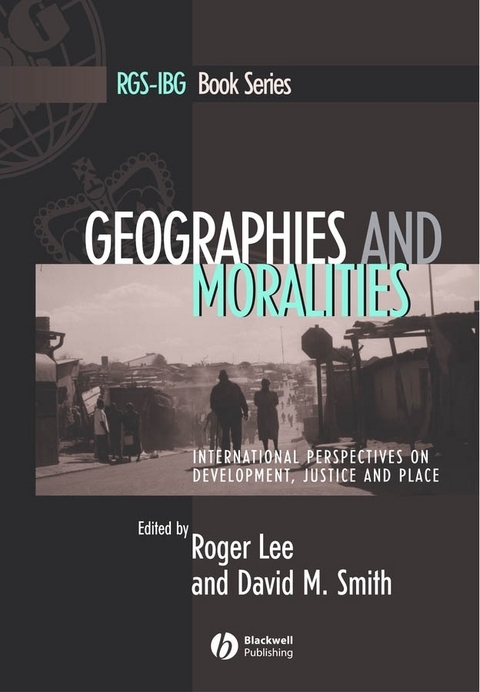
Geographies and Moralities (eBook)
336 Seiten
John Wiley & Sons (Verlag)
9781444355505 (ISBN)
interconnections between geography and morality.
* * Covers both the geographical context of morality, and
moralities in geographical methods and practices.
* Contains up-to-date case studies based on original
research.
* Deals with controversial issues, such as problems of
globalization, European integration, human rights in Nigeria,
territorial conflict in Israel, and land reform in post-apartheid
South Africa.
* The editors are well-published leading international
authorities.
* The contributors are drawn from Australia, Eastern Europe,
Israel, South Africa, the UK and the US.
Roger Lee is Professor of Geography at Queen Mary, University of London. He was editor of the Transactions of the Institute of British Geographers from 1993 to 1998 and is currently an editor of Progress in Human Geography. His previous publications include Economic Geography (third edition, 1982), Teaching Geography in Higher Education (Blackwell, 1991), Geographies of Economies (1997) and Alternative Economic Spaces (2003). He is also an academician of the Academy of Learned Societies in the Social Sciences. David M. Smith is Emeritus Professor of Geography at Queen Mary, University of London. He held earlier appointments at the Universities of Manchester, Southern Illinois, Florida, Natal, the Witwatersrand and New England (Australia). He is the author or editor of twenty books, including Geography and Social Justice (Blackwell, 1994) and Moral Geographies: Ethics in a World of Difference (2000).
Series Editors' Preface.
Notes on Contributors.
Foreword.
Preface.
Acknowledgements.
1. Introduction: Geographies of Morality/Moralities of
Geography: Roger Lee and David M. Smith (Both at Queen Mary,
University of London).
Part I: Geography and Ethics: Method and Practice.
2. The Quality of Ethics: Moral Causation and the
Interdisciplinary Science of Geography: William S. Lynn (Centre for
Humans and Nature in New York).
3. On the Pavement: Reflections on Fieldwork with Poor Black
Women Street Traders in Durban, South Africa: Priscilla Cunnan
(Queen Mary, University of London).
Part II: Moral Geographies of Uneven Development.
4. Globalisation, Production and Inequalities in Development:
Peter Dicken (University of Manchester).
5. Regional Inequality, Convergence and Enlargement in the
European Union: Nigel Spence (Queen Mary, University of
London).
6. Moral Problems of Eastern Wilderness: European Core and
Periphery: Boleslaw Domañski (Jagiellonian University).
7. Where the Grass is Greener in Poland: Regional and
Intra-urban Inequalities: Grzegorz Wêclawowicz (Polish Academy
of Sciences).
Part III: Moral Geographies of Distribution: Justice, Welfare
and Rights.
8. Social Exclusion, Health and Health Care: The Case of the
National Health Service in England: Sarah E. Curtis (Queen Mary,
University of London).
9. The Problem with Welfare: Susan Smith and Donna Easterlow
(Both at University of Edinburgh).
10. Struggles over Human Rights in Nigeria: Rex Honey
(University of Iowa).
11. Valuing Land and Distributing Territory: Avery Kolers
(University of Louisville, Kentucky).
12. When Two Rights Collide: Some Lessons from Jerusalem: Shlomo
Hasson (Hebrew University of Jerusalem).
13. Land Reform Policy in Post-Apartheid South Africa: The
Elusive Quest for Social Justice?: Brij Maharaj (University of
Natal).
Part IV: Moral Geographies in Place.
14. Waiting in Line, or the Moral and Material Geographies of
Queue-Jumping: Stuart Corbridge (University of Miami).
15. Moral Geographies of Sexual Citizenship: Gill Valentine
(University of Sheffield).
16. But Tight Jeans are Better! Moral Improvisation and Ethical
Judgement in Local Planning Decision-making: Jean Hillier
(University of Newcastle).
Part V: Moral Context and Professional Practice in
Geography.
17. Disciplinary Change and Career Paths: Ron Johnston
(University of Bristol).
18. From Location Theory to Moral Philosophy: Views from the
Fringe: David M. Smith (Queen Mary, University of London).
Index.
"This book provides a clear-sighted, critical and even-handed
introduction to this most troubled and troubling terrain."
Peter Jackson, University of Sheffield
"Geographies and Moralities honours David M. Smith
for his sustained contributions in this area, and illustrates the
diversity and relevance of contemporary geographical reflections on
moral issues."
Jim Proctor, University of California, Santa Barbara
"David M. Smith is among the first geographers to give
serious and sustained thought to the relationship between geography
and morality. This book is a collection of essays that originated
as a tribute to his life and work. And a worthy collection it is.
Each contribution is a thoughtful and caring expression of how, due
to Smith's inspiration, a particular part of that researcher's
interests now bears on moral issues."
Annals of the Association of American Geographers, Volume 96
Issue 1, March 2006
| Erscheint lt. Verlag | 22.7.2011 |
|---|---|
| Reihe/Serie | RGS-IBG Book Series | RGS-IBG Book Series |
| Sprache | englisch |
| Themenwelt | Naturwissenschaften ► Geowissenschaften ► Geografie / Kartografie |
| Sozialwissenschaften ► Politik / Verwaltung | |
| Sozialwissenschaften ► Soziologie ► Makrosoziologie | |
| Schlagworte | Economic Geography • Geographie • Geography • Global politics • Political Science • Politikwissenschaft • Social & Cultural Geography • Sozio- u. Kulturgeographie • Weltpolitik • Wirtschaftsgeographie |
| ISBN-13 | 9781444355505 / 9781444355505 |
| Informationen gemäß Produktsicherheitsverordnung (GPSR) | |
| Haben Sie eine Frage zum Produkt? |
 EPUB (Adobe DRM)
Kopierschutz: Adobe-DRM
Adobe-DRM ist ein Kopierschutz, der das eBook vor Mißbrauch schützen soll. Dabei wird das eBook bereits beim Download auf Ihre persönliche Adobe-ID autorisiert. Lesen können Sie das eBook dann nur auf den Geräten, welche ebenfalls auf Ihre Adobe-ID registriert sind.
Details zum Adobe-DRM
Dateiformat: EPUB (Electronic Publication)
EPUB ist ein offener Standard für eBooks und eignet sich besonders zur Darstellung von Belletristik und Sachbüchern. Der Fließtext wird dynamisch an die Display- und Schriftgröße angepasst. Auch für mobile Lesegeräte ist EPUB daher gut geeignet.
Systemvoraussetzungen:
PC/Mac: Mit einem PC oder Mac können Sie dieses eBook lesen. Sie benötigen eine
eReader: Dieses eBook kann mit (fast) allen eBook-Readern gelesen werden. Mit dem amazon-Kindle ist es aber nicht kompatibel.
Smartphone/Tablet: Egal ob Apple oder Android, dieses eBook können Sie lesen. Sie benötigen eine
Geräteliste und zusätzliche Hinweise
Buying eBooks from abroad
For tax law reasons we can sell eBooks just within Germany and Switzerland. Regrettably we cannot fulfill eBook-orders from other countries.
aus dem Bereich