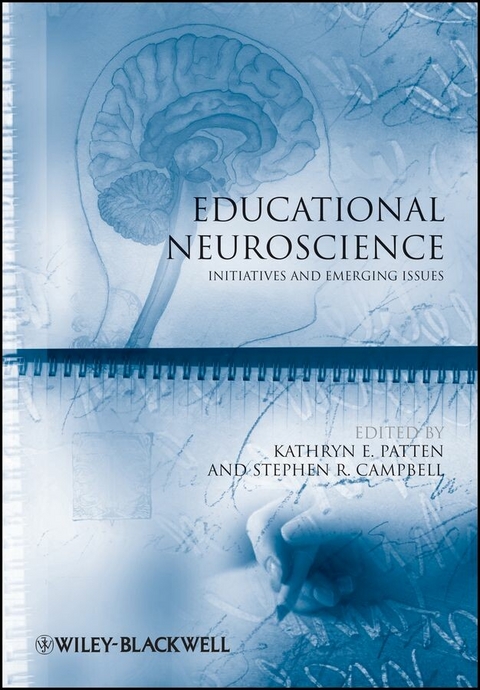
Educational Neuroscience (eBook)
John Wiley & Sons (Verlag)
978-1-4443-4580-3 (ISBN)
- Encourages interdisciplinary perspectives in educational neuroscience
- Contributions from leading researchers examine key issues relating to educational neuroscience and mind, brain, and education more generally
- Promotes a theoretical and empirical base for the subject area
- Explores a range of methods available to researchers
- Identifies agencies, organizations, and associations facilitating development in the field
- Reveals a variety of on-going efforts to establish theories, models, methods, ethics, and a common language
Kathryn E. Patten, Ph.D., teaches English Literature and Psychology; and is also the Outreach Coordinator for the Educational Neuroscience Laboratory, a.k.a. the ENGRAMMETRON, at Simon Fraser University.
Stephen R. Campbell, Ph.D., is Associate Professor of Education, co-Director of the David Wheeler Institute for Research in Mathematics Education, and Director of the Educational Neuroscience Laboratory, a.k.a., the ENGRAMMETRON, at Simon Fraser University.
Kathryn E. Patten, Ph.D., teaches English Literature and Psychology; and is also the Outreach Coordinator for the Educational Neuroscience Laboratory, a.k.a. the ENGRAMMETRON, at Simon Fraser University. Stephen R. Campbell, Ph.D., is Associate Professor of Education, co-Director of the David Wheeler Institute for Research in Mathematics Education, and Director of the Educational Neuroscience Laboratory, a.k.a., the ENGRAMMETRON, at Simon Fraser University.
Notes on Contributors vii
Foreword
Michael A. Peters xi
1 Introduction: Educational Neuroscience
Kathryn E. Patten & Stephen R. Campbell 1
2 Educational Neuroscience: Motivations, methodology, and
implications
Stephen R. Campbell 7
3 Can Cognitive Neuroscience Ground a Science of
Learning?
Anthony E. Kelly 17
4 A Multiperspective Approach to Neuroeducational
Research
Paul A. Howard-Jones 23
5 What Can Neuroscience Bring to Education?
Michel Ferrari 30
6 Connecting Education and Cognitive Neuroscience: Where will
the journey take us?
Daniel Ansar1, Donna Coch & Bert De Smedt
36
7 Position Statement on Motivations, Methodologies, and
Practical Implications of Educational Neuroscience Research: fMRI
studies of the neural correlates of creative intelligence
John Geake 42
8 Brain-Science Based Cohort Studies
Hideaki Koizumi 47
9 Directions for Mind, Brain, and Education: Methods, Models,
and Morality
Zachary Stein & Kurt W. Fischer 55
10 The Birth of a Field and the Rebirth of the Laboratory
School
Marc Schwartz & Jeanne Gerlach 66
11 Mathematics Education and Neurosciences: Towards
interdisciplinary insights into the development of young
children's mathematical abilities
Fenna Van Nes 74
12 Neuroscience and the Teaching of Mathematics
Kerry Lee & Swee Fong Ng 80
13 The Somatic Appraisal Model of Affect: Paradigm for
Educational Neuroscience and Neuropedagogy
Kathryn E. Patten 86
14 Implications of Affective and Social Neuroscience for
Educational Theory
Mary Helen Immordino-Yang 97
Index 103
| Erscheint lt. Verlag | 7.9.2011 |
|---|---|
| Reihe/Serie | Educational Philosophy and Theory Special Issues |
| Educational Philosophy and Theory Special Issues | Educational Philosophy and Theory Special Issues |
| Sprache | englisch |
| Themenwelt | Geisteswissenschaften ► Psychologie ► Pädagogische Psychologie |
| Naturwissenschaften ► Biologie ► Humanbiologie | |
| Naturwissenschaften ► Biologie ► Zoologie | |
| Sozialwissenschaften ► Pädagogik ► Allgemeines / Lexika | |
| Sozialwissenschaften ► Pädagogik ► Bildungstheorie | |
| Schlagworte | Bildungswesen • Education • Education, neuroscience, educational neuroscience, mind, brain, philosophy, method, theory • Pädagogik • Pädagogik • Theorie der Pädagogik • Theorie der Pädagogik • Theory of Education |
| ISBN-10 | 1-4443-4580-X / 144434580X |
| ISBN-13 | 978-1-4443-4580-3 / 9781444345803 |
| Informationen gemäß Produktsicherheitsverordnung (GPSR) | |
| Haben Sie eine Frage zum Produkt? |
 EPUB (Adobe DRM)
Kopierschutz: Adobe-DRM
Adobe-DRM ist ein Kopierschutz, der das eBook vor Mißbrauch schützen soll. Dabei wird das eBook bereits beim Download auf Ihre persönliche Adobe-ID autorisiert. Lesen können Sie das eBook dann nur auf den Geräten, welche ebenfalls auf Ihre Adobe-ID registriert sind.
Details zum Adobe-DRM
Dateiformat: EPUB (Electronic Publication)
EPUB ist ein offener Standard für eBooks und eignet sich besonders zur Darstellung von Belletristik und Sachbüchern. Der Fließtext wird dynamisch an die Display- und Schriftgröße angepasst. Auch für mobile Lesegeräte ist EPUB daher gut geeignet.
Systemvoraussetzungen:
PC/Mac: Mit einem PC oder Mac können Sie dieses eBook lesen. Sie benötigen eine
eReader: Dieses eBook kann mit (fast) allen eBook-Readern gelesen werden. Mit dem amazon-Kindle ist es aber nicht kompatibel.
Smartphone/Tablet: Egal ob Apple oder Android, dieses eBook können Sie lesen. Sie benötigen eine
Geräteliste und zusätzliche Hinweise
Buying eBooks from abroad
For tax law reasons we can sell eBooks just within Germany and Switzerland. Regrettably we cannot fulfill eBook-orders from other countries.
aus dem Bereich