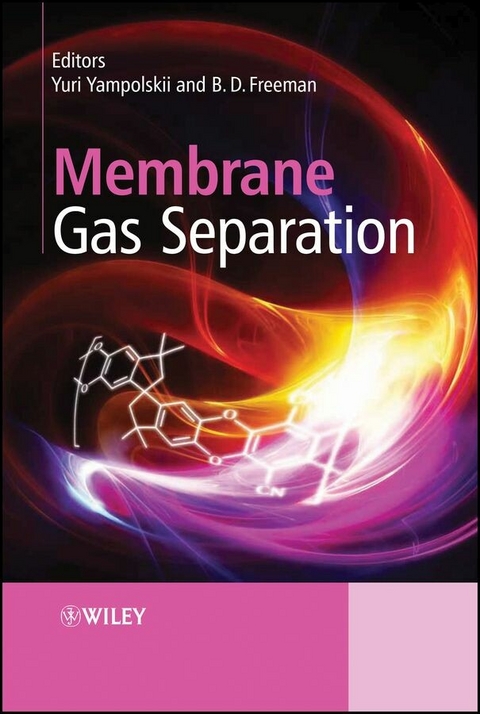
Membrane Gas Separation (eBook)
John Wiley & Sons (Verlag)
978-1-119-95658-7 (ISBN)
This book describes recent and emerging results in membrane gas separation, including highlights of nanoscience and technology, novel polymeric and inorganic membrane materials, new membrane approaches to solve environmental problems e.g. greenhouse gases, aspects of membrane engineering, and recent achievements in industrial gas separation. It includes:
- Hyperbranched polyimides, amorphous glassy polymers and perfluorinated copolymers
- Nanocomposite (mixed matrix) membranes
- Polymeric magnetic membranes
- Sequestration of CO2 to reduce global warming
- Industrial applications of gas separation
Developed from sessions of the most recent International Congress on Membranes and Membrane Processes, Membrane Gas Separation gives a snapshot of the current situation, and presents both fundamental results and applied achievements.
Benny D.Freeman - Kenneth A. Kobe and Paul D. and Betty Robertson Meek & American Petrofina Foundation Centennial Professor of Chemical Engineering University of Texas at Austin, Center for Energy and Environmental Resources. He researches in polymer science and engineering and, more specifically, in mass transport in polymers. His work in this field started in North Carolina State University, where he worked as assistant, associate professor and full professor during the period 1989-2002. In 2002 he moved to Department of Chemical Engineering of the University of Texas at Austin and currently directs 18 Ph.D. students and one postdoctoral fellow performing fundamental research in mass transport in polymers. I have taught a variety of short courses in the membranes area for societies such the ACS, the North American Membrane Society, and the International Congress on Membranes. I have also taught a course on this topic at the graduate level at the university. I have co-edited 4 books. Professor Freeman will be the 2009 ACS Awardee in Polymer Science in 2009.
Yuri Yampolskii, Professor, Head of Laboratory of membrane gas separation, A.V.Topchiev Institute of Petrochemical Synthesis, Moscow, Russia. Since the middle of 70s has been engaged in the studies of membrane separation, polymer physical chemistry and related subjects. At present he is Head of the laboratory dealing with the problems of membrane separation and pervaporation, gas permeation properties of various polymeric materials, vapor separation processes, sorption thermodynamics, free volume in polymers. He has published about 200 papers in peer reviewed journals and authored or co-authored several books.
Benny D.Freeman - Kenneth A. Kobe and Paul D. and Betty Robertson Meek & American Petrofina Foundation Centennial Professor of Chemical Engineering University of Texas at Austin, Center for Energy and Environmental Resources. He researches in polymer science and engineering and, more specifically, in mass transport in polymers. His work in this field started in North Carolina State University, where he worked as assistant, associate professor and full professor during the period 1989-2002. In 2002 he moved to Department of Chemical Engineering of the University of Texas at Austin and currently directs 18 Ph.D. students and one postdoctoral fellow performing fundamental research in mass transport in polymers. I have taught a variety of short courses in the membranes area for societies such the ACS, the North American Membrane Society, and the International Congress on Membranes. I have also taught a course on this topic at the graduate level at the university. I have co-edited 4 books. Professor Freeman will be the 2009 ACS Awardee in Polymer Science in 2009. Yuri Yampolskii, Professor, Head of Laboratory of membrane gas separation, A.V.Topchiev Institute of Petrochemical Synthesis, Moscow, Russia. Since the middle of 70s has been engaged in the studies of membrane separation, polymer physical chemistry and related subjects. At present he is Head of the laboratory dealing with the problems of membrane separation and pervaporation, gas permeation properties of various polymeric materials, vapor separation processes, sorption thermodynamics, free volume in polymers. He has published about 200 papers in peer reviewed journals and authored or co-authored several books.
| Erscheint lt. Verlag | 20.6.2011 |
|---|---|
| Sprache | englisch |
| Themenwelt | Naturwissenschaften ► Chemie ► Technische Chemie |
| Technik ► Umwelttechnik / Biotechnologie | |
| Schlagworte | APPROACHES • Benefits • Book • chemical engineering • Chemische Verfahrenstechnik • costs • Dünne Schichten, Oberflächen u. Grenzflächen • Dünne Schichten, Oberflächen u. Grenzflächen • environmental • Gas • Highlights • impacts • increasingly important • many industrial processes • Materials Science • Materialwissenschaften • Membrane • membrane gas • Membranes • Nanoscience • New • Number • Polymer Science & Technology • Polymerwissenschaft u. -technologie • Problems • Role • Separation • Thin Films, Surfaces & Interfaces |
| ISBN-10 | 1-119-95658-7 / 1119956587 |
| ISBN-13 | 978-1-119-95658-7 / 9781119956587 |
| Informationen gemäß Produktsicherheitsverordnung (GPSR) | |
| Haben Sie eine Frage zum Produkt? |
 EPUB (Adobe DRM)
Kopierschutz: Adobe-DRM
Adobe-DRM ist ein Kopierschutz, der das eBook vor Mißbrauch schützen soll. Dabei wird das eBook bereits beim Download auf Ihre persönliche Adobe-ID autorisiert. Lesen können Sie das eBook dann nur auf den Geräten, welche ebenfalls auf Ihre Adobe-ID registriert sind.
Details zum Adobe-DRM
Dateiformat: EPUB (Electronic Publication)
EPUB ist ein offener Standard für eBooks und eignet sich besonders zur Darstellung von Belletristik und Sachbüchern. Der Fließtext wird dynamisch an die Display- und Schriftgröße angepasst. Auch für mobile Lesegeräte ist EPUB daher gut geeignet.
Systemvoraussetzungen:
PC/Mac: Mit einem PC oder Mac können Sie dieses eBook lesen. Sie benötigen eine
eReader: Dieses eBook kann mit (fast) allen eBook-Readern gelesen werden. Mit dem amazon-Kindle ist es aber nicht kompatibel.
Smartphone/Tablet: Egal ob Apple oder Android, dieses eBook können Sie lesen. Sie benötigen eine
Geräteliste und zusätzliche Hinweise
Buying eBooks from abroad
For tax law reasons we can sell eBooks just within Germany and Switzerland. Regrettably we cannot fulfill eBook-orders from other countries.
aus dem Bereich