Infochemistry (eBook)
John Wiley & Sons (Verlag)
978-1-118-31619-1 (ISBN)
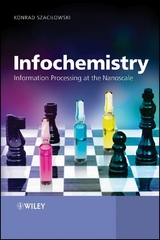
Infochemistry: Information Processing at the Nanoscale, defines a new field of science, and describes the processes, systems and devices at the interface between chemistry and information sciences. The book is devoted to the application of molecular species and nanostructures to advanced information processing. It includes the design and synthesis of suitable materials and nanostructures, their characterization, and finally applications of molecular species and nanostructures for information storage and processing purposes.
Divided into twelve chapters; the first three chapters serve as an introduction to the basic concepts of digital information processing, its development, limitations and finally introduces some alternative concepts for prospective technologies. Chapters four and five discuss traditional low-dimensional metals and semiconductors and carbon nanostructures respectively, while further chapters discuss Photoelectrochemical photocurrent switching and related phenomena and self-organization and self-assembly. Chapters eight, nine and ten discuss information processing at the molecular level, and eleven describes information processing in natural systems. The book concludes with a discussion of the future prospects for the field.
Further topics:
- Traditional electronic device development is rapidly approaching a limit, so molecular scale information processing is critical in order to meet increasing demand for high computational power
- Characterizes chemical systems not according to their chemical nature, but according to their role as prospective information technology elements
- Covers the application of molecular species and nanostructures as molecular scale logic gates, switches, memories, and complex computing devices
This book will be of particular interest to researchers in nanoelectronics, organic electronics, optoelectronics, chemistry and materials science.
Infochemistry: Information Processing at the Nanoscale, defines a new field of science, and describes the processes, systems and devices at the interface between chemistry and information sciences. The book is devoted to the application of molecular species and nanostructures to advanced information processing. It includes the design and synthesis of suitable materials and nanostructures, their characterization, and finally applications of molecular species and nanostructures for information storage and processing purposes. Divided into twelve chapters; the first three chapters serve as an introduction to the basic concepts of digital information processing, its development, limitations and finally introduces some alternative concepts for prospective technologies. Chapters four and five discuss traditional low-dimensional metals and semiconductors and carbon nanostructures respectively, while further chapters discuss Photoelectrochemical photocurrent switching and related phenomena and self-organization and self-assembly. Chapters eight, nine and ten discuss information processing at the molecular level, and eleven describes information processing in natural systems. The book concludes with a discussion of the future prospects for the field. Further topics: Traditional electronic device development is rapidly approaching a limit, so molecular scale information processing is critical in order to meet increasing demand for high computational power Characterizes chemical systems not according to their chemical nature, but according to their role as prospective information technology elements Covers the application of molecular species and nanostructures as molecular scale logic gates, switches, memories, and complex computing devices This book will be of particular interest to researchers in nanoelectronics, organic electronics, optoelectronics, chemistry and materials science.
Konrad Szacilowski is Professor of Inorganic Chemistry at AGH University of Science and Technology, and Associate Professor in Chemistry at Jagiellonian University, Poland. His research interests are focused mainly on information processing at the molecular level, surface engineering of nanocrystalline materials, photoelectrochemistry of wide band gap semiconductors, and molecular nanoelectronics.
Preface
1 Introduction to the theory of information
1.1 Introduction
1.2 Definition and properties of information
1.3 Principles of Boolean algebra
1.4 Digital information processing and logic gates
1.4.1 Simple logic gates
1.4.2 Concatenated logic circuits
1.4.3 Sequential logic circuits
1.5 Ternary and higher logic calculi
1.6 Irreversible vs reversible logic
2 Physical and technological limits of classical electronics
2.1 Introduction
2.2 Fundamental limitations of information processing
2.3 Technological limits of miniaturization
3 Changing the paradigm: towards computation with molecules
4 Low-dimensional metals and semiconductors
4.1 Dimensionality and morphology of nanostructures
4.2 Electrical and optical properties of nanoobjects and nanostructures
4.2.1 Metals
4.2.2 Semiconductors
4.3 Molecular scale engineering of semiconducting surfaces
4.3.1 Semiconductor-molecule interactions
4.2.3 Electronic coupling between semiconducting surfaces and adsorbates
5 Carbon nanostructures
5.1 Nanoforms of carbon
5.2 Electronic structure and properties of graphene
5.3 Carbon nanotubes
5.4 Conjugated and polyaromatic systems
5.5 Nanocarbon and organic semiconductor devices
6 Photoelectrochemical photocurrent switching and related phenomena
6.1 Photocurrent generation and switching in neat semiconductors
6.2 Photocurrent switching in MIM organic devices
6.3 Photocurrent switching in semiconducting composites
6.4 Photocurrent switching in surface-modified semiconductors
7 Self-organization and self-assembly in supramolecular systems
7.1 Supramolecular assembly: Towards molecular devices
7.2 Self-assembled semiconducting structures
7.3 Self-assembly at solid interfaces
7.4 Controlling self-assembly of nanoparticles
7.5 Self-assembly and molecular electronics
8 Molecular-scale electronics
8.1 Electron transfer and molecular junctions
8.2 Nanoscale electromagnetism
8.3 Molecular rectifiers
9 Molecular logic gates
9.1 Introduction
9.2 Chemically driven logic gates
9.2.1 OR gates
9.2.2 AND gates
9.2.3 XOR gates
9.2.4 INH gates
9.2.5 IMP gates
9.2.6 Inverted logic gates (NOR, NAND, XNOR)
9.2.7 Behind classical Boolean scheme - ternary logic and Feynman gate
9.3 All-optical logic gates
9.4 Electrochemical logic systems
10 Molecular computing systems
10.1 Introduction
10.2 Reconfigurable and superimposed molecular logic devices
10.3 Concatenated chemical logic systems
10.4 Molecular-scale digital communication
10.4.1 Multiplexers and demultiplexers
10.4.2 Encoders and decoders
10.4.3 Molecular scale signal amplification
10.5 Molecular arithmetics: Adders and subtractors
10.5.1 Molecular-scale half-adders
10.5.2 Molecular-scale half subtractors
10.5.3 Half adders/half subtractors
10.5.4 Full adders and full subtractors: towards molecular processors
10.6 Molecular scale security systems
10.7 Noise and error propagation in concatenated systems
11 Bioinspired and biomimetic logic devices
11.1 Information processing in natural systems
11.2 Protein-based digital systems
11.2.1 Enzymes as information processing molecules
11.2.2 Enzymes as information carriers
11.3 Binary logic devices based on nucleic acidd
11.4 Logic devices based on whole organisms
12 Concluding remarks and future prospects
| Erscheint lt. Verlag | 16.4.2012 |
|---|---|
| Sprache | englisch |
| Themenwelt | Naturwissenschaften ► Chemie |
| Technik ► Elektrotechnik / Energietechnik | |
| Technik ► Maschinenbau | |
| Schlagworte | Between • Book • Chemistry • Computational • Due • Electrical & Electronics Engineering • Electronic materials • Elektronische Materialien • Elektrotechnik u. Elektronik • Information • Interface • Key • Limits • Materials Science • Materialwissenschaften • miniaturization • molecular • Nanochemie • nanochemistry • Nanomaterial • Nanostrukturiertes Material • Nanotechnologie • nanotechnology • Need • Potential • Power • Processing • Science • Sciences • Storage • Switches • traditional transistors • use |
| ISBN-10 | 1-118-31619-3 / 1118316193 |
| ISBN-13 | 978-1-118-31619-1 / 9781118316191 |
| Informationen gemäß Produktsicherheitsverordnung (GPSR) | |
| Haben Sie eine Frage zum Produkt? |
 EPUB (Adobe DRM)
Kopierschutz: Adobe-DRM
Adobe-DRM ist ein Kopierschutz, der das eBook vor Mißbrauch schützen soll. Dabei wird das eBook bereits beim Download auf Ihre persönliche Adobe-ID autorisiert. Lesen können Sie das eBook dann nur auf den Geräten, welche ebenfalls auf Ihre Adobe-ID registriert sind.
Details zum Adobe-DRM
Dateiformat: EPUB (Electronic Publication)
EPUB ist ein offener Standard für eBooks und eignet sich besonders zur Darstellung von Belletristik und Sachbüchern. Der Fließtext wird dynamisch an die Display- und Schriftgröße angepasst. Auch für mobile Lesegeräte ist EPUB daher gut geeignet.
Systemvoraussetzungen:
PC/Mac: Mit einem PC oder Mac können Sie dieses eBook lesen. Sie benötigen eine
eReader: Dieses eBook kann mit (fast) allen eBook-Readern gelesen werden. Mit dem amazon-Kindle ist es aber nicht kompatibel.
Smartphone/Tablet: Egal ob Apple oder Android, dieses eBook können Sie lesen. Sie benötigen eine
Geräteliste und zusätzliche Hinweise
Buying eBooks from abroad
For tax law reasons we can sell eBooks just within Germany and Switzerland. Regrettably we cannot fulfill eBook-orders from other countries.
aus dem Bereich