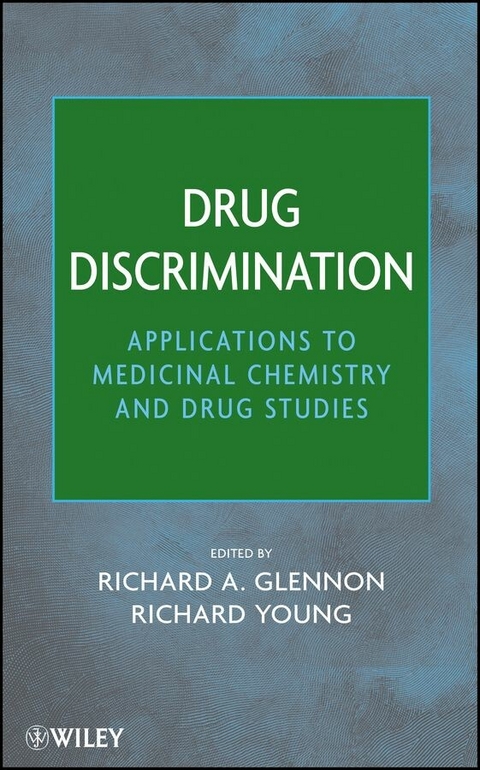
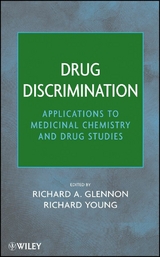
Drug Discrimination (eBook)
John Wiley & Sons (Verlag)
978-1-118-02313-6 (ISBN)
Drug discrimination: a practical guide to its contributions to the invention of new chemical entities and evaluations of new or known pharmacological agents
Drug discrimination can be described as a 'drug detection' procedure that uses a pharmacologically active agent as the subjective stimulus. Although the procedure does require some effort to implement, it can be an extremely important tool for understanding drug action. Whereas medicinal chemists should come to learn the types of information that drug discrimination studies can offer, pharmacologists and psychologists might come to realize how medicinal chemists can apply the types of information that the paradigm routinely provides. Drug Discrimination: Applications to Medicinal Chemistry and Drug Studies provides in-depth analyses of the nature and use of drugs as discriminative stimuli and bridges some of the numerous gaps between medicinal chemistry, pharmacology, and psychology.
Stressing the practical aspects of drug discrimination, including types of procedures, study design, data, and interpretation, the book details the advantages and limitations of drug discrimination studies versus other pharmacologic evaluations. Practical information from leading researchers in the field addresses specific topics and techniques that are of interest in drug discovery, evaluation, and development.
A groundbreaking new guide to the applications of drug discrimination studies for medicinal chemistry and neuroscience, Drug Discrimination is essential for any scientist, researcher, or student whose interests involve the design, development, and/or action of drugs acting at the level of the central nervous system.
Richard Glennon is Chair of the Department of Medicinal Chemistry at Virginia Commonwealth University. He is the author of over four hundred scientific publications and book chapters.
Richard Young is an Associate Professor in the Department of Medicinal Chemistry at Virginia Commonwealth University. Previously, he worked in the pharmaceutical industry at Ayerst and A. H. Robins (both now Pfizer).
Drug discrimination: a practical guide to its contributions to the invention of new chemical entities and evaluations of new or known pharmacological agents Drug discrimination can be described as a "e;drug detection"e; procedure that uses a pharmacologically active agent as the subjective stimulus. Although the procedure does require some effort to implement, it can be an extremely important tool for understanding drug action. Whereas medicinal chemists should come to learn the types of information that drug discrimination studies can offer, pharmacologists and psychologists might come to realize how medicinal chemists can apply the types of information that the paradigm routinely provides. Drug Discrimination: Applications to Medicinal Chemistry and Drug Studies provides in-depth analyses of the nature and use of drugs as discriminative stimuli and bridges some of the numerous gaps between medicinal chemistry, pharmacology, and psychology. Stressing the practical aspects of drug discrimination, including types of procedures, study design, data, and interpretation, the book details the advantages and limitations of drug discrimination studies versus other pharmacologic evaluations. Practical information from leading researchers in the field addresses specific topics and techniques that are of interest in drug discovery, evaluation, and development. A groundbreaking new guide to the applications of drug discrimination studies for medicinal chemistry and neuroscience, Drug Discrimination is essential for any scientist, researcher, or student whose interests involve the design, development, and/or action of drugs acting at the level of the central nervous system.
Richard Glennon is Chair of the Department of Medicinal Chemistry at Virginia Commonwealth University. He is the author of over four hundred scientific publications and book chapters. Richard Young is an Associate Professor in the Department of Medicinal Chemistry at Virginia Commonwealth University. Previously, he worked in the pharmaceutical industry at Ayerst and A. H. Robins (both now Pfizer).
Part I.
Chapter 1. An Introduction to Drug Discrimination.
Chapter 2. Methodological Considerations.
Chapter 3. Drug Discrimination: Practical Considerations.
Chapter 4. Role of Stereochemistry in Drug Discrimination Studies.
Chapter 5. Drug Discrimination and In Vivo Structure-Activity Relationships.
Chapter 6. Drug Discrimination and Mechanisms of Drug Action.
Chapter 7. Drug Discrimination and Development of Novel Agents and Pharmacological Tools.
Part II.
Chapter 8. Perceptual Drug Discriminative Aspects of the Endocannabinoid Signaling System in Animals and Man (Torbjörn U. C. Järbe).
Chapter 9. Discriminative Stimulus Properties of Receptor Antagonists (Joseph H. Porter).
Chapter 10. The Discrimination of Drug Mixtures (P. Stolerman).
Chapter 11. Making the Right Choice: Lessons From Drug Discrimination for Research on Drug Reinforcement and Drug Self-Administration (S. Stevens Negus and Matthew L. Banks).
Chapter 12. Inhalant Drug Discrimination: Methodology, Literature Review and Future Directions (Keith L. Shelton and Robert L. Balster).
Chapter 13. Drug Discrimination Studies in Rhesus Monkeys: Drug Dependence and Withdrawal (Jun-Xu Li, Lisa R. Gerak, and Charles P. France).
Chapter 14. Human Drug Discrimination: Methodological Considerations and Application to Elucidating the Neurophar,acology of Amphetamines (Craig R. Rush, Andrea R. Vansickel, and William W. Stoops).
Chapter 15. Nicotine Discrimination in Humans (Kenneth A. Perkins).
Chapter 16. Drug Discrimination: A Perspective (Francis C. Colpaert).
| Erscheint lt. Verlag | 4.8.2011 |
|---|---|
| Sprache | englisch |
| Themenwelt | Medizin / Pharmazie ► Gesundheitsfachberufe |
| Medizin / Pharmazie ► Medizinische Fachgebiete ► Pharmakologie / Pharmakotherapie | |
| Naturwissenschaften ► Biologie | |
| Naturwissenschaften ► Chemie | |
| Schlagworte | action • Active • Agent • Biowissenschaften • Chemie • Chemistry • Chemists • Contributions • Drug • Drug Discovery & Development • effort • Evaluations • extremely • Guide • implement • important • Information • Invention • Life Sciences • Medical Science • Medizin • Medizinische Chemie • Neuroscience • Neurowissenschaften • new chemical • pharmacologically • Pharmacology & Pharmaceutical Medicine • Pharmakologie u. Pharmazeutische Medizin • Practical • Procedure • Studies • subjective stimulus • Tool • Types • Wirkstoffforschung • Wirkstoffforschung u. -entwicklung |
| ISBN-10 | 1-118-02313-7 / 1118023137 |
| ISBN-13 | 978-1-118-02313-6 / 9781118023136 |
| Informationen gemäß Produktsicherheitsverordnung (GPSR) | |
| Haben Sie eine Frage zum Produkt? |
 EPUB (Adobe DRM)
Größe: 7,9 MB
Kopierschutz: Adobe-DRM
Adobe-DRM ist ein Kopierschutz, der das eBook vor Mißbrauch schützen soll. Dabei wird das eBook bereits beim Download auf Ihre persönliche Adobe-ID autorisiert. Lesen können Sie das eBook dann nur auf den Geräten, welche ebenfalls auf Ihre Adobe-ID registriert sind.
Details zum Adobe-DRM
Dateiformat: EPUB (Electronic Publication)
EPUB ist ein offener Standard für eBooks und eignet sich besonders zur Darstellung von Belletristik und Sachbüchern. Der Fließtext wird dynamisch an die Display- und Schriftgröße angepasst. Auch für mobile Lesegeräte ist EPUB daher gut geeignet.
Systemvoraussetzungen:
PC/Mac: Mit einem PC oder Mac können Sie dieses eBook lesen. Sie benötigen eine
eReader: Dieses eBook kann mit (fast) allen eBook-Readern gelesen werden. Mit dem amazon-Kindle ist es aber nicht kompatibel.
Smartphone/Tablet: Egal ob Apple oder Android, dieses eBook können Sie lesen. Sie benötigen eine
Geräteliste und zusätzliche Hinweise
Buying eBooks from abroad
For tax law reasons we can sell eBooks just within Germany and Switzerland. Regrettably we cannot fulfill eBook-orders from other countries.
 PDF (Adobe DRM)
Kopierschutz: Adobe-DRM
Adobe-DRM ist ein Kopierschutz, der das eBook vor Mißbrauch schützen soll. Dabei wird das eBook bereits beim Download auf Ihre persönliche Adobe-ID autorisiert. Lesen können Sie das eBook dann nur auf den Geräten, welche ebenfalls auf Ihre Adobe-ID registriert sind.
Details zum Adobe-DRM
Dateiformat: PDF (Portable Document Format)
Mit einem festen Seitenlayout eignet sich die PDF besonders für Fachbücher mit Spalten, Tabellen und Abbildungen. Eine PDF kann auf fast allen Geräten angezeigt werden, ist aber für kleine Displays (Smartphone, eReader) nur eingeschränkt geeignet.
Systemvoraussetzungen:
PC/Mac: Mit einem PC oder Mac können Sie dieses eBook lesen. Sie benötigen eine
eReader: Dieses eBook kann mit (fast) allen eBook-Readern gelesen werden. Mit dem amazon-Kindle ist es aber nicht kompatibel.
Smartphone/Tablet: Egal ob Apple oder Android, dieses eBook können Sie lesen. Sie benötigen eine
Geräteliste und zusätzliche Hinweise
Buying eBooks from abroad
For tax law reasons we can sell eBooks just within Germany and Switzerland. Regrettably we cannot fulfill eBook-orders from other countries.
aus dem Bereich