Principles and Case Studies of Simultaneous Design (eBook)
John Wiley & Sons (Verlag)
978-1-118-00163-9 (ISBN)
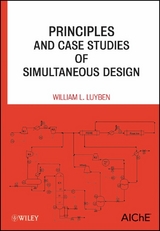
WILLIAM L. LUYBEN, PhD, is a professor at Lehigh University, and the author/co-author of thirteen textbooks. He has published over 250 technical papers in the area of process control and design and has supervised thirty-five PhD dissertations He has nine years of industrial experience with Exxon and DuPont.
Preface.
Chapter 1. Introduction.
1.1Overview.
1.2 History.
1.3 Books.
1.4 Tools.
1.5 Reference Textbooks.
Chapter 2. Principles of Reactor Design and Control.
2.1 Background.
2.2 Principles Derived from Chemistry.
2.3 Principles Derived from Phase of Reaction.
2.4 Determining Kinetic Parameters.
2.5 Principles of Reactor Heat Exchange.
2.6 Heuristic Design of Reactor/Separation Processes.
2.7 Conclusion.
Chapter 3. Principles of Distillation Design and Control.
3.1 Economic Optimum Design.
3.2 Principles of Distillation Control.
3.3 Conclusion.
Chapter 4. Basics of Dynamic Plantwide Control.
4.1 History.
4.2 Effects of Recycle.
4.3 Management of Fresh Feed Streams.
4.4 Conclusion.
Chapter 5. Economic Basis.
5.1 Assumptions.
5.2 Sizing Equipment.
5.3 Capital Investment.
5.4 Energy Costs.
5.5 Chemical Costs.
Chapter 6. Design and Control of the Acetone Process via Dehydrogenation of Isopropanol.
6.1 Process Description.
6.2 Turton Flowsheet.
6.3 Revised Flowsheet.
6.4 Economic Comparison.
6.5 Plantwide Control.
6.6 Conclusion.
Chapter 7. Design and Control of an Auto-Refrigerated Alkylation Process.
7.1 Introduction.
7.2 Process Description.
7.3 Design of Distillation Columns.
7.4 Economic Optimization of Entire Process.
7.5 Alternative Flowsheet.
7.6 Plantwide Control.
7.7 Conclusion.
Chapter 8. Design and Control of the Butyl Acetate Process.
8.1 Introduction.
8.2 Chemical Kinetics and Phase Equilibrium.
8.3 Process Flowsheet.
8.4 Economic Optimum Design.
8.5 Plantwide Control.
8.6 Conclusion.
Chapter 9. Design and Control of the Cumene Process.
9.1 Introduction.
9.2 Process Studied.
9.3 Economic Optimization.
9.4 Plantwide Control.
9.5 Conclusion.
Chapter 10. Design and Control of the Ethyl Benzene Process.
10.1 Introduction.
10.2 Process Studied.
10.3 Design of Distillation Columns.
10.4 Economic Optimization of Entire Process.
10.5 Plantwide Control.
10.6 Conclusion.
Chapter 11. Design and Control of a Methanol Reactor/Column Process.
11.1 Introduction.
11.2 Process Studies.
11.3 Reaction Kinetics.
11.4 Overall and Per-Pass Conversion.
11.5 Phase Equilibrium.
11.6 Effects of Design Optimization Variables.
11.7 Plantwide Control.
11.8 Conclusion.
Chapter 12. Design and Control of the Methoxy-Methy-Heptane Process.
12.1 Introduction.
12.2 Process Studies.
12.3 Reaction Kinetics.
12.4 Phase Equilibrium.
12.5 Design Optimization.
12.6 Optimum Distillation Column Design.
12.7 Plantwide Control.
12.8 Conclusion.
Chapter 13. Methyl Acetate.
13.1 Introduction.
13.2 Dehydration Section.
13.3 Carbonylation Section.
13.4 Plantwide Control.
13.5 Conclusion.
Chapter 14. Design and Control of the Mono-Isopropyl Amine Process.
14.1 Introduction.
14.2 Process Studies.
14.3 Economic Optimization.
14.4 Plantwide Control.
14.5 Conclusion.
Chapter 15. Design and Control of the Styrene Process.
15.1 Introduction.
15.2 Kinetics and Phase Equilibrium.
15.3 Vasudevan et al Flowsheet.
15.4 Effects of Design Optimization Variables.
15.5 Proposed Design.
15.6 Plantwide Control.
15.7 Conclusion.
"I highly recommend the important and all encompassing book Principles and Case Studies of Simultaneous Design by William L. Luyben, to any chemistry or engineering students, practicing chemical engineers, product designers in industry, and business leaders looking for a fresh approach to simultaneous design issues. This book will transform your company's industrial processes and product design into one of a leader in process design." (Blog Business World, 26 November 2011)
| Erscheint lt. Verlag | 30.9.2011 |
|---|---|
| Sprache | englisch |
| Themenwelt | Naturwissenschaften ► Chemie ► Technische Chemie |
| Technik ► Maschinenbau | |
| Technik ► Umwelttechnik / Biotechnologie | |
| Schlagworte | CASE • chemical engineering • Chemie • Chemische Verfahrenstechnik • Chemistry • complex industrial • Control • Creation • Design • designcomplete • economic • Effective • Examples • General • Guides • indepth • Maschinenbau • Maschinenbau - Entwurf • mechanical engineering • Mechanical Engineering - Design • Methods • Petrochemie / Brennstoffindustrie • Petrochemistry / Fuel • Presenting • Principles • processes • Readers • Rich • series • Simultaneous • Simultaneous Engineering • Studies • typically |
| ISBN-10 | 1-118-00163-X / 111800163X |
| ISBN-13 | 978-1-118-00163-9 / 9781118001639 |
| Informationen gemäß Produktsicherheitsverordnung (GPSR) | |
| Haben Sie eine Frage zum Produkt? |
 PDF (Adobe DRM)
Kopierschutz: Adobe-DRM
Adobe-DRM ist ein Kopierschutz, der das eBook vor Mißbrauch schützen soll. Dabei wird das eBook bereits beim Download auf Ihre persönliche Adobe-ID autorisiert. Lesen können Sie das eBook dann nur auf den Geräten, welche ebenfalls auf Ihre Adobe-ID registriert sind.
Details zum Adobe-DRM
Dateiformat: PDF (Portable Document Format)
Mit einem festen Seitenlayout eignet sich die PDF besonders für Fachbücher mit Spalten, Tabellen und Abbildungen. Eine PDF kann auf fast allen Geräten angezeigt werden, ist aber für kleine Displays (Smartphone, eReader) nur eingeschränkt geeignet.
Systemvoraussetzungen:
PC/Mac: Mit einem PC oder Mac können Sie dieses eBook lesen. Sie benötigen eine
eReader: Dieses eBook kann mit (fast) allen eBook-Readern gelesen werden. Mit dem amazon-Kindle ist es aber nicht kompatibel.
Smartphone/Tablet: Egal ob Apple oder Android, dieses eBook können Sie lesen. Sie benötigen eine
Geräteliste und zusätzliche Hinweise
Buying eBooks from abroad
For tax law reasons we can sell eBooks just within Germany and Switzerland. Regrettably we cannot fulfill eBook-orders from other countries.
aus dem Bereich