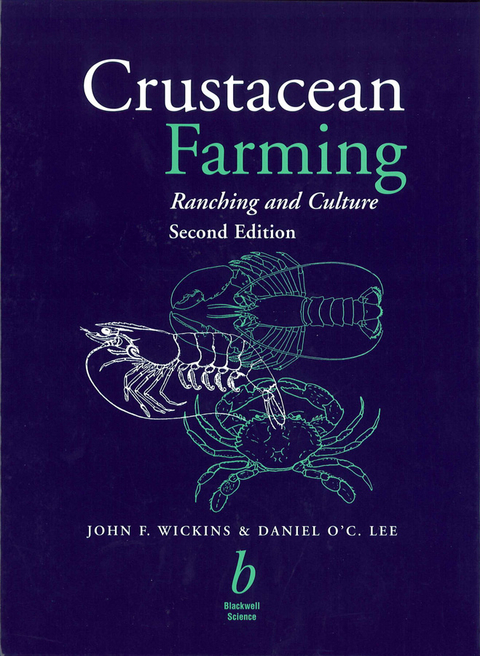
Crustacean Farming (eBook)
John Wiley & Sons (Verlag)
978-0-470-99507-5 (ISBN)
John F. Wickins and Daniel O'C Lee.
The second edition of an extremely well-received book, Crustacean Farming, deals with all cultivated crustaceans of commercial significance, shrimp, prawns, crayfish, lobsters, crabs, and spiny lobsters, and examines the criteria by which both the feasibility and desirability of farming proposals are assessed. The characteristics and production methods of farmed and candidate crustacean species are described in sufficient detail to enable areas of profitable involvement to be distinguished form other opportunities presenting only very high risks and possibilities for serious loss. Coverage extends right from broodstock acquisition and management through to the operation of hatcheries, nurseries and on-growing units to key aspects of processing and marketing. New to this second edition are ranching and re-stocking operations together with the culture of ornamental shrimp and small crustaceans used as live food in fish and shellfish hatcheries. The sections on crustacean diseases, genetics and nutrition have been extended in the light of recent research advances.
Examples of investment and operating costs of the different culture options are compared and an analysis of current trends in world crustacean markets is presented to assist in economic and financial appraisal.
Special consideration is given to the place of crustacean farming within the economics of developing nations in relation to social and environmental impact in order to promote awareness of the wider implications of global developments.
The consequences of recent research and technical developments are considered, together with concerns over genetic and animal welfare issues. Specific areas where further advances in technology are needed to improve the reliability or productivity of farming systems are highlighted. This important book is a vital tool and reference work for all those involved with crustacean farming worldwide.
John Wickins graduated in zoology at Southampton University in 1966. He then led research programmes on crustacean biology. Culture, recirculation systems and artificial habitats at the Conwy Laboratory of the Centre for Fisheries, Environment and Aquaculture Science (formerly Ministry of Agriculture, Fisheries and Food) until the laboratory was closed in December 1999. Before taking early retirement, he was an honorary lecturer at the Institute of Aquaculture, University of Stirling, and travelled widely on short-term advisory and assessment mission related to crustacean aquaculture.
Belfast-born Dan Lee became involved in commercial crustacean aquaculture in South America, initially as a biologist in Semacua, the first penaeid shrimp hatchery in Ecuador, and later as designer and technical manager of another Ecuadorian hatchery, Macrobio. Originally a graduate in zoology and marine biology at the University of Wales, Bangor, he returned to North Wales after five years and then worked on a series of shrimp hatchery and farm projects in Asia and Africa in the roles of research assistant, consultant and manger. He went on to gain MSc in project analysis, finance and investment at the University of York and remains active in commercial shrimp farming, currently from a base in the Caribbean.
Crustacean Farming: Ranching and Culture, Second edition. John F. Wickins and Daniel O'C Lee. The second edition of an extremely well-received book, Crustacean Farming, deals with all cultivated crustaceans of commercial significance, shrimp, prawns, crayfish, lobsters, crabs, and spiny lobsters, and examines the criteria by which both the feasibility and desirability of farming proposals are assessed. The characteristics and production methods of farmed and candidate crustacean species are described in sufficient detail to enable areas of profitable involvement to be distinguished form other opportunities presenting only very high risks and possibilities for serious loss. Coverage extends right from broodstock acquisition and management through to the operation of hatcheries, nurseries and on-growing units to key aspects of processing and marketing. New to this second edition are ranching and re-stocking operations together with the culture of ornamental shrimp and small crustaceans used as live food in fish and shellfish hatcheries. The sections on crustacean diseases, genetics and nutrition have been extended in the light of recent research advances. Examples of investment and operating costs of the different culture options are compared and an analysis of current trends in world crustacean markets is presented to assist in economic and financial appraisal. Special consideration is given to the place of crustacean farming within the economics of developing nations in relation to social and environmental impact in order to promote awareness of the wider implications of global developments. The consequences of recent research and technical developments are considered, together with concerns over genetic and animal welfare issues. Specific areas where further advances in technology are needed to improve the reliability or productivity of farming systems are highlighted. This important book is a vital tool and reference work for all those involved with crustacean farming worldwide.
John Wickins graduated in zoology at Southampton University in 1966. He then led research programmes on crustacean biology. Culture, recirculation systems and artificial habitats at the Conwy Laboratory of the Centre for Fisheries, Environment and Aquaculture Science (formerly Ministry of Agriculture, Fisheries and Food) until the laboratory was closed in December 1999. Before taking early retirement, he was an honorary lecturer at the Institute of Aquaculture, University of Stirling, and travelled widely on short-term advisory and assessment mission related to crustacean aquaculture. Belfast-born Dan Lee became involved in commercial crustacean aquaculture in South America, initially as a biologist in Semacua, the first penaeid shrimp hatchery in Ecuador, and later as designer and technical manager of another Ecuadorian hatchery, Macrobio. Originally a graduate in zoology and marine biology at the University of Wales, Bangor, he returned to North Wales after five years and then worked on a series of shrimp hatchery and farm projects in Asia and Africa in the roles of research assistant, consultant and manger. He went on to gain MSc in project analysis, finance and investment at the University of York and remains active in commercial shrimp farming, currently from a base in the Caribbean.
Acknowledgements.
Introduction: History, Objectives, Current status,
Advances and constraints.
Biology: Terminology, Disease, Genetics;.
Markets: Marketing crustaceans, World crustacean
markets.
Candidates for cultivation: Location, Broodstock, Larvae,
Post-larvae and juveniles, On-growing, Comparison of species.
On-growing options: Tropical climates, Warm temperate and
Mediterranean climates, Temperate climates, Polyculture, Production
of soft shelled crustaceans.
Hatchery supported fisheries, ranching and habitat
modification.
Site selection: Country or region, Locality,
Modifications to an existing facility.
Techniques: Species and groups: Penaeid shrimp,
Macrobrachium.
Other caridean shrimps and prawns, Crayfish: USA, Europe,
Australia, Clawed lobsters, Spiny lobsters, Crabs, Non-decapod
crustaceans.
Techniques: General, Materials: Pond design and
construction, Pond management, Water treatment methods, Water
quality tolerance, Monitoring water quality, Humane slaughter, Food
preparation and storage, Disease diagnosis, transmission,
prevention and control, Genetics, Hatchery supported fisheries,
ranching and habitat modification.
Project implementation and management: Conceptual phase,
Validation phase, Detailed planning phase, Implementation phase,
Food safety and HACCP, Management.
Economics: Finance, Investment appraisal, Risk,
Intensification, Costs.
Impact of crustacean aquaculture: Social impact,
Ecological impact, Environmental impact, Institutional
interactions.
The future for Crustacean farming: Introduction; Disease
Management; Domestication; Reproduction; Nutrition; Effluents and
environmental impacts; Stock enhancement; Production technologies;
Ornamental shrimp; Non-decapod crustaceans.
Appendix 1:Summary of biological data and examples of typical
culture performance.
Appendix 2:Shrimp counts.
Appendix 3:Glossary. .
Index
"...the book is so much enlarged and improved, yet still retaining
its accessability. This book is a "must-have" for anyone with an
interest in Crustacea whether from biological or economic point of
view."-Janet H Brown (Aquaculture News, April 2002)
"This fine book, which takes a global view, is absolutely
up-to-date and gives a very detailed overview of the problems and
most of their potential solutions. Anyone involved with investment
in crustacean farming, or its management by government, would be
foolish to make a move without first studying this very valuable
contribution to the body of knowledge." (Professional
Fisherman)
"In preparing a second edition of this excellent book... the
authors have taken the opportunity not only to update it but also
to radically broaden its scope... This edition... is worth every
penny.... it is a 'must have' for everyone involved in crustacean
aquaculture, even if they already own the first edition."
(Aquaculture Research)
"This book overall is a monumental piece of work. It is replete
with useful citations of other works... a great job of giving the
big picture of world crustacean farming. Moreover, it would serve
as a fine textbook at the college level."-Dr James W Avault
Jr (Aquaculture Magazine, 2002)
| Erscheint lt. Verlag | 15.4.2008 |
|---|---|
| Sprache | englisch |
| Themenwelt | Naturwissenschaften ► Biologie |
| Technik | |
| Weitere Fachgebiete ► Land- / Forstwirtschaft / Fischerei | |
| Schlagworte | Aquaculture, Fisheries & Fish Science • Aquakultur, Fischereiwesen u. Fischforschung • Book • candidate • Characteristics • commercial • crustacean • Crustaceans • Cultivated • Deals • described • Detail • Edition • extremely wellreceived • farmed • farming • Fisch u. Fischfang • Fish & Fisheries • Methods • Production • proposals • significance • species |
| ISBN-10 | 0-470-99507-6 / 0470995076 |
| ISBN-13 | 978-0-470-99507-5 / 9780470995075 |
| Informationen gemäß Produktsicherheitsverordnung (GPSR) | |
| Haben Sie eine Frage zum Produkt? |
 PDF (Adobe DRM)
Kopierschutz: Adobe-DRM
Adobe-DRM ist ein Kopierschutz, der das eBook vor Mißbrauch schützen soll. Dabei wird das eBook bereits beim Download auf Ihre persönliche Adobe-ID autorisiert. Lesen können Sie das eBook dann nur auf den Geräten, welche ebenfalls auf Ihre Adobe-ID registriert sind.
Details zum Adobe-DRM
Dateiformat: PDF (Portable Document Format)
Mit einem festen Seitenlayout eignet sich die PDF besonders für Fachbücher mit Spalten, Tabellen und Abbildungen. Eine PDF kann auf fast allen Geräten angezeigt werden, ist aber für kleine Displays (Smartphone, eReader) nur eingeschränkt geeignet.
Systemvoraussetzungen:
PC/Mac: Mit einem PC oder Mac können Sie dieses eBook lesen. Sie benötigen eine
eReader: Dieses eBook kann mit (fast) allen eBook-Readern gelesen werden. Mit dem amazon-Kindle ist es aber nicht kompatibel.
Smartphone/Tablet: Egal ob Apple oder Android, dieses eBook können Sie lesen. Sie benötigen eine
Geräteliste und zusätzliche Hinweise
Buying eBooks from abroad
For tax law reasons we can sell eBooks just within Germany and Switzerland. Regrettably we cannot fulfill eBook-orders from other countries.
aus dem Bereich