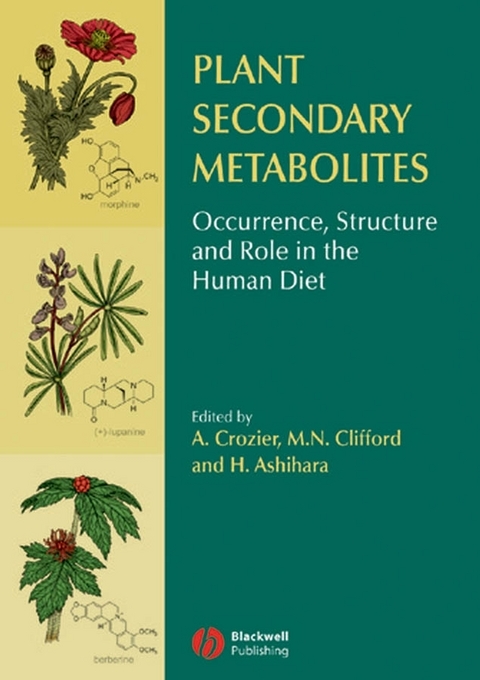
Plant Secondary Metabolites (eBook)
John Wiley & Sons (Verlag)
978-0-470-99413-9 (ISBN)
Plant Secondary Metabolites: Occurrence, Structure and Role in the Human Diet addresses this wider interest by covering the main groups of natural products from a chemical and biosynthetic perspective with illustrations of how genetic engineering can be applied to manipulate levels of secondary metabolites of economic value as well as those of potential importance in diet and health. These descriptive chapters are augmented by chapters showing where these products are found in the diet, how they are metabolised and reviewing the evidence for their beneficial bioactivity.
Alan Crozier is Professor of Plant Biochemistry and Human Nutrition in the Institute of Biomedical and Life Sciences at the University of Glasgow, UK, Mike Clifford is Professor of Food Safety in the School of Biomedical and Molecular Sciences at the University of Surrey, UK, and Hiroshi Ashihara is Professor of Plant Biochemistry in the Department of Biology at Ochanomizu University, Tokyo, Japan.
Contributors to the book:
Dr Michael H Beale
Dr Kirsten Brandt
Dr Lars P Christensen
Dr Jennifer L Donovan
Professor Peter J Facchini
Dr Richard M Faulks
Professor Glenn R Gibson
Dr Andrew J Humphrey
Dr Indu B Jaganath
Dr Paul A Kroon
Dr David K Liscombe
Dr Claudine Manach
Dr Serena Marks
Professor Richard Mithen
Dr Michael Saltmarsh
Dr Kieran M Tuohy
Dr Takao Yokota
Dr Katherine G Zulak
Plant secondary metabolites have been a fertile area of chemical investigation for many years, driving the development of both analytical chemistry and of new synthetic reactions and methodologies. The subject is multi-disciplinary with chemists, biochemists and plant scientists all contributing to our current understanding. In recent years there has been an upsurge in interest from other disciplines, related to the realisation that secondary metabolites are dietary components that may have a considerable impact on human health, and to the development of gene technology that permits modulation of the contents of desirable and undesirable components. Plant Secondary Metabolites: Occurrence, Structure and Role in the Human Diet addresses this wider interest by covering the main groups of natural products from a chemical and biosynthetic perspective with illustrations of how genetic engineering can be applied to manipulate levels of secondary metabolites of economic value as well as those of potential importance in diet and health. These descriptive chapters are augmented by chapters showing where these products are found in the diet, how they are metabolised and reviewing the evidence for their beneficial bioactivity.
Alan Crozier is Professor of Plant Biochemistry and Human Nutrition in the Institute of Biomedical and Life Sciences at the University of Glasgow, UK, Mike Clifford is Professor of Food Safety in the School of Biomedical and Molecular Sciences at the University of Surrey, UK, and Hiroshi Ashihara is Professor of Plant Biochemistry in the Department of Biology at Ochanomizu University, Tokyo, Japan. Contributors to the book: Dr Michael H Beale Dr Kirsten Brandt Dr Lars P Christensen Dr Jennifer L Donovan Professor Peter J Facchini Dr Richard M Faulks Professor Glenn R Gibson Dr Andrew J Humphrey Dr Indu B Jaganath Dr Paul A Kroon Dr David K Liscombe Dr Claudine Manach Dr Serena Marks Professor Richard Mithen Dr Michael Saltmarsh Dr Kieran M Tuohy Dr Takao Yokota Dr Katherine G Zulak
Contributors.
1 Phenols, Polyphenols and Tannins: An Overview (AlanCrozier, Indu B. Jaganath and Michael N. Clifford).
1.1 Introduction.
1.2 Classification of phenolic compounds.
1.3 Biosynthesis.
1.4 Genetic engineering of the flavonoid biosyntheticpathway.
1.5 Databases.
2 Sulphur-Containing Compounds (RichardMithen).
2.1 Introduction.
2.2 The glucosinolates-myrosinase system.
2.3 Chemical diversity of glucosinolates in dietarycrucifers.
2.4 Biosynthesis.
2.5 Genetic factors affecting glucosinolate content.
2.6 Environmental factors affecting glucosinolate content.
2.7 Myrosinases and glucosinolate hydrolysis.
2.8 Hydrolytic products.
2.9 Metabolism and detoxification of isothiocyanates.
2.10 The Alliin-alliinase system.
2.11 Biological activity of sulphur-containing compounds.
2.12 Anti-nutritional effects in livestock and humans.
2.13 Beneficial effects of sulphur-containing compounds in thehuman diet.
3 Terpenes (Andrew J. Humphrey and Michael H.Beale).
3.1 Introduction.
3.2 The biosynthesis of IPP and DMAPP.
3.3 Enzymes of terpene biosynthesis.
3.4 Isoprenoid biosynthesis in the plastids.
3.5 Isoprenoid biosynthesis in the cytosol.
3.6 Terpenes in the environment and human health: futureprospects.
4 Alkaloids (Katherine G. Zulak, David K. Liscombe,Hiroshi Ashihara and Peter J. Facchini).
4.1 Introduction.
4.2 Benzylisoquinoline alkaloids.
4.3 Tropane alkaloids.
4.4 Nicotine.
4.5 Terpenoid indole alkaloids.
4.6 Purine alkaloids.
4.7 Pyrrolizidine alkaloids.
4.8 Other alkaloids.
4.9 Metabolic engineering.
5 Acetylenes and Psoralens (Lars P. Christensen andKirsten Brandt).
5.1 Introduction.
5.2 Acetylenes in common food plants.
5.3 Psoralens in common food plants.
5.4 Perspectives in relation to food safety.
6. Functions of the Human Intestinal Flora: The Use ofProbiotics and Prebiotics (Kieran M. Tuohy and Glenn R.Gibson).
6.1 Introduction.
6.2 Composition of the gut microflora.
6.3 Successional development and the gut microflora in oldage.
6.4 Modulation of the gut microflora through dietary means.
6.5 In vitro and in vivo measurement of microbialactivities.
6.6 Molecular methodologies for assessing microflorachanges.
6.7 Assessing the impact of dietary modulation of the gutmicroflora-does it improve health, what are the likelihoods forsuccess and what are the biomarkers of efficacy?
6.8 Justification for the use of probiotics and prebiotics tomodulate the gut flora composition.
7 Secondary Metabolites in Fruits, Vegetables, Beverages andOther Plant-Based Dietary Components (Alan Crozier, TakaoYokota, Indu B. Jaganath, Serena Marks, Michael Saltmarsh andMichael N. Clifford).
7.1 Introduction.
7.2 Dietary phytochemicals.
7.3 Vegetables.
7.4 Fruits.
7.5 Herbs and spices.
7.6 Cereals.
7.7 Nuts.
7.8 Algae.
7.9 Beverages.
7.10 Databases.
8 Absorption and Metabolism of Dietary Plant SecondaryMetabolites (Jennifer L. Donovan, Claudine Manach, RichardM. Faulks and Paul A. Kroon).
8.1 Introduction.
8.2 Flavonoids.
8.3 Hydroxycinnamic acids.
8.4 Gallic acid and ellagic acid.
8.5 Dihydrochalcones.
8.6 Betalains.
8.7 Glucosinolates.
8.8 Carotenoids.
8.9 Conclusions.
Index.
"This book provides an excellent in-depth overview of the major
plant secondary metabolities which have been inverstigated for
health effects in recent years ... I believe this book will be of
interest to a wide array of readers, including plant biologists,
nutritional biochemists, public health scientists and medical
doctors, who need an overview of natural products and the pathways
of their formation." (The Biochemist, 1 February 2012)
"I'd strongly recommend this book for a variety of scientists.
Not only is it up to date, but it is also very readable. The topics
are related to the real world of food science in an effective way.
Most scientists (including graduate students) in areas of study
related to chemistry, biology and food science will find the book
of value and a good investment." Chemistry World
"The information in the book is recent and easy to
locate...would serve well as a textbook for graduate
students...as well as a good reference source."
Inform
"Of great value for botanists looking for basic information
about plant chemical compounds." Folia Geobotanica
"I'd strongly recommend this book for a variety of scientists. Not
only is it up to date, but it is also very readable. The topics are
related to the real world of food science in an effective way. Most
scientists (including graduate students) in areas of study related
to chemistry, biology and food science will find the book of value
and a good investment."
Chemistry World
"The information in the book is recent and easy to
locate...would serve well as a textbook for graduate
students...as well as a good reference source."
Inform
| Erscheint lt. Verlag | 15.4.2008 |
|---|---|
| Sprache | englisch |
| Themenwelt | Medizin / Pharmazie ► Gesundheitsfachberufe ► Diätassistenz / Ernährungsberatung |
| Naturwissenschaften ► Biologie | |
| Naturwissenschaften ► Chemie | |
| Technik ► Lebensmitteltechnologie | |
| Weitere Fachgebiete ► Land- / Forstwirtschaft / Fischerei | |
| Schlagworte | Analytical • area • Chemical • Chemie • Chemistry • Chemists • contributing • Current • Development • Fertile • Food chemistry • Food Science & Technology • Industrial Chemistry • Interest • investigation • Lebensmittelchemie • Lebensmittelforschung u. -technologie • many • Metabolites • multidisciplinary • New • Plant • scientists • Secondary • Subject • synthetic reactions • Technische u. Industrielle Chemie • upsurge • years |
| ISBN-10 | 0-470-99413-4 / 0470994134 |
| ISBN-13 | 978-0-470-99413-9 / 9780470994139 |
| Informationen gemäß Produktsicherheitsverordnung (GPSR) | |
| Haben Sie eine Frage zum Produkt? |
 PDF (Adobe DRM)
Kopierschutz: Adobe-DRM
Adobe-DRM ist ein Kopierschutz, der das eBook vor Mißbrauch schützen soll. Dabei wird das eBook bereits beim Download auf Ihre persönliche Adobe-ID autorisiert. Lesen können Sie das eBook dann nur auf den Geräten, welche ebenfalls auf Ihre Adobe-ID registriert sind.
Details zum Adobe-DRM
Dateiformat: PDF (Portable Document Format)
Mit einem festen Seitenlayout eignet sich die PDF besonders für Fachbücher mit Spalten, Tabellen und Abbildungen. Eine PDF kann auf fast allen Geräten angezeigt werden, ist aber für kleine Displays (Smartphone, eReader) nur eingeschränkt geeignet.
Systemvoraussetzungen:
PC/Mac: Mit einem PC oder Mac können Sie dieses eBook lesen. Sie benötigen eine
eReader: Dieses eBook kann mit (fast) allen eBook-Readern gelesen werden. Mit dem amazon-Kindle ist es aber nicht kompatibel.
Smartphone/Tablet: Egal ob Apple oder Android, dieses eBook können Sie lesen. Sie benötigen eine
Geräteliste und zusätzliche Hinweise
Buying eBooks from abroad
For tax law reasons we can sell eBooks just within Germany and Switzerland. Regrettably we cannot fulfill eBook-orders from other countries.
aus dem Bereich