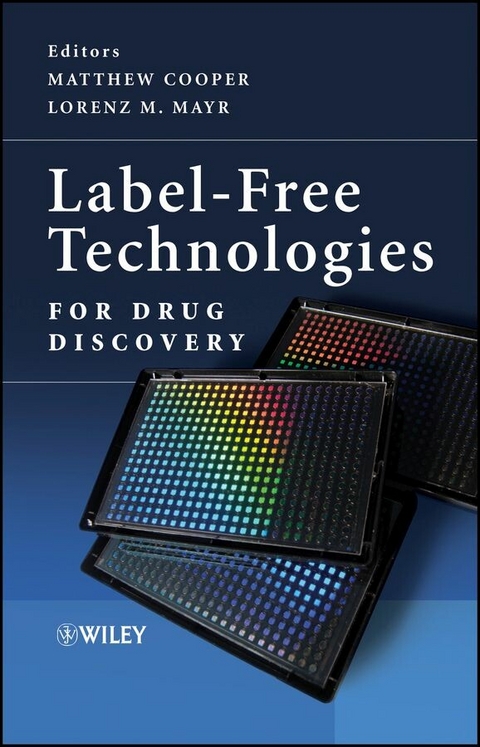
Label-Free Technologies For Drug Discovery (eBook)
John Wiley & Sons (Verlag)
978-0-470-97913-6 (ISBN)
Label-Free Technologies For Drug Discovery summarises the latest and emerging developments in label-free detection systems, their underlying technology principles and end-user case studies that reveal the power and limitations of label-free in all areas of drug discovery.
Label-free technologies discussed include SPR, NMR, high-throughput mass spectrometry, resonant waveguide plate-based screening, transmitted-light imaging, isothermal titration calorimetry, optical and impedance cell-based assays and other biophysical methods. The technologies are discussed in relation to their use as screening technologies, high-content technologies, hit finding and hit validation strategies, mode of action and ADME/T, access to difficult target classes, cell-based receptor/ligand interactions particularly orphan receptors, and antibody and small molecule affinity and kinetic analysis.
Label-Free Technologies For Drug Discovery is an essential guide to this emerging class of tools for researchers in drug discovery and development, particularly high-throughput screening and compound profiling teams, medicinal chemists, structural biologists, assay developers, ADME/T specialists, and others interested in biomolecular interaction analysis.
Dr Matthew Cooper, Institute for Molecular Bioscience, University of Queensland, Australia
Dr Cooper is a scientist and entrepreneur. He is Co-Founder and Chief Scientific Officer of Akubio Ltd; and Founder and Managing Director of Cambridge Medical Innovations. He has written more than 60 publications and invited reviews in leading scientific journals including Nature Biotechnology, Nature Cell Biology, and Nature Drug Discovery.
Dr Lorenz M. Mayr, Biology Unit, Protease Platform, Novartis Pharma AG, Basel, Switzerland
Dr Mayer is Head of the Biology Unit at the Protease Platform, Centre of Proteomic Chemistry (CPC), at Novartis Pharma AG with responsibility for target finding and target validation, protein expression, assay development and compound screening and profiling for all protease projects. Dr. Mayr is a member of several editorial and scientific advisory boards and also serves as a member at the Board of Directors of SBS, the Society of Biomolecular Sciences.
Over the past two decades the benefits of label-free biosensor analysis have begun to make an impact in the market, and systems are beginning to be used as mainstream research tools in many drug discovery laboratories. Label-Free Technologies For Drug Discovery summarises the latest and emerging developments in label-free detection systems, their underlying technology principles and end-user case studies that reveal the power and limitations of label-free in all areas of drug discovery. Label-free technologies discussed include SPR, NMR, high-throughput mass spectrometry, resonant waveguide plate-based screening, transmitted-light imaging, isothermal titration calorimetry, optical and impedance cell-based assays and other biophysical methods. The technologies are discussed in relation to their use as screening technologies, high-content technologies, hit finding and hit validation strategies, mode of action and ADME/T, access to difficult target classes, cell-based receptor/ligand interactions particularly orphan receptors, and antibody and small molecule affinity and kinetic analysis. Label-Free Technologies For Drug Discovery is an essential guide to this emerging class of tools for researchers in drug discovery and development, particularly high-throughput screening and compound profiling teams, medicinal chemists, structural biologists, assay developers, ADME/T specialists, and others interested in biomolecular interaction analysis.
Dr Matthew Cooper, Institute for Molecular Bioscience, University of Queensland, Australia Dr Cooper is a scientist and entrepreneur. He is Co-Founder and Chief Scientific Officer of Akubio Ltd; and Founder and Managing Director of Cambridge Medical Innovations. He has written more than 60 publications and invited reviews in leading scientific journals including Nature Biotechnology, Nature Cell Biology, and Nature Drug Discovery. Dr Lorenz M. Mayr, Biology Unit, Protease Platform, Novartis Pharma AG, Basel, Switzerland Dr Mayer is Head of the Biology Unit at the Protease Platform, Centre of Proteomic Chemistry (CPC), at Novartis Pharma AG with responsibility for target finding and target validation, protein expression, assay development and compound screening and profiling for all protease projects. Dr. Mayr is a member of several editorial and scientific advisory boards and also serves as a member at the Board of Directors of SBS, the Society of Biomolecular Sciences.
Label-Free TechnologiesFor Drug Discovery 3
Contents 7
Preface 17
List of Contributors 21
1 The Revolution of Real-Time, Label-Free Biosensor Applications 29
1.1 Introduction 29
1.2 SPR Pessimists 32
1.3 Setting Up Experiments 36
1.4 Data Processing and Analysis 41
1.5 The Good News 50
References 53
2 Design and Implementation of Vertically Emitting Distributed Feedback Lasers for Biological Sensing 55
2.1 Introduction 56
2.2 DFB Laser Biosensor Design 57
2.3 Fabrication and Instrumentation 60
2.4 Experimental Results 62
2.4.1 Vertically Emitting DFB Laser 62
2.4.2 Bulk Material Sensing 62
2.4.3 Sensitivity Resolution 64
2.4.4 Small Molecule Binding Detection 66
2.5 Conclusions 67
Acknowledgements 67
References 68
3 SPR Screening of Chemical Microarrays for Fragment-Based Discovery 69
3.1 Introduction 70
3.2 Key Features of Fragment Screening 70
3.3 SPR Fragment Screening 70
3.4 Synthesis of Library Compounds 71
3.5 Library Design and Array Content 72
3.6 Chemical Microarray Production 74
3.7 Surface Plasmon Resonance 76
3.8 SPR Imaging 77
3.9 Array Visualization and Analysis 78
3.10 Follow-up 80
3.11 Applications: MMP Case Study 80
3.11.1 Search for New Binding Modes 80
3.11.2 Selectivity Studies 81
3.12 Other Target Classes 82
3.13 Conclusion 82
References 83
4 The CellKey R System: A Label-Free Cell-Based Assay Platform for Early Drug Discovery Applications 85
4.1 Introduction 85
4.2 Cellular Impedance Technology 87
4.3 Target Identification and Validation 90
4.4 Screening and Lead Optimization 93
4.5 Conclusion 96
References 97
5 Dynamic and Label-Free Cell-Based Assays Using the xCELLigence System 99
5.1 Introduction 100
5.2 The xCELLigence System 101
5.3 Principle of Detection 102
5.4 Applications 102
5.4.1 Cell Proliferation, Cytotoxicity and Time Dependent Cellular Response Profiling 102
5.5 Functional Assays for G-Protein Coupled Receptors 106
5.6 Conclusion 108
References 108
6 Selecting the Best HTS Hits to Move Forward: ITC Ligand Binding Characterization Provides Guidance 111
6.1 Introduction 112
6.2 Principles of Isothermal Titration Calorimetry (ITC) 113
6.3 Applications of ITC in Hit Validation 113
6.3.1 Assay Design for Hit Confirmation and Affinity Determination 114
6.3.2 Identification of Nonspecific Binders, Unstable Protein Targets and Multiple Binding Sites 116
6.3.3 High Speed ITC Hit Characterization Assays 116
6.4 Applications of ITC in Fragment-Based Drug Discovery 118
6.4.1 Measuring Weak Affinities by ITC 118
6.5 Applications of ITC in Mechanism of Action Studies 121
6.6 Applications of ITC in Lead Optimization 122
6.7 ITC as an Enzyme Activity Monitor 125
6.8 Conclusion 126
References 127
7 Incorporating Transmitted Light Modalities into High-Content Analysis Assays 129
7.1 Introduction 129
7.2 Transmitted Light (Bright Field) Imaging 131
7.3 Image Analysis of Phase Contrast Images 131
7.4 Conclusion 136
References 138
8 Nonradioactive Rubidium Efflux Assay Technology for Screening of Ion Channels 139
8.1 Introduction 139
8.2 Ion Channels as Drug Targets 141
8.3 Ion Channel Assays and Screening 142
8.4 Nonradioactive Rubidium Efflux Assay Based on Atomic Absorption Spectrometry 142
8.5 A Typical Assay Protocol 147
8.6 Conclusions 149
References 150
9 Expanding the Scope of HTMS Methods 153
9.1 Introduction 154
9.2 Development of the HTMS Method for Underivatized Cystathionine in Biological Samples Spanning In Vivo Cell Culture, and Ex Vivo Assays 155
9.2.1 Analytical Method Development 155
9.2.2 Assay Development 158
9.3 Development of a 2D HTMS Method for Plasma-bound Small Molecules 161
9.3.1 Analytical Method Development 161
9.3.2 Application to Small Peptide in Plasma 162
9.4 Conclusion 165
References 167
10 A Novel Multiplex SPR Array for Rapid Screening and Affinity Determination of Monoclonal Antibodies: The ProteOn XPR36 Label Free System: Kinetic Screening of Monoclonal Antibodies 169
10.1 Introduction 170
10.2 Optimized Assay Configuration 171
10.3 Selection of the Optimal Capture Agent 171
10.4 Kinetic Analysis of 192 Human Anti-IL-12 Supernatants 175
10.5 Kinetic Analysis of 243 Human Hemoglobin Supernatants 179
10.6 Conclusions 181
References 182
11 Biophysics/Label-Free Assays in Hit Discovery and Verification 183
11.1 Introduction 184
11.2 Why Biophysics? 184
11.2.1 Quests of Lead Discovery Program Teams for Biophysics 186
11.3 Biophysics/Label-Free Toolbox 186
11.4 Which Biophysical Measurement at Which Stage of a Drug Discovery Project Flowchart? 187
11.4.1 Hit Finding 187
11.4.2 Hit Validation 188
11.4.3 Hit Expansion 189
11.5 Examples of Higher Throughput Biophysics Applied in Hit and Lead Finding 190
11.5.1 Compound Aggregation Artifacts 190
11.5.2 Direct Binding of Compounds on Proteins: High Throughput is Still Challenging! 191
11.5.3 Affinity MS Screening: Qualitative and Quantitative Screening Free in Solution 193
11.6 Conclusion 195
11.7 Outlook 196
References 197
12 Harnessing Optical Label-Free on Microtiter Plates for Lead Finding: From Binding to Phenotypes 199
12.1 Introduction 200
12.1.1 What’s Limiting the Development of Chemical-Genomics? 200
12.1.2 Why are Biological Assays of the Therapeutic Relevance of a Compound Not Equally Predictable? 202
12.1.3 Compounds Hitting an Assay are not Always Genuine and Tractable Hits of the Target 202
12.2 Value Proposition and Advantages of Label-Free Methodologies 203
12.3 Detection Principle of an Optical Label-Free Resonant Grating Sensor 205
12.4 Biological Applications of Optical Label-Free in Lead Discovery 207
12.4.1 Direct Binding of Compound Libraries to Protein Targets 208
12.4.2 Functional Biochemical Assays 210
12.4.3 Cellular Phenotypic Assays 210
12.5 Current and Future Challenges 213
12.6 Conclusion 214
References 215
13 Use of Label-Free Detection Technologies in the Hit-to-Lead Process: Surface Optical Detection of Cellular Processes 217
13.1 Introduction 218
13.2 Overview of Label-Free Assay Platforms 219
13.3 Surface Optical Detection of Cellular Processes 221
13.3.1 Experimental Details 221
13.3.2 Results from Recombinant Cellular Assays 223
13.4 Discussion 228
References 231
14 Cellular Screening for 7TM Receptors Using Label-Free Detection 233
14.1 Introduction 234
14.2 Results and Discussion 235
14.2.1 Compound Profiling 235
14.2.2 Hit Identification 241
14.3 Conclusions and Perspective 245
14.4 Materials and Methods 246
14.4.1 Materials 246
14.4.2 Methods 247
14.4.3 Data Analysis and Statistics 249
Acknowledgements 249
References 249
15 Novartis Evaluation of the ForteBio Octet RED: A Versatile Instrument for Direct Binding Experiments 251
15.1 Introduction 252
15.2 Methods 254
15.2.1 Production of Proteins 254
15.2.2 Protein Loading and Small Molecule Binding Analysis 254
15.2.3 Referencing 256
15.2.4 Data Analysis 257
15.2.5 Binding Studies 257
15.3 Results and Discussion 259
15.3.1 Protein “E” 259
15.3.2 Protein “D” 260
15.3.3 Protein “K” 262
15.3.4 Medium Throughput Screening 263
15.3.5 Protein “P” 264
15.4 Conclusion 267
References 268
16 The PyramidTM Approach to Fragment-Based Biophysical Screening 269
16.1 Introduction 269
16.2 Astex and the PyramidTM Approach 270
16.3 Design of Fragment Libraries 274
16.4 Biophysical Methods in PyramidTM 275
16.5 Application of PyramidTM to HSP90 276
16.6 Summary and Conclusions 278
Acknowledgements 280
References 280
17 Characterisation of Antibodies Against the Active Conformation of G i1 Using the SRU-BIND R Label-Free Detection System 283
17.1 Introduction 284
17.2 Materials and Methods 286
17.2.1 Materials 286
17.2.2 Methods 287
17.3 Results and Discussion 290
17.4 Conclusions 293
Acknowledgements 295
References 295
18 SPR-Based Direct Binding Assays in Drug Discovery 297
18.1 Introduction 298
18.2 Screening Using SPR-Based Direct Binding Assay 298
18.2.1 What is Required for Fragment Screening 298
18.2.2 Bace-1 Fragment Screen (11) 303
18.3 Lead Selection Using SPR-Based Binding Assay 306
18.3.1 Information Content of Kinetic Rate Constants 306
18.3.2 Lead Selection for DPP-IV 307
18.4 Conclusion 309
Acknowledgements 310
References 310
19 Kinetic Binding Mechanisms: Their Contribution to an Optimal Therapeutic Index 311
19.1 Introduction 312
19.2 Why are Binding Mechanisms and Kinetics Important to Drug Action? 312
19.3 How Can Kinetics Contribute to an Optimal Mechanism? 314
19.3.1 Reversible Equilibrium 315
19.3.2 Covalent Irreversible Inhibition 316
19.3.3 Reversible Non-Equilibrium 317
19.3.4 Slow Reversible Association Kinetics Associated with Conformational Change 322
19.4 Binding Kinetics Differentiate Physiological Responses 323
19.5 Utilization of Binding Kinetics in Drug Discovery. How to get Maximum Value out of Kinetic Analysis? 324
19.6 Conclusion 327
References 329
20 ITC: More Than Just Binding Affinities 331
20.1 Introduction 331
20.2 Why Should We Care About Enthalpy and Entropy? 333
20.2.1 The Forces of Binding 333
20.2.2 Thermodynamic Signature 334
20.2.3 Blueprint for Optimization 336
20.2.4 Thermodynamic Optimization Plot 337
20.3 Conclusion 339
Acknowledgements 339
References 339
Index 341
"Label-Free Technologies For Drug Discovery summarises the latest and emerging developments in label-free detection systems, their underlying technology principles and end-user case studies that reveal the power and limitations of label-free in all areas of drug discovery." (Laboratory Journal, 10 March 2011)
| Erscheint lt. Verlag | 31.1.2011 |
|---|---|
| Sprache | englisch |
| Themenwelt | Medizin / Pharmazie ► Gesundheitsfachberufe |
| Medizin / Pharmazie ► Medizinische Fachgebiete ► Pharmakologie / Pharmakotherapie | |
| Naturwissenschaften ► Chemie | |
| Technik | |
| Schlagworte | Analytical Chemistry • Analytische Chemie • Biowissenschaften • Cell & Molecular Biology • Chemie • Chemistry • Drug Discovery & Development • label-free technologies, drug discovery, drug development, analytical chemistry, label-free detecion systems, high-throughput screening, compound profiling teams, biomolecular interaction analysis • Life Sciences • Wirkstoffforschung u. -entwicklung • Zell- u. Molekularbiologie |
| ISBN-10 | 0-470-97913-5 / 0470979135 |
| ISBN-13 | 978-0-470-97913-6 / 9780470979136 |
| Informationen gemäß Produktsicherheitsverordnung (GPSR) | |
| Haben Sie eine Frage zum Produkt? |
 PDF (Adobe DRM)
Kopierschutz: Adobe-DRM
Adobe-DRM ist ein Kopierschutz, der das eBook vor Mißbrauch schützen soll. Dabei wird das eBook bereits beim Download auf Ihre persönliche Adobe-ID autorisiert. Lesen können Sie das eBook dann nur auf den Geräten, welche ebenfalls auf Ihre Adobe-ID registriert sind.
Details zum Adobe-DRM
Dateiformat: PDF (Portable Document Format)
Mit einem festen Seitenlayout eignet sich die PDF besonders für Fachbücher mit Spalten, Tabellen und Abbildungen. Eine PDF kann auf fast allen Geräten angezeigt werden, ist aber für kleine Displays (Smartphone, eReader) nur eingeschränkt geeignet.
Systemvoraussetzungen:
PC/Mac: Mit einem PC oder Mac können Sie dieses eBook lesen. Sie benötigen eine
eReader: Dieses eBook kann mit (fast) allen eBook-Readern gelesen werden. Mit dem amazon-Kindle ist es aber nicht kompatibel.
Smartphone/Tablet: Egal ob Apple oder Android, dieses eBook können Sie lesen. Sie benötigen eine
Geräteliste und zusätzliche Hinweise
Buying eBooks from abroad
For tax law reasons we can sell eBooks just within Germany and Switzerland. Regrettably we cannot fulfill eBook-orders from other countries.
aus dem Bereich