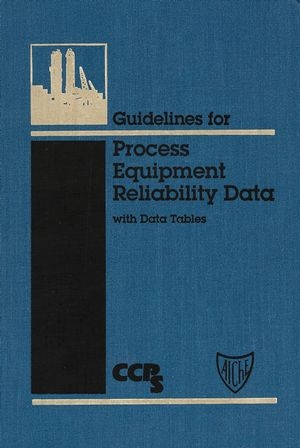
Guidelines for Process Equipment Reliability Data, with Data Tables (eBook)
328 Seiten
John Wiley & Sons (Verlag)
978-0-470-93834-8 (ISBN)
The CENTER FOR CHEMICAL PROCESS SAFETY (CCPS), an industry technology alliance of the American Institute of Chemical Engineers (AIChE), has been a world leader in developing and disseminatinginformation on process safety management and technology since 1985. CCPS has published over 80 books in its process safety guidelines and process safety concepts series. For more information, visit www.ccpsonline.org.
Preface.
Acknowledgments.
Glossary.
Acronyms.
1. Introduction.
1.1 Background.
1.2 Guidelines Purpose, Scope and Organization.
1.3 Use of This Guidelines.
2. Equipment Failure Rate Data.
2.1 Sources and Types of Failure Rate Data.
2.2 Failure Model.
2.3 Taxonomy.
2.4 Confidence and Tolerance.
2.5 Sources of Variation in Failure Rates.
2.6 Time-Related and Demand-Related Failure Causes.
2.7 Using Failure Rate Data.
References.
3. CCPS Taxonomy.
3.1 CCPS Taxonomy Structure.
3.2 CCPS Taxonomy Development.
3.3 The CCPS Taxonomy and Its Use.
References.
4. Data Bases, Sources, and Studies.
4.1 Data Resource Selection.
4.2 Data Resource Presentation.
4.3 Process Equipment Data Bases.
4.4 Process Equipment Data Sources.
4.5 Chemical Process Quantitative Risk Assessments (CPQRAs).
4.6 Nonprocess Equipment Data Bases.
4.7 Nonprocess Equipment Data Sources.
4.8 Probabilistic Risk Assessment (PRAs).
5. CCPS Generic Failure Rate Data Base.
5.1 Data Selection.
5.2 Data Treatment.
5.3 Data Table Presentation.
5.4 Use of the CCPS Generic Failure Rate Data Base.
5.5 CCPS Generic Data Tables.
6. Collection and Conversion of Plant-Specific Data.
6.1 Data Sources.
6.2 Data Collection.
6.3 Data Review and Qualification.
6.4 Data Conversion.
6.5 Statistical Treatment.
References.
7. Failure Rate Data Transfer.
8. Supplemental References.
Appendix A. CCPS Generic Failure Rate Data Base Taxonomy.
Appendix B. Equipment Index.
Appendix C. Matrix of Data Elements in Data Resources.
Appendix D. Unreviewed Data Bases, Data Sources, and
Studies.
| Erscheint lt. Verlag | 29.9.2010 |
|---|---|
| Sprache | englisch |
| Themenwelt | Naturwissenschaften ► Chemie |
| Technik ► Bauwesen | |
| Technik ► Umwelttechnik / Biotechnologie | |
| Wirtschaft | |
| Schlagworte | chemical engineering • Chemische Verfahrenstechnik • Process Safety • Prozesssicherheit |
| ISBN-10 | 0-470-93834-X / 047093834X |
| ISBN-13 | 978-0-470-93834-8 / 9780470938348 |
| Informationen gemäß Produktsicherheitsverordnung (GPSR) | |
| Haben Sie eine Frage zum Produkt? |
 PDF (Adobe DRM)
Kopierschutz: Adobe-DRM
Adobe-DRM ist ein Kopierschutz, der das eBook vor Mißbrauch schützen soll. Dabei wird das eBook bereits beim Download auf Ihre persönliche Adobe-ID autorisiert. Lesen können Sie das eBook dann nur auf den Geräten, welche ebenfalls auf Ihre Adobe-ID registriert sind.
Details zum Adobe-DRM
Dateiformat: PDF (Portable Document Format)
Mit einem festen Seitenlayout eignet sich die PDF besonders für Fachbücher mit Spalten, Tabellen und Abbildungen. Eine PDF kann auf fast allen Geräten angezeigt werden, ist aber für kleine Displays (Smartphone, eReader) nur eingeschränkt geeignet.
Systemvoraussetzungen:
PC/Mac: Mit einem PC oder Mac können Sie dieses eBook lesen. Sie benötigen eine
eReader: Dieses eBook kann mit (fast) allen eBook-Readern gelesen werden. Mit dem amazon-Kindle ist es aber nicht kompatibel.
Smartphone/Tablet: Egal ob Apple oder Android, dieses eBook können Sie lesen. Sie benötigen eine
Geräteliste und zusätzliche Hinweise
Buying eBooks from abroad
For tax law reasons we can sell eBooks just within Germany and Switzerland. Regrettably we cannot fulfill eBook-orders from other countries.
aus dem Bereich