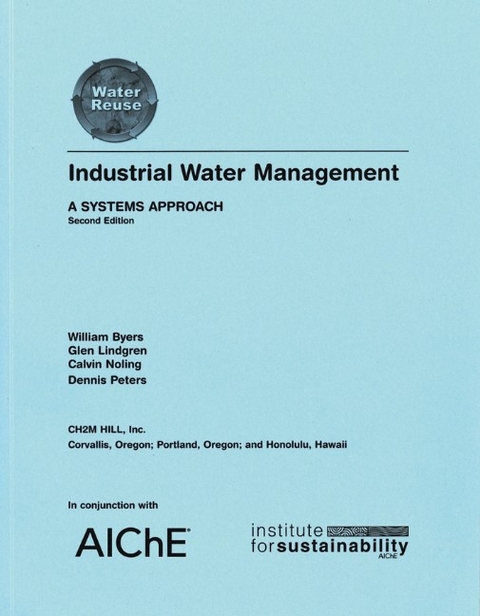
Industrial Water Management (eBook)
John Wiley & Sons (Verlag)
978-0-470-93562-0 (ISBN)
Included in the price of this CD-ROM is an additional chapter, available in December 2002, detailing water reuse opportunities by industry. The chapter will address the general uses of water in industry, their associated energy costs, and energy management as related to water use and water use reduction.
This CD-ROM shows how to systematically incorporate the principles of water conservation, recycling, and reuse into the design of new plants, retrofits of existing systems, and technology development. Technology summaries and case studies that support this systematic approach to water reuse, as well as recommendations for further research, are included. Included in the price of this CD-ROM is an additional chapter, available in December 2002, detailing water reuse opportunities by industry. The chapter will address the general uses of water in industry, their associated energy costs, and energy management as related to water use and water use reduction.
William Byers is the author of Industrial Water Management: A Systems Approach, 2nd Edition, published by Wiley. Glen Lindgren is the author of Industrial Water Management: A Systems Approach, 2nd Edition, published by Wiley. Calvin Noling is the author of Industrial Water Management: A Systems Approach, 2nd Edition, published by Wiley. Dennis Peters is the author of Industrial Water Management: A Systems Approach, 2nd Edition, published by Wiley.
Section.
Foreword.
Acknowledgments.
Abbreviations and Acronyms.
Chapter 1. Introduction.
1.1. Project Purpose.
1.2. Water Reuse- A Historical Context.
1.3. The Center for Waste Reduction Technologies.
1.4. Monograph Tasks and Scope.
Chapter 2. The Systematic Approach.
2.1. Overview of Approach.
2.2. Step 1 - Establish Leadership and Commitment.
2.3. Step 2 - Frame the Problem.
2.4. Step 3 - Develop Alternatives.
2.5. Step 4 - Select a Course of Action.
2.6. Step 5 - Implement the Course of Action.
2.7. Step 6 - Review and Update.
Chapter 3. water Reclamation Strategies and
Technologies.
3.1. Guidance.
3.2. Industry Standard Water Management Strategies.
3.3. Technology Summaries.
Exhibits.
Chapter 4. Case Studies.
4.1. Basis for Selection.
4.2. Case Study # 1: Aluminum Smelting Plant.
4.3. Case Study # 2: Pulp Mill.
4.4. Case Study # 3: Transportation Equipment Facility.
4.5. Case Study # 4: Electric Power Plant.
4.6. Case Study # 5: Semiconductor Fabricator.
4.7. Case Study # 6: Aerospace Manufacturer.
Chapter 5. Water Use in Industries of the Future.
5.1. Overview.
5.2. Agriculture Industry.
5.3. Aluminum Industry.
5.4. Chemical Industry.
5.5. Forest Products Industry.
5.6. Mining Industry.
5.7. Petroleum Industry.
5.8. Steel Industry.
Chapter 6. Developments to Watch.
6.1. Basis.
6.2. Process Issues.
6.3. Regulatory Developments and Voluntary Programs.
6.4. Resource Limitations.
References.
Appendices.
A. Water Reuse Questionnaire.
B. Surveyed Organizations and Responses.
C. Water Analysis Data.
D. Decision Making Using Environmental, Health, and Safety Costs
in a Coherent Model.
E. Glossary.
| Erscheint lt. Verlag | 26.8.2010 |
|---|---|
| Sprache | englisch |
| Themenwelt | Naturwissenschaften ► Chemie ► Technische Chemie |
| Technik ► Umwelttechnik / Biotechnologie | |
| Schlagworte | action • Aerospace • Alternatives • Center • chemical engineering • Chemische Verfahrenstechnik • ConText • Course • earth sciences • equipment • Future • Geowissenschaften • Industries • Industry • Management von Wasservorräten • Management von Wasservorräten • Mill • Overview • Problem • questionnaire • reclamation strategies • reduction • semiconductor • Standard • Study • study electric • Waste • Water resource management |
| ISBN-10 | 0-470-93562-6 / 0470935626 |
| ISBN-13 | 978-0-470-93562-0 / 9780470935620 |
| Informationen gemäß Produktsicherheitsverordnung (GPSR) | |
| Haben Sie eine Frage zum Produkt? |
 PDF (Ohne DRM)
Digital Rights Management: ohne DRM
Dieses eBook enthält kein DRM oder Kopierschutz. Eine Weitergabe an Dritte ist jedoch rechtlich nicht zulässig, weil Sie beim Kauf nur die Rechte an der persönlichen Nutzung erwerben.
Dateiformat: PDF (Portable Document Format)
Mit einem festen Seitenlayout eignet sich die PDF besonders für Fachbücher mit Spalten, Tabellen und Abbildungen. Eine PDF kann auf fast allen Geräten angezeigt werden, ist aber für kleine Displays (Smartphone, eReader) nur eingeschränkt geeignet.
Systemvoraussetzungen:
PC/Mac: Mit einem PC oder Mac können Sie dieses eBook lesen. Sie benötigen dafür einen PDF-Viewer - z.B. den Adobe Reader oder Adobe Digital Editions.
eReader: Dieses eBook kann mit (fast) allen eBook-Readern gelesen werden. Mit dem amazon-Kindle ist es aber nicht kompatibel.
Smartphone/Tablet: Egal ob Apple oder Android, dieses eBook können Sie lesen. Sie benötigen dafür einen PDF-Viewer - z.B. die kostenlose Adobe Digital Editions-App.
Buying eBooks from abroad
For tax law reasons we can sell eBooks just within Germany and Switzerland. Regrettably we cannot fulfill eBook-orders from other countries.
aus dem Bereich