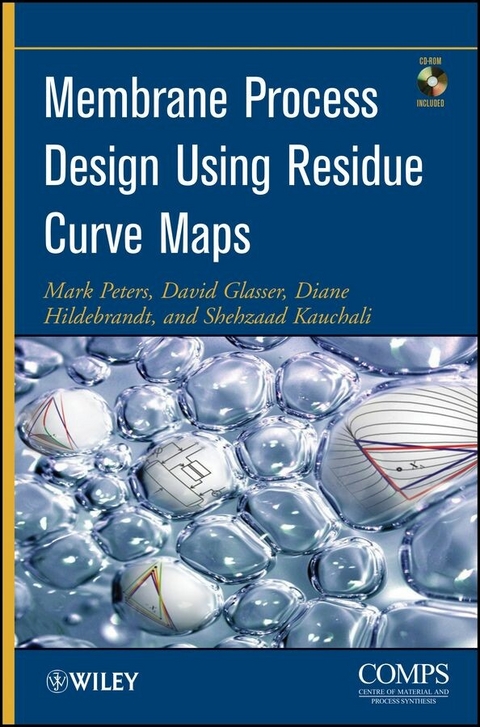
Membrane Process Design Using Residue Curve Maps (eBook)
248 Seiten
John Wiley & Sons (Verlag)
978-0-470-91002-3 (ISBN)
provides a novel method of design and synthesis for membrane
separation. While the main focus of the book is given to gas
separation and pervaporation membranes, the theory has been
developed in such a way that it is general and valid for any
type of membrane.
The method, which uses a graphical technique, allows one to
calculate and visualize the change in composition of the retentate
(non-permeate) phase. This graphical approach is based on Membrane
Residue Curve Maps. One of the strengths of this approach is that
it is exactly analogous to the method of Residue Curve Maps that
has proved so successful in distillation system synthesis and
design.
MARK PETERS graduated with both undergraduate and PhD degrees in chemical engineering from the University of the Witwatersrand in Johannesburg, South Africa. He has previously worked at Sasol Technology, where he focused on low-temperature Fischer-Tropsch gas-to-liquids conversion. He is currently a separations consultant at the Centre of Material and Process Synthesis (COMPS), based at the University of the Witwatersrand. DAVID GLASSER is a Personal Professor of Chemical Engineering and Director of the Centre of Material and Process Synthesis (COMPS) at the University of the Witwatersrand. He has been awarded an A1 rating as a scientist by the National Research Foundation, the central research-funding organization in South Africa, and has authored or coauthored more than a hundred scientific papers. DIANE HILDEBRANDT is the Co-Director for the Centre of Material and Process Synthesis (COMPS) at the University of the Witwatersrand. She has authored or coauthored over seventy scientific papers. She received the Presidents' Award from the Foundation for Research and Development as well as the Distinguished Researcher Award from the University of the Witwatersrand. SHEHZAAD KAUCHALI obtained his PhD at the School of Chemical and Metallurgical Engineering at the University of the Witwatersrand. He is currently a full-time senior academic and the Director of the Gasification Technology and Research Group.
Preface.
Acknowledgments.
Notation.
About the Authors.
1 Introduction.
2 Permeation Modeling.
2.1 Diffusion Membranes.
2.2 Membrane Classification.
3 Introduction to Graphical Techniques in MembraneSeperations.
3.1 A Thought experiment.
3.2 Binary Separations.
3.3 Multicomponent Systems.
4 Properties of Membrane Residue Curve Maps.
4.1 Stationary Points.
4.2 Membrane Vector Field.
4.3 Unidistribution Lines.
4.4 The Effect of a-Values on the Topology of M-RCM's.
4.5 Properties of an Existing Selective M-RCM.
4.6 Conclusion.
5 Application of Membrane Residue Curve Maps to Batchand Continuous Processes.
5.1 Introduction.
5.2 Review of Previous Chapters.
5.3 Batch Membrane Operation.
5.4 Permeation Time.
5.5 Continuous Membrane Operation.
5.6 Conclusion.
6 Column Profiles for Membrane Column Sections.
6.1 Introduction to Membrane Column Development.
6.2 Generalised Column Sections.
6.3 Theory.
6.4 Column Section Profiles: Operating Condition 1.
6.5 Column Section Profiles: Operating Condition 2.
6.6 Column Section Profiles: Operating Condition 3 and4.
6.7 Applications and Conclusion.
7 Novel Graphical Design Methods for Complex MembraneConfigurations.
7.1 Introduction.
7.2 Column Sections.
7.3 Complex Membrane Configuration Designs: General.
7.4 Complex Membrane Configuration Designs: Operating Condition1.
7.5 Complex Membrane Configuration Designs: Operating Condition2.
7.6 Complex Membrane Configurations: Comparison with ComplexDistillation Systems.
7.7 Hybrid Distillation-Membrane Design.
7.8 Conclusion.
8 Synthesis and Design of Hybrid Distillation-MembraneProcesses.
8.1 Introduction.
8.2 Methanol/Butene/MTBE System.
8.3 Synthesis of a Hybrid Configuration.
8.4 Design of a Hybrid Configuration.
8.5 Conclusion.
9 Concluding Remarks.
9.1 Conclusions.
9.2 Recommendations and Future Work.
9.3 Design Considerations.
9.4 Challenges for Membrane Process Engineering.
References.
Appendix A: MemWorX User Manual.
A.1 System Requirements.
A.2 Installation.
A.3 Layout of MemWorX.
A.4 Appearance of Plots.
A.5 Step-by-Step Guide to Plot Using MemWorX.
A.6 Tutorial Solutions.
Appendix B: Flux Model for PERVAP 1137 Membrane.
Appendix C: Proof of Equation for Determining Permeation Timein a Batch Process.
Appendix D: Proof of Equation for Determining Permeation Areain a Continuous Process.
Appendix E: Proof of the Difference Point Equation.
E.1 Proof Using Analogous Method to Distillation.
E.2 Proof Using Mass Transfer.
Index.
| Erscheint lt. Verlag | 20.4.2011 |
|---|---|
| Sprache | englisch |
| Themenwelt | Naturwissenschaften ► Chemie ► Technische Chemie |
| Technik ► Umwelttechnik / Biotechnologie | |
| Schlagworte | chemical engineering • Chemie • Chemische Verfahrenstechnik • Chemistry • Chromatographie / Trennverfahren • Chromatography / Separation Techniques • Maschinenbau • Maschinenbau - Entwurf • mechanical engineering • Mechanical Engineering - Design |
| ISBN-10 | 0-470-91002-X / 047091002X |
| ISBN-13 | 978-0-470-91002-3 / 9780470910023 |
| Informationen gemäß Produktsicherheitsverordnung (GPSR) | |
| Haben Sie eine Frage zum Produkt? |
 EPUB (Adobe DRM)
Größe: 4,5 MB
Kopierschutz: Adobe-DRM
Adobe-DRM ist ein Kopierschutz, der das eBook vor Mißbrauch schützen soll. Dabei wird das eBook bereits beim Download auf Ihre persönliche Adobe-ID autorisiert. Lesen können Sie das eBook dann nur auf den Geräten, welche ebenfalls auf Ihre Adobe-ID registriert sind.
Details zum Adobe-DRM
Dateiformat: EPUB (Electronic Publication)
EPUB ist ein offener Standard für eBooks und eignet sich besonders zur Darstellung von Belletristik und Sachbüchern. Der Fließtext wird dynamisch an die Display- und Schriftgröße angepasst. Auch für mobile Lesegeräte ist EPUB daher gut geeignet.
Systemvoraussetzungen:
PC/Mac: Mit einem PC oder Mac können Sie dieses eBook lesen. Sie benötigen eine
eReader: Dieses eBook kann mit (fast) allen eBook-Readern gelesen werden. Mit dem amazon-Kindle ist es aber nicht kompatibel.
Smartphone/Tablet: Egal ob Apple oder Android, dieses eBook können Sie lesen. Sie benötigen eine
Geräteliste und zusätzliche Hinweise
Buying eBooks from abroad
For tax law reasons we can sell eBooks just within Germany and Switzerland. Regrettably we cannot fulfill eBook-orders from other countries.
 PDF (Adobe DRM)
Kopierschutz: Adobe-DRM
Adobe-DRM ist ein Kopierschutz, der das eBook vor Mißbrauch schützen soll. Dabei wird das eBook bereits beim Download auf Ihre persönliche Adobe-ID autorisiert. Lesen können Sie das eBook dann nur auf den Geräten, welche ebenfalls auf Ihre Adobe-ID registriert sind.
Details zum Adobe-DRM
Dateiformat: PDF (Portable Document Format)
Mit einem festen Seitenlayout eignet sich die PDF besonders für Fachbücher mit Spalten, Tabellen und Abbildungen. Eine PDF kann auf fast allen Geräten angezeigt werden, ist aber für kleine Displays (Smartphone, eReader) nur eingeschränkt geeignet.
Systemvoraussetzungen:
PC/Mac: Mit einem PC oder Mac können Sie dieses eBook lesen. Sie benötigen eine
eReader: Dieses eBook kann mit (fast) allen eBook-Readern gelesen werden. Mit dem amazon-Kindle ist es aber nicht kompatibel.
Smartphone/Tablet: Egal ob Apple oder Android, dieses eBook können Sie lesen. Sie benötigen eine
Geräteliste und zusätzliche Hinweise
Buying eBooks from abroad
For tax law reasons we can sell eBooks just within Germany and Switzerland. Regrettably we cannot fulfill eBook-orders from other countries.
aus dem Bereich