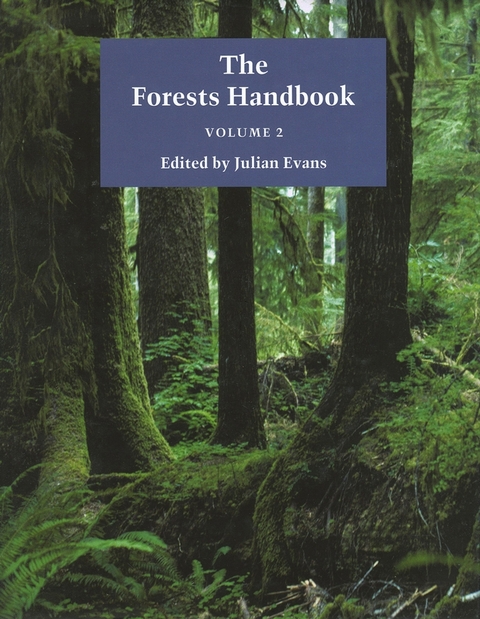
The Forests Handbook, Volume 2 (eBook)
John Wiley & Sons (Verlag)
978-0-470-75683-6 (ISBN)
Volume One presents an overview of the world's forests; their locations and what they are like, the science of how they operate as complex ecosystems and how they interact with their environment. Volume Two applies this science to reality; it focuses on forestry interventions and their impact, the principles governing how to protect forests and on how we can better harness the enormous benefits forests offer. Case studies are drawn from several different countries and are used to illustrate the key points.
Development specialists, forest managers and those involved with land and land-use will find this handbook a valuable and comprehensive overview of forest science and forestry practice. Researchers and students of forestry, biology, ecology and geography will find it equally accessible and useful.
Julian Evans is professor of Tropical Forestry at the Imperial College of Science, Technology and Medicine, University of London and also holds an Honorary Chair at the University of Wales, Bangor, UK. He was formerly Chief Research Officer of the British Forestry Commission and is a Fellow of the Institute of Chartered Foresters. He is author of over 100 scientific papers and seven technical books on temperate and tropical forestry. Julian is a vice-chair of the Commonwealth Forestry Association and Country Vice-President for UK of the International Society of Tropical Foresters (IUSF).
The future of the world's forests is at the forefront of environmental debate. Rising concerns over the effects of deforestation and climate change are highlighting the need both to conserve and manage existing forests and woodland through sustainable forestry practices. The Forests Handbook, written by an international team of both scientists and practitioners, presents an integrated approach to forests and forestry, applying our present understanding of forest science to management practices, as a basis for achieving sustainability. Volume One presents an overview of the world's forests; their locations and what they are like, the science of how they operate as complex ecosystems and how they interact with their environment. Volume Two applies this science to reality; it focuses on forestry interventions and their impact, the principles governing how to protect forests and on how we can better harness the enormous benefits forests offer. Case studies are drawn from several different countries and are used to illustrate the key points. Development specialists, forest managers and those involved with land and land-use will find this handbook a valuable and comprehensive overview of forest science and forestry practice. Researchers and students of forestry, biology, ecology and geography will find it equally accessible and useful.
Julian Evans is professor of Tropical Forestry at the Imperial College of Science, Technology and Medicine, University of London and also holds an Honorary Chair at the University of Wales, Bangor, UK. He was formerly Chief Research Officer of the British Forestry Commission and is a Fellow of the Institute of Chartered Foresters. He is author of over 100 scientific papers and seven technical books on temperate and tropical forestry. Julian is a vice-chair of the Commonwealth Forestry Association and Country Vice-President for UK of the International Society of Tropical Foresters (IUSF).
List of contributors.
Preface to Volume 1.
Preface to Volume 2.
Acknowledgements.
1. History and Impact of Forest Management.
Part 1: Sustaining Forest Influences.
2. Forest Reserves, Parks and Wilderness: An Australian
Perspective.
3. Forests as Protection from Natural Hazards.
4. Interventions to enhance the conservation of
biodiversity.
Part 2: Sustainable Wood Production.
5. assessing Potential Sustainable Wood Yield.
6. Silvicultural Treatments to Enhance Productivity.
7. Sustainable Management of Soil and Site.
8. Management of Pest Threats.
9. Management of the Disease Burden.
Part 3. Sustaining Social Values and Benefits.
10. Working with Forest Stakeholders.
11. The New Forest Policy and Joint Forest Management in
India.
12. Trees in the Urban Environment.
Part 4: Case Studies of Sustainable Management.
13. The Structure, Functioning and Management of Old Growth
Cedar/Hemlock/Fir Forests on Vancouver Island, British
Columbia.
14. The Beech Forests of Haute-Normandie, France.
15. Restructuring of Plantation Forest, Kielder, UK.
16. Sustainable Management of the Mountain Ash Forests in the
Central Highlands, Victoria, Australia.
17. Sustainable Management of Malaysian Rain Forest.
18. Sustainable Plantation Forestry: A Case Study of Wood
Production and Environmental Management Strategies in the Usutu
Forest, Swaziland.
Synthesis and Conclusions.
Index.
| Erscheint lt. Verlag | 15.4.2008 |
|---|---|
| Sprache | englisch |
| Themenwelt | Naturwissenschaften ► Biologie ► Ökologie / Naturschutz |
| Naturwissenschaften ► Geowissenschaften | |
| Technik | |
| Weitere Fachgebiete ► Land- / Forstwirtschaft / Fischerei | |
| Schlagworte | Agriculture • Approach • Basis • climate change • Complex • Concerns • Debate • Ecosystems • Effects • environmental • Environmental Management, Policy & Planning • Environmental Studies • Forefront • Forest • forestry • forests • Forstwirtschaft • Future • Integrated • international team • Landwirtschaft • Locations • One • Overview • Practices • present • Science • Umweltforschung • Umweltmanagement, Politik u. -Planung • Volume • Worlds |
| ISBN-10 | 0-470-75683-7 / 0470756837 |
| ISBN-13 | 978-0-470-75683-6 / 9780470756836 |
| Informationen gemäß Produktsicherheitsverordnung (GPSR) | |
| Haben Sie eine Frage zum Produkt? |
 PDF (Adobe DRM)
Kopierschutz: Adobe-DRM
Adobe-DRM ist ein Kopierschutz, der das eBook vor Mißbrauch schützen soll. Dabei wird das eBook bereits beim Download auf Ihre persönliche Adobe-ID autorisiert. Lesen können Sie das eBook dann nur auf den Geräten, welche ebenfalls auf Ihre Adobe-ID registriert sind.
Details zum Adobe-DRM
Dateiformat: PDF (Portable Document Format)
Mit einem festen Seitenlayout eignet sich die PDF besonders für Fachbücher mit Spalten, Tabellen und Abbildungen. Eine PDF kann auf fast allen Geräten angezeigt werden, ist aber für kleine Displays (Smartphone, eReader) nur eingeschränkt geeignet.
Systemvoraussetzungen:
PC/Mac: Mit einem PC oder Mac können Sie dieses eBook lesen. Sie benötigen eine
eReader: Dieses eBook kann mit (fast) allen eBook-Readern gelesen werden. Mit dem amazon-Kindle ist es aber nicht kompatibel.
Smartphone/Tablet: Egal ob Apple oder Android, dieses eBook können Sie lesen. Sie benötigen eine
Geräteliste und zusätzliche Hinweise
Buying eBooks from abroad
For tax law reasons we can sell eBooks just within Germany and Switzerland. Regrettably we cannot fulfill eBook-orders from other countries.
aus dem Bereich