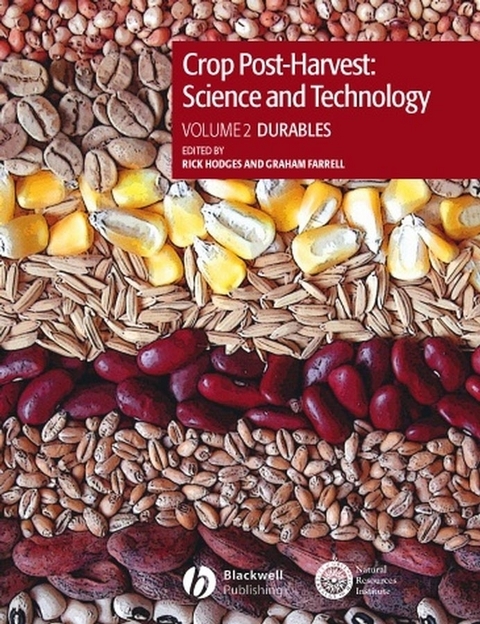
Crop Post-Harvest: Science and Technology, Volume 2 (eBook)
John Wiley & Sons (Verlag)
978-0-470-75037-7 (ISBN)
The editors of this comprehensive and thorough book are well known and respected in the world of post-harvest science and technology. They have drawn together 36 expert contributors from Europe, North America, Asia, Australasia, South America and Africa to provide a huge wealth of information on major world crops including rice, maize, wheat, barley, sorghum, beans, cowpea, oilseeds, peanuts, copra, coffee, cocoa, dried fruit and nuts, and dried fish.
Crop Post Harvest, Volume 2 is an essential purchase for cereal technologists, food scientists and technologists, agricultural scientists, entomologists, post-harvest crop protection specialists and consultants, commercial growers, shippers and warehousing operatives, and personnel of packaging companies. Researchers and upper-level students in food science, food technology, post-harvest science and technology, crop protection, applied biology, and plant and agricultural sciences will find a huge amount of great use within this landmark publication and the three-volume series as a whole. All libraries in research establishments and universities where these subjects are studied and taught should have several copies of each on their shelves.
Dr Rick Hodges is Reader in Post-Harvest Entromology at the Natural Resources Institute, University of Greenwich, U.K. and is Secretary of the Global Post-Harvest Forum (PhAction). Dr Graham Farrell is Director of Plant Clinic Limited, a U.K. based company, providing advice on plant health based on sustainable principles.
Durable commodities are the raw products from which food can be made and are the staples on which most humans rely; with but a few exceptions they are the seeds of plants. Volume 1 of this ground-breaking book series (details below) explains how crops should be dried, handled, protected from pests and stored by smaller holders or large-scale enterprises. This second volume presents a series of case studies on how durable crops are actually stored and marketed. The compilation of this three-volume work has been supported and is endorsed by the Natural Resources Institute of the University of Greenwich, U.K. The editors of this comprehensive and thorough book are well known and respected in the world of post-harvest science and technology. They have drawn together 36 expert contributors from Europe, North America, Asia, Australasia, South America and Africa to provide a huge wealth of information on major world crops including rice, maize, wheat, barley, sorghum, beans, cowpea, oilseeds, peanuts, copra, coffee, cocoa, dried fruit and nuts, and dried fish. Crop Post Harvest, Volume 2 is an essential purchase for cereal technologists, food scientists and technologists, agricultural scientists, entomologists, post-harvest crop protection specialists and consultants, commercial growers, shippers and warehousing operatives, and personnel of packaging companies. Researchers and upper-level students in food science, food technology, post-harvest science and technology, crop protection, applied biology, and plant and agricultural sciences will find a huge amount of great use within this landmark publication and the three-volume series as a whole. All libraries in research establishments and universities where these subjects are studied and taught should have several copies of each on their shelves.
Dr Rick Hodges is Reader in Post-Harvest Entromology at the Natural Resources Institute, University of Greenwich, U.K. and is Secretary of the Global Post-Harvest Forum (PhAction). Dr Graham Farrell is Director of Plant Clinic Limited, a U.K. based company, providing advice on plant health based on sustainable principles.
Contributors.
Preface.
Acknowledgements.
1. Rice.
2. Maize.
3. Wheat.
4. Malting Barley: Europe.
5. Sorghum.
6. Common Beans: Latin America.
7. Cowpea: United States of America.
8. Miscellaneous Oilseeds.
9. Peanuts.
10. Copra: The Philippines.
11. Coffee.
12. Cocoa: West Africa (Ghana).
13. Dried Fruit and Nuts: United States of America.
14. Cured Fish.
Index.
| Erscheint lt. Verlag | 15.4.2008 |
|---|---|
| Sprache | englisch |
| Themenwelt | Naturwissenschaften ► Biologie |
| Technik | |
| Weitere Fachgebiete ► Land- / Forstwirtschaft / Fischerei | |
| Schlagworte | actually • Agriculture • Below • Book • CASE • Compilation • crops • Durable • durable crops • Exceptions • Feldfrüchte • Feldfrüchte • Food • groundbreaking • holders • humans • Institute • Landwirtschaft • NATURAL • Pests • plants • Products • RAW • seeds • series • smaller • staples • Studies • University • Volume • Work |
| ISBN-10 | 0-470-75037-5 / 0470750375 |
| ISBN-13 | 978-0-470-75037-7 / 9780470750377 |
| Informationen gemäß Produktsicherheitsverordnung (GPSR) | |
| Haben Sie eine Frage zum Produkt? |
 PDF (Adobe DRM)
Kopierschutz: Adobe-DRM
Adobe-DRM ist ein Kopierschutz, der das eBook vor Mißbrauch schützen soll. Dabei wird das eBook bereits beim Download auf Ihre persönliche Adobe-ID autorisiert. Lesen können Sie das eBook dann nur auf den Geräten, welche ebenfalls auf Ihre Adobe-ID registriert sind.
Details zum Adobe-DRM
Dateiformat: PDF (Portable Document Format)
Mit einem festen Seitenlayout eignet sich die PDF besonders für Fachbücher mit Spalten, Tabellen und Abbildungen. Eine PDF kann auf fast allen Geräten angezeigt werden, ist aber für kleine Displays (Smartphone, eReader) nur eingeschränkt geeignet.
Systemvoraussetzungen:
PC/Mac: Mit einem PC oder Mac können Sie dieses eBook lesen. Sie benötigen eine
eReader: Dieses eBook kann mit (fast) allen eBook-Readern gelesen werden. Mit dem amazon-Kindle ist es aber nicht kompatibel.
Smartphone/Tablet: Egal ob Apple oder Android, dieses eBook können Sie lesen. Sie benötigen eine
Geräteliste und zusätzliche Hinweise
Buying eBooks from abroad
For tax law reasons we can sell eBooks just within Germany and Switzerland. Regrettably we cannot fulfill eBook-orders from other countries.
aus dem Bereich