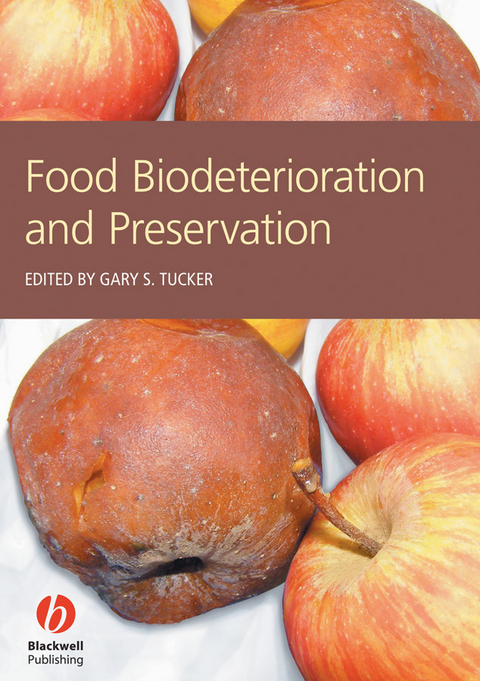
Food Biodeterioration and Preservation (eBook)
John Wiley & Sons (Verlag)
978-0-470-69796-2 (ISBN)
This book discusses how the agents of food biodeterioration operate, and examines the commercially-used industrial methods available to control them, allowing the production of safe and wholesome foods. There is an emphasis on the equipment employed to carry out the various methods of preservation.
The introductory chapter describes in detail the microorganisms and mechanisms of food breakdown intrinsic to various key food types; dairy, meat and fish, fruit, and vegetables. Direct microorganism action will be covered in addition to enzymatic breakdown. The second chapter addresses HACCP, including food safety legislation. Subsequent chapters outline the principal, commercially-used methods of preserving foods. These chapters follow a common structure: theoretical background; flow sheets of operations; food preparation/processing equipment; special features of hygiene; packaging; shelf life; and product safety.
Food Biodeterioration and Preservation is directed at food scientists and technologists in industry and academia. Since it covers all the commonly-used methods of food preservation, it will be relevant across the entire food manufacturing industry.
Dr Gary S. Tucker, Department of Process and Product Development, Campden & Chorleywood Food Research Association, Chipping Campden, Gloucester, UK
Biodeterioration can be defined as the breakdown of food by agents of microbiological origin, either directly or from products of their metabolism. Microbiological sources can be present in foods prior to packaging or on the surfaces of packaging materials. The shelf life and safety of the food will depend on the type and quantity of microorganism, as well as the hurdles to their growth offered by various preservation techniques. This book discusses how the agents of food biodeterioration operate, and examines the commercially-used industrial methods available to control them, allowing the production of safe and wholesome foods. There is an emphasis on the equipment employed to carry out the various methods of preservation. The introductory chapter describes in detail the microorganisms and mechanisms of food breakdown intrinsic to various key food types; dairy, meat and fish, fruit, and vegetables. Direct microorganism action will be covered in addition to enzymatic breakdown. The second chapter addresses HACCP, including food safety legislation. Subsequent chapters outline the principal, commercially-used methods of preserving foods. These chapters follow a common structure: theoretical background; flow sheets of operations; food preparation/processing equipment; special features of hygiene; packaging; shelf life; and product safety. Food Biodeterioration and Preservation is directed at food scientists and technologists in industry and academia. Since it covers all the commonly-used methods of food preservation, it will be relevant across the entire food manufacturing industry.
Dr Gary S. Tucker, Department of Process and Product Development, Campden & Chorleywood Food Research Association, Chipping Campden, Gloucester, UK
1. Control of biodeterioration in food.
Susan Featherstone, Nampak Research and Development, Cape Town,
South Africa.
2. Principles of HACCP: the importance of HACCP Systems in food
manufacturing Sara Mortimore, Director, Quality and Regulatory
Operations, General Mills Inc., Minneapolis, USA; and.
Sue Emond, Campden and Chorleywood Food Research Association,
Chipping Camden, Gloucestershire, UK.
3. Thermal processing.
Dr Ian J. Britt, IFTPS, Guelph, ON, Canada; and.
Dr Gary S. Tucker, Campden and Chorleywood Food Research
Association, Department of Process and Product Development,
Chipping Camden, Gloucestershire, UK.
4. Food chilling.
Dr Steve James and Christian James, Food Refrigeration and
Process Engineering Research Centre (FRPERC), Langford, North
Somerset, UK.
5. Freezing.
Dr Martin George, Campden and Chorleywood Food Research
Association, Department of Food Manufacturing Technologies,
Chipping Camden, Gloucestershire, UK.
6. Drying as a means of controlling food bio-deterioration.
Professor Xiao Dong Chen, Department of Chemical Engineering,
Monash University, Clayton, VIC, Australia.
7. Modified atmosphere packaging (MAP).
Brian P.F. Day, Key Project Manager - Food Processing
& Differentiation, Food Science Australia, Werribee, Victoria,
Australia..
8. Hurdle techniques.
Gail Betts and Linda Everis, Department of Microbiology, Campden
and Chorleywood Food Research Association, Chipping Campden,
Gloucestershire, UK.
9. Novel commercial preservation methods.
Craig Leadley, Campden and Chorleywood Food Research
Association, Department of Food Manufacturing Technologies,
Chipping Camden, Gloucestershire, UK
| Erscheint lt. Verlag | 30.4.2008 |
|---|---|
| Sprache | englisch |
| Themenwelt | Naturwissenschaften ► Biologie |
| Naturwissenschaften ► Chemie | |
| Technik ► Lebensmitteltechnologie | |
| Weitere Fachgebiete ► Land- / Forstwirtschaft / Fischerei | |
| Schlagworte | Food Science & Technology • Lebensmittelforschung u. -technologie • Microbiology, Food Safety & Security • Mikrobiologie u. Nahrungsmittelsicherheit • shelf life, food preservation, food quality, food safety, food processing, food microbiology |
| ISBN-10 | 0-470-69796-2 / 0470697962 |
| ISBN-13 | 978-0-470-69796-2 / 9780470697962 |
| Informationen gemäß Produktsicherheitsverordnung (GPSR) | |
| Haben Sie eine Frage zum Produkt? |
 PDF (Adobe DRM)
Kopierschutz: Adobe-DRM
Adobe-DRM ist ein Kopierschutz, der das eBook vor Mißbrauch schützen soll. Dabei wird das eBook bereits beim Download auf Ihre persönliche Adobe-ID autorisiert. Lesen können Sie das eBook dann nur auf den Geräten, welche ebenfalls auf Ihre Adobe-ID registriert sind.
Details zum Adobe-DRM
Dateiformat: PDF (Portable Document Format)
Mit einem festen Seitenlayout eignet sich die PDF besonders für Fachbücher mit Spalten, Tabellen und Abbildungen. Eine PDF kann auf fast allen Geräten angezeigt werden, ist aber für kleine Displays (Smartphone, eReader) nur eingeschränkt geeignet.
Systemvoraussetzungen:
PC/Mac: Mit einem PC oder Mac können Sie dieses eBook lesen. Sie benötigen eine
eReader: Dieses eBook kann mit (fast) allen eBook-Readern gelesen werden. Mit dem amazon-Kindle ist es aber nicht kompatibel.
Smartphone/Tablet: Egal ob Apple oder Android, dieses eBook können Sie lesen. Sie benötigen eine
Geräteliste und zusätzliche Hinweise
Buying eBooks from abroad
For tax law reasons we can sell eBooks just within Germany and Switzerland. Regrettably we cannot fulfill eBook-orders from other countries.
aus dem Bereich