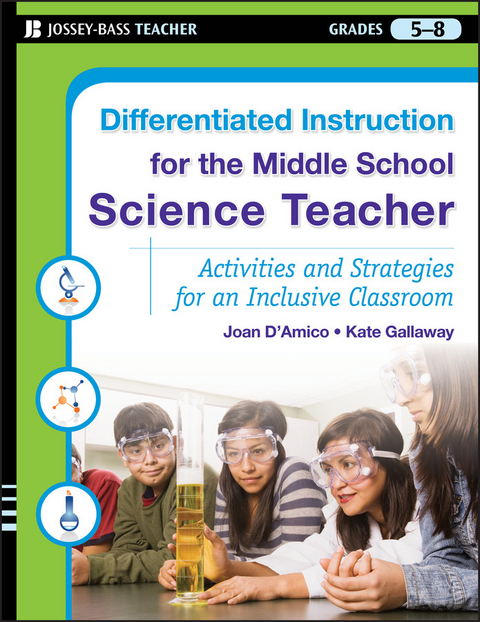
Differentiated Instruction for the Middle School Science Teacher (eBook)
256 Seiten
John Wiley & Sons (Verlag)
978-0-470-58515-3 (ISBN)
have inclusive classrooms
The third volume in the Differentiated Instruction series,
Differentiated Instruction for the Middle School Science
Teacher offers teachers proven techniques for designing and
delivering effective science instruction, measuring success,
getting students to work together, and collaborating with other
professionals. The ready-to-use activities are tied to core
curriculum standards for middle school students and each lesson
incorporates adaptations for students with different learning
needs.
* Includes strategies for teaching a standards-based science
curriculum
* Contains a wealth of activities that can be adapted for
learners of all abilities
* Offers information for delivering effective instruction,
measuring success, and student collaboration
The authors, both experienced teachers, offer a range of
techniques, such as station/group activities, enrichment
activities, and modifications for students with specific
disabilities.
THE AUTHORS JOAN D'AMICO, M.A., L.D.T.C., is a learning disabilities teacher and consultant in the Garfield School District in New Jersey. She has over 15 years of experience as a learning disabilities teacher and consultant in both public and private schools, and also has a private practice as a learning disabilities specialist. KATE GALLAWAY, M.A., teaches science and math methods to beginning teachers and graduate students. She has worked with districts and teachers nationwide on differentiated instruction. Joan and Kate are also the co-authors of Differentiated Instruction for the Middle School Math Teacher and Differentiated Instruction for the Middle School Language Arts Teacher.
About This Book vii
About the Authors ix
Acknowledgments xi
Foreword xiii
Part One: Being Successful in the Inclusive Classroom
Chapter 1: Collaborating Effectively 3
Collaborating for Intervention 3
Collaborating with the Child Study Team 4
Collaborating with Parents and Families 13
Tips for Talking with Parents 16
Chapter 2: Preparing for Differentiated Learning 17
Working with Core Curriculum Standards 17
Assessing Learning Styles 18
Multiple Intelligences and Learning Strengths 20
Planning for Students with Special Needs 21
Chapter 3: Effective Teaching Strategies for Differentiating Instruction 25
The Effective Inclusive Classroom 26
Measuring Success 28
Part Two: Science Activities for the Inclusive Middle School Classroom
Chapter 4: Scientific Inquiry 33
Activity 1: Scientific Method 34
Activity 2: Famous Scientists 40
Chapter 5: Physical Science 45
Activity 1: Force 46
Activity 2: Motion 52
Activity 3: Properties of Matter 58
Activity 4: Phases of Matter 63
Activity 5: Acids and Bases 69
Activity 6: Using the Periodic Table 76
Activity 7: Alternative Energy Sources 82
Chapter 6: Earth and Space Science 89
Activity 1: Types of Rocks 90
Activity 2: Volcanoes 95
Activity 3: Minerals 101
Activity 4: Oceans and Seas 107
Activity 5: The Solar System 115
Activity 6: Stars and Galaxies 123
Activity 7: The Water Cycle 129
Chapter 7: Life Science 137
Activity 1: Classification of Organisms 138
Activity 2: The Structure and Function of Cells 145
Activity 3: Cell Division--Mitosis 150
Activity 4: Cell Division--Meiosis 155
Activity 5: Heredity and Genetics 160
Activity 6: Plants 166
Chapter 8: The Human Body 173
Activity 1: The Skeletal System, Joints, and Muscles 174
Activity 2: The Cardiovascular System 180
Activity 3: The Central Nervous System 188
Activity 4: The Digestive System 194
Activity 5: Blood 200
Activity 6: The Ear 207
Activity 7: The Eye 213
Answer Key 219
National Curriculum Standards 225
Glossary 229
Bibliography 237
Index 238
| Erscheint lt. Verlag | 18.2.2010 |
|---|---|
| Reihe/Serie | Differentiated Instruction for Middle School Teachers | Differentiated Instruction for Middle School Teachers |
| Sprache | englisch |
| Themenwelt | Schulbuch / Wörterbuch |
| Geisteswissenschaften | |
| Naturwissenschaften | |
| Sozialwissenschaften ► Pädagogik ► Bildungstheorie | |
| Sozialwissenschaften ► Pädagogik ► Schulpädagogik / Sekundarstufe I+II | |
| Schlagworte | Bildungswesen • Education • Lehrpläne / Naturwissenschaften • Lehrpläne / Naturwissenschaften • Science • Sonder- u. Förderschulen • Sonder- u. Förderschulen • special educational needs |
| ISBN-10 | 0-470-58515-3 / 0470585153 |
| ISBN-13 | 978-0-470-58515-3 / 9780470585153 |
| Informationen gemäß Produktsicherheitsverordnung (GPSR) | |
| Haben Sie eine Frage zum Produkt? |
 EPUB (Adobe DRM)
Größe: 4,1 MB
Kopierschutz: Adobe-DRM
Adobe-DRM ist ein Kopierschutz, der das eBook vor Mißbrauch schützen soll. Dabei wird das eBook bereits beim Download auf Ihre persönliche Adobe-ID autorisiert. Lesen können Sie das eBook dann nur auf den Geräten, welche ebenfalls auf Ihre Adobe-ID registriert sind.
Details zum Adobe-DRM
Dateiformat: EPUB (Electronic Publication)
EPUB ist ein offener Standard für eBooks und eignet sich besonders zur Darstellung von Belletristik und Sachbüchern. Der Fließtext wird dynamisch an die Display- und Schriftgröße angepasst. Auch für mobile Lesegeräte ist EPUB daher gut geeignet.
Systemvoraussetzungen:
PC/Mac: Mit einem PC oder Mac können Sie dieses eBook lesen. Sie benötigen eine
eReader: Dieses eBook kann mit (fast) allen eBook-Readern gelesen werden. Mit dem amazon-Kindle ist es aber nicht kompatibel.
Smartphone/Tablet: Egal ob Apple oder Android, dieses eBook können Sie lesen. Sie benötigen eine
Geräteliste und zusätzliche Hinweise
Zusätzliches Feature: Online Lesen
Dieses eBook können Sie zusätzlich zum Download auch online im Webbrowser lesen.
Buying eBooks from abroad
For tax law reasons we can sell eBooks just within Germany and Switzerland. Regrettably we cannot fulfill eBook-orders from other countries.
 PDF (Adobe DRM)
Kopierschutz: Adobe-DRM
Adobe-DRM ist ein Kopierschutz, der das eBook vor Mißbrauch schützen soll. Dabei wird das eBook bereits beim Download auf Ihre persönliche Adobe-ID autorisiert. Lesen können Sie das eBook dann nur auf den Geräten, welche ebenfalls auf Ihre Adobe-ID registriert sind.
Details zum Adobe-DRM
Dateiformat: PDF (Portable Document Format)
Mit einem festen Seitenlayout eignet sich die PDF besonders für Fachbücher mit Spalten, Tabellen und Abbildungen. Eine PDF kann auf fast allen Geräten angezeigt werden, ist aber für kleine Displays (Smartphone, eReader) nur eingeschränkt geeignet.
Systemvoraussetzungen:
PC/Mac: Mit einem PC oder Mac können Sie dieses eBook lesen. Sie benötigen eine
eReader: Dieses eBook kann mit (fast) allen eBook-Readern gelesen werden. Mit dem amazon-Kindle ist es aber nicht kompatibel.
Smartphone/Tablet: Egal ob Apple oder Android, dieses eBook können Sie lesen. Sie benötigen eine
Geräteliste und zusätzliche Hinweise
Buying eBooks from abroad
For tax law reasons we can sell eBooks just within Germany and Switzerland. Regrettably we cannot fulfill eBook-orders from other countries.
aus dem Bereich